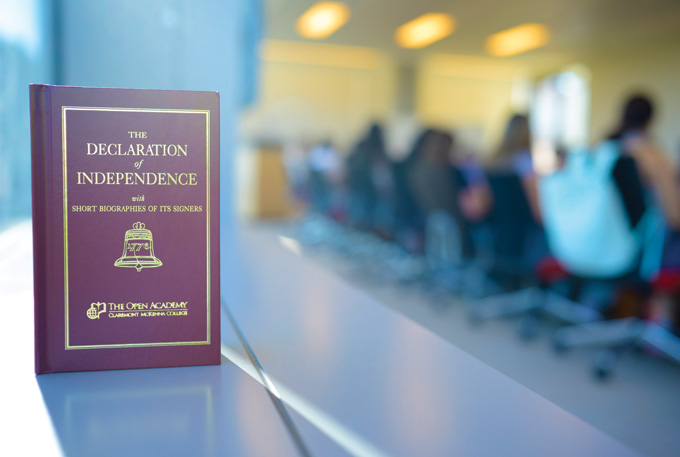
Over the summer, students from CMC’s Incoming Class of 2029 received a surprise gift in the mail: An Open Academy-branded version of the Declaration of Independence.
Now, “gift” might be too casual of a description. Given his recent appointment as director of The Open Academy, Professor Ioannis Evrigenis wanted to send something both thoughtful and purposeful for students new to the CMC experience. So, while not a homework assignment, per se, the Declaration of Independence will be a guiding source for Open Academy programming and constructive dialogue in the year ahead, Evrigenis emphasized.
“This year is the lead-up to the 250th Anniversary of our country’s founding. And that fits with not just the principles of The Open Academy, but a lot of what CMC stands for,” said Evrigenis, Alice Tweed Tuohy Professor of Government and Ethics. “The questions raised by the Declaration of Independence, whatever position one takes on them, provide for constant conversation. So, it felt like a good way to organize our thinking around the year and to provide incoming students with a common reference point that they could return to if they’ve gone to an Ath event, or a lecture, or a workshop, or even as they engage in conversations with their friends.”
The Open Academy and Salvatori Center were recently awarded grants by the Jack Miller Center for programming related to the 250th anniversary in July 2026 and Constitution Day this past September. In addition to a range of topical Open Academy salons, seminars, and reading groups throughout the academic year, Evrigenis is proud to have facilitated Declaration-themed talks by luminaries like Nadine Strossen and William Kristol in the fall. He is also excited that CMC will soon host Danielle Allen (in February), Mark Lilla (in February), and David Armitage (in April).
“We have a lot planned, and I think it’s going to broaden our understanding of the major issues that we all face together,” he said. “More than anything, I really want students to read, think about, and discuss the Declaration as a matter of civic duty—not only because it’s the framing document of the United States, but also because it’s been so influential around the world.”
Below, Evrigenis shared his additional hopes for The Open Academy.
Why was it important to build programming around a central theme in your first year with The Open Academy?
Part of what we see time and again in the various pathologies of public discourse is that people are often speaking at cross purposes. They’re speaking past each other. They’re not listening to each other. They don’t understand what the other person means. I strongly believe that a common language and an agreement on basic meanings or basic points of reference is necessary if a discussion is going to be grounded—and expect to go anywhere productive. I wanted to do that in this moment, and I intend to do that every year.
Specifically with the Declaration, I also want to treat the founding documents as living documents. Because that’s what they are. I want students to think of this exercise as part and parcel of what they’re doing, not just as CMC students, but for the rest of their lives. And I get that reasonable questions for my plan would be: So, why do you need to print the Declaration of Independence and send it? Why not just send a link for everyone to click on and open? I purposely wanted to send a hardback edition of the Declaration of Independence that students could hold in their hands, know where to find, and hopefully keep forever. I think it’s important to get back to the habit of recognizing that there are some books you should own. Some books you should keep going back to. That’s something the founders did and what any great thinker in any era has done as a matter of principle. This is how we remain in constant dialogue with our past, present, and future.