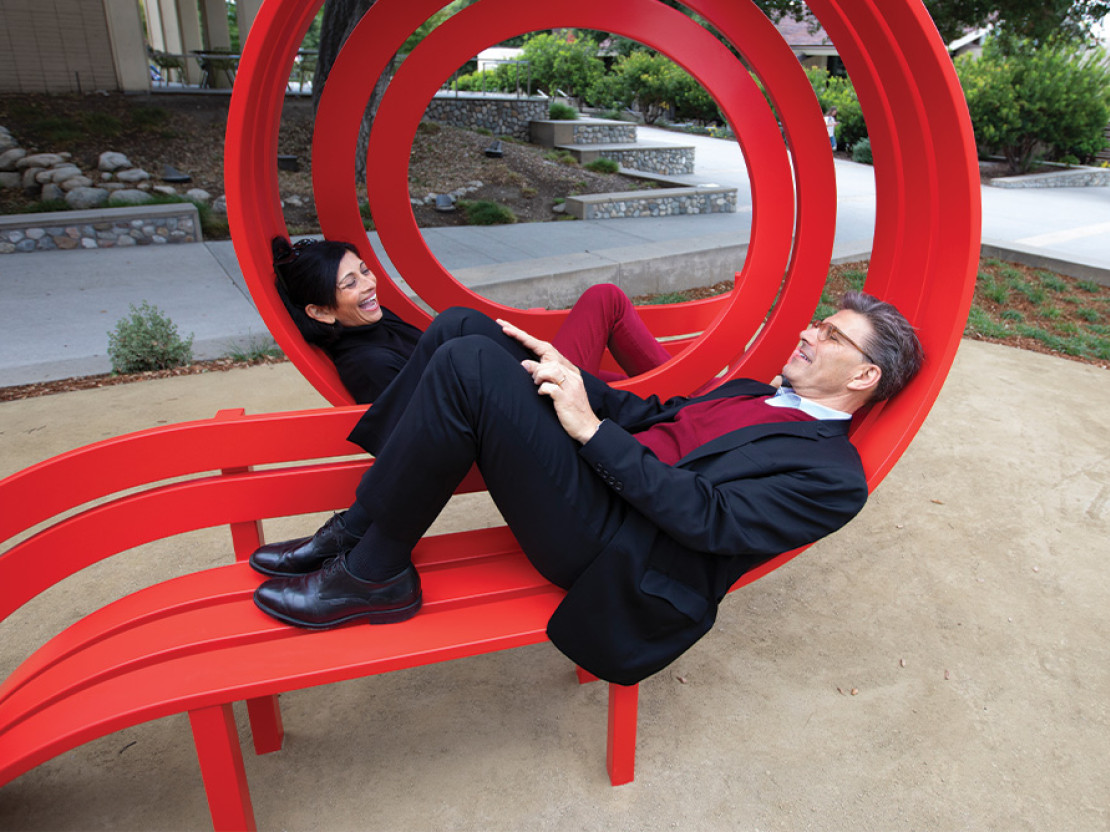
First and foremost, congratulations on your 35th wedding anniversary this month! Has anything changed since that day? Anything at all?
Hiram: What’s changed? Nothing and everything. Nothing: I still learn every moment from the very same big, brilliant, telescopic eyes that seem to see everything and the warm, beautiful person I cut in line to meet when we were in graduate school. And everything: A growing family of Caleb and Saja (now with Nick), and the arrival of their daughter, our first grandchild, Rhea Mel Martino on February 24; shared life experiences across the country and world beyond that must make us the luckiest people on earth; and the rare privilege of working together as a close team for so many years in shared purpose.
Priya: Stating the absolute obvious, we are older! But it is not so much that we feel older or look older—though both are true—it’s the incredulous feeling that time has gone by so, so fast. It’s trite to say, but it’s really something that surprises me every day. Fundamentally though, as far as being married for all those years, Hiram is still as kind, sweet, and caring as always. And he still insists on doing the dishes.
What’s the primary feeling as you look ahead to the next two months? Are you trying to savor “extra” moments at CMC a bit more? Anything you still want to do?
Hiram: I want to make the most of every moment, including defying any uninformed expectations that I would be “winding down” or “running out the clock.” Instead, I’m trying to run up the score! On the road, pulling everyone together to connect. On campus, sharing my excitement in celebration of CMC’s incredibly bright future. Working hard to attract attention to what we’ve accomplished, raising new resources to accelerate that success, building on our momentum across every sphere, and ensuring we execute on our commitments along the way.
Priya: Bittersweet describes it best. We are excited to be able to leave CMC at such a high point, top of its game. It’s hard to leave something that is going well. But that’s also precisely a good time to leave. To attract the best new talent. To pave the path to the next great chapter. We are so grateful for the years of steadfast support and constructive engagement that have brought CMC to this point. It’s been the collective effort of many people. So, in these last months, I hope to celebrate with everyone who has made this fruitful, exhilarating, and once-in-a-lifetime journey possible for us.
For those who aren’t yet aware, what are your immediate plans for this next chapter? How do you plan to stay connected to CMC?
Priya: We hope to be as involved and engaged as possible, but all the while giving wide berth to President-Elect Will Dudley and his spouse, Dr. Carola Tanna, to settle in and feel at home at CMC. In the meantime, Hiram and I plan to move back to the Bay Area, where I hope Hiram will slow down and decompress for a bit before diving into his personal projects of access and affordability in higher education, constructive dialogue, and civic education. For my part, I hope to master the pottery wheel and create something that doesn’t wobble, hike a lot with Theo, and spend as much time as I can with our granddaughter, Rhea, who with any luck, could be in the CMC Class of 2048!
Hiram: We will both keep a very strong social connection and I have a faculty position at CMC. I also plan to take advantage of a multi-year visiting fellowship at Oxford. Most of all, I look forward to writing and leading experimental models of collaboration in the civic sector that have the promise of unlocking new philanthropy. These include projects in higher education and K-12, global conflict resolution, and other forms of civic renewal in the U.S. and abroad.
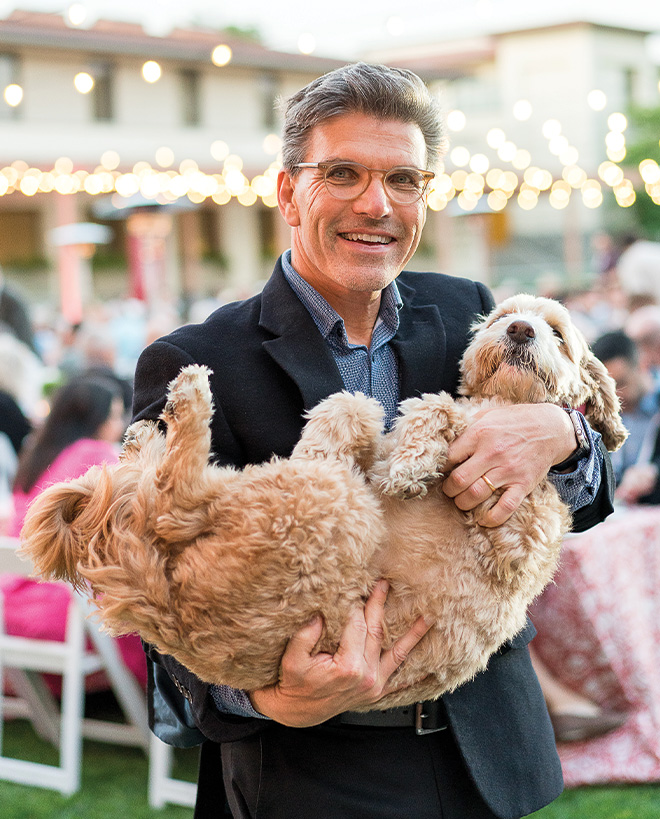
Photo by Aaron Morey
When you both arrived at CMC, did you have a personal set of goals for what you hoped this experience would look like? Did those change? Expand? Settle into a rhythm?
Hiram: I looked forward first to absorbing CMC in every way and then contributing to it with every urgh, every wit I could muster. Those goals and the experiences that have followed produced an entirely unpredictable journey, but the challenge and joy of it all have been an enduring, rewarding continuity that has only become increasingly strong.
Priya: I didn’t want to presuppose what it meant to be a college president’s spouse, and I think that mindset served me well because I was then able to seize the opportunity of being Ath director when that possibility arose early in Hiram’s 2nd year as president. What I hadn’t anticipated was how that timely opportunity gave me pathways for friendships and relationships with faculty, students, staff, parents, alumni, and trustees that were beyond what otherwise might have been possible, and for which I am so grateful.
Hiram, in your State of the College address from December, you mentioned how 13 years ago, you could not have imagined “how insanely challenging the role of college or university president would become,” and you then listed off a range of titles, from CEO to talent scout to rabbi to super fan. Priya, which role of Hiram’s stood out most to you? And Hiram, why is this the new reality in higher education—and is it sustainable?
Priya: Coach. I think that is his super-power. Students know they can come see him about anything—from personal matters to professional guidance—and he will coach and advise them even through hard choices. He has also been a great advocate for staff, elevating and supporting them even if it means losing a valuable staff member to a great opportunity elsewhere. Indeed, being all the things he mentioned in his State of the College is essential today in higher education, but it’s not so easy to deliver given the demands and day-to-day responsibilities. But, especially in a small liberal arts environment like ours, it is imperative. I think the community needs to see you and feel your involvement. And it can’t feel contrived. People see right through that.
Hiram: Sustainability is a big challenge in higher ed. Do we have a sustainable business model? Can we improve the value proposition, and counteract politicization, over-specialization, and the hollow feelings so many in this generation experience? The day-to-day burdens on higher ed leaders in the face of these challenges are formidable. We need to make sure that we are creating the conditions to attract the right people to these positions, like President-Elect Dudley, who love the full range of roles and interactions. I can’t speak for other institutions, but Priya and I have thrived in this role for 13 years, and CMC has made an inspired choice in Will and Carola to build on CMC’s remarkable success.
What kept you most grounded during the highest and lowest moments at CMC?
Hiram: Priya. My incredible kids, Caleb and Saja (and over the past several years, her husband, Nick). Theo. Now Rhea. Getting out for a run, and diving into an art project when I feel moved.
Priya: Having a values framework and internal compass is crucial to get you through highs and lows of life, whether personal or professional. When things get rough, you can lean into what is sustaining, provides orientation, and gives you courage. For me, it’s about making people and communities I care about feel valued, cherished, respected, and motivated. That’s not always easy, and feels impossible sometimes. You can and will disappoint people—and also yourself along the way. But when things are tough, I always try to reflect on whether I am living by those values and principles.
In our main CMC Leads feature, we spoke to a variety of community members about what they believe has made the College so special during the past 13 years. Above all, it was clear that they most appreciated the humanity that both of you extended so naturally through your leadership—many of those shared as personal asides that didn’t even make it into the feature. What do you hope you brought out of CMC, and what do you believe CMC brought out of you?
Priya: It must have been reciprocal. Human relations ideally should be: Kindness brings forth kindness and curiosity brings forth curiosity. So, the humanity folks refer to must have been reinforced by their humanity toward us. For sure, that impulse has to exist in you to begin with, but it can blossom under the right circumstances. So, thank you, CMC.
Hiram: CMC has helped me grow as a person, as a student, as a leader. Whatever social warmth and humanity we each contributed would not have been possible without the greater love we’ve received in this community, from the very first step on this campus through this special moment.
Knowing what you’ve seen up close during the past 13 years, what kind of CMC student do you think you both would have been? Where would you have wanted to dig into the student experience the most?
Hiram: I’m not sure I was mature or intellectually secure enough to have taken full advantage of CMC in the way our students do. I would have loved the Ath. I probably would have gravitated to PPE and IR, but the integrated sciences curriculum would have changed my life. I would have tried to walk on to the soccer team and been cut.
Priya: If I could get into CMC now—not at all sure about that!—I would be remiss if I didn’t take advantage of it all! The small classes, the ease of getting to know faculty, the mentorship of the staff, the access to the Board, the unique opportunities at the institutes, the Ath … I see it all around me and, honestly, I sort of envy the easy camaraderie of faculty and students at Ath Tea enjoying a break during an afternoon seminar, the confidence students manifest every night at the Ath asking such insightful questions, the joyful exuberance of a sunny afternoon on Green Beach, and more. I just hope I would have been the student to take advantage of all that.
If you both had the power to go back in time, is there a specific moment from your tenure you would like to linger in again just a bit longer?
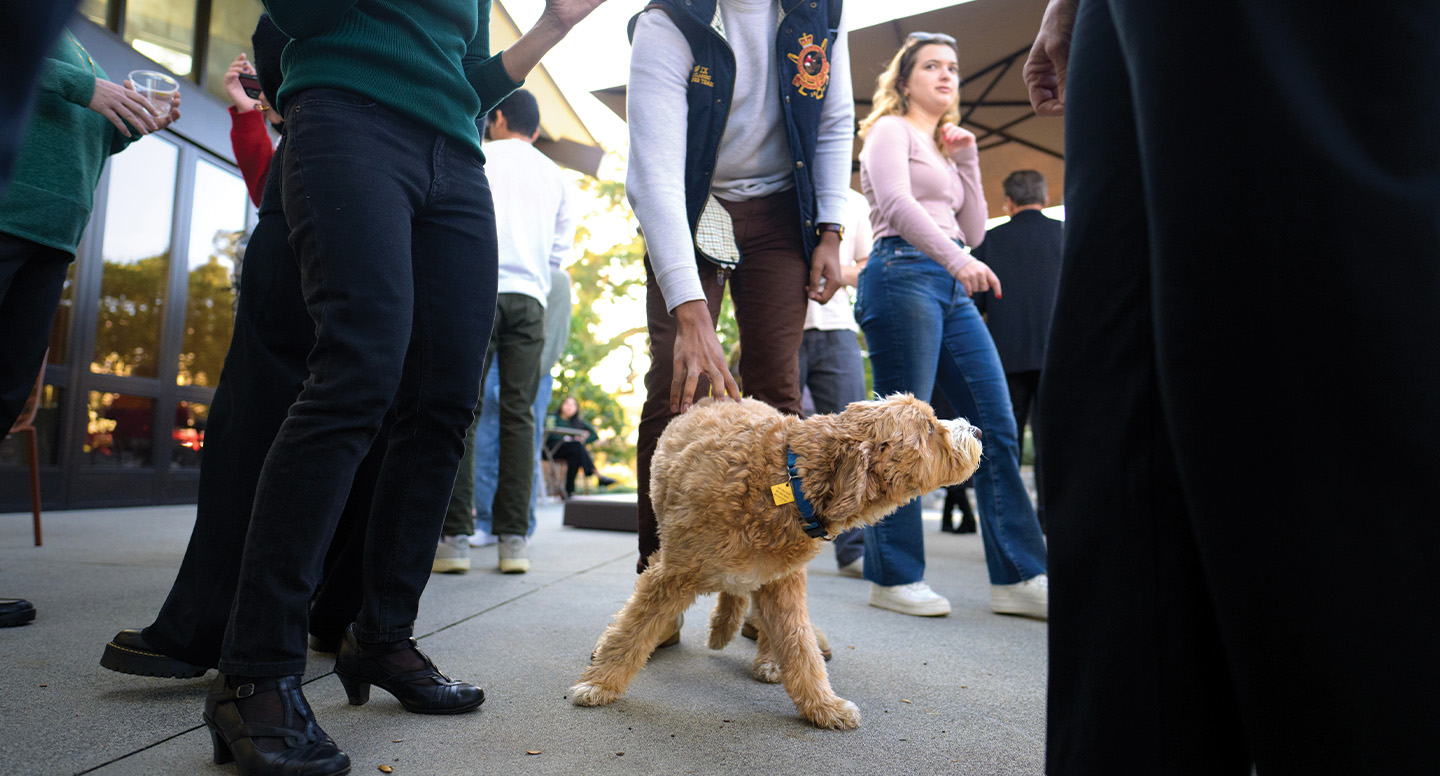
Priya: There are many lovely moments, but one that I think was just pure, unadulterated joy for all was when we brought eight-week-old, brand new to us and to CMC, Theo, to thesis surge in the fall of 2017. From student to student, he was passed around and cradled like a baby. Theo was exactly the elixir needed to give those seniors slogging away on their thesis a boost of endorphins. I loved that afternoon—the smallest of gestures, bringing our puppy to campus, the absolute and unconditional devotion from CMC students forever imprinted on Theo. And vice versa for the students.
Hiram: So many moments, like getting ponded my first year! I especially cherish the underdog moments, when we defied expectations, created something beautiful from the lowest probability, and raised the resources we needed to realize our biggest dreams. I say this not just on a personal and leadership level. I say this as witness to the successes of our faculty in their discipline-altering work and innovative teaching, to the students who suffered from imposter syndrome and other barriers to discover their own superpowers and success, and to the staff who took on big challenges and created nationally renowned programs. I love those moments, in particular, and will savor them forever.
What makes both of you feel the most hopeful for the future of higher education?
Hiram: CMC. Our students and their peers around the country, who have much stronger capabilities than we did, and who have a much greater sense of purpose than I believe we did at this age. The world has an unfair perception of this generation. This is the time when employers should be doubling their entry-level hires. I believe today’s CMC graduates are more capable and effective than their more senior peers in the workforce for the integrated learning and judgment we need in the world. This is the time when we should be celebrating and expanding their opportunities in the civic and public sectors, too, as the world is changing very quickly, in some ways leaving the solutions and strategies of older generations behind.
Priya: Same, our CMC students. I am just so impressed and in awe of their commitment to each other, to our society, and to making the world a good place. If higher education at large can nurture college students to be the leaders we need for them to be now, then I think we might be OK. And by the way, I see those students around me every day at CMC, and that gives me peace of mind.