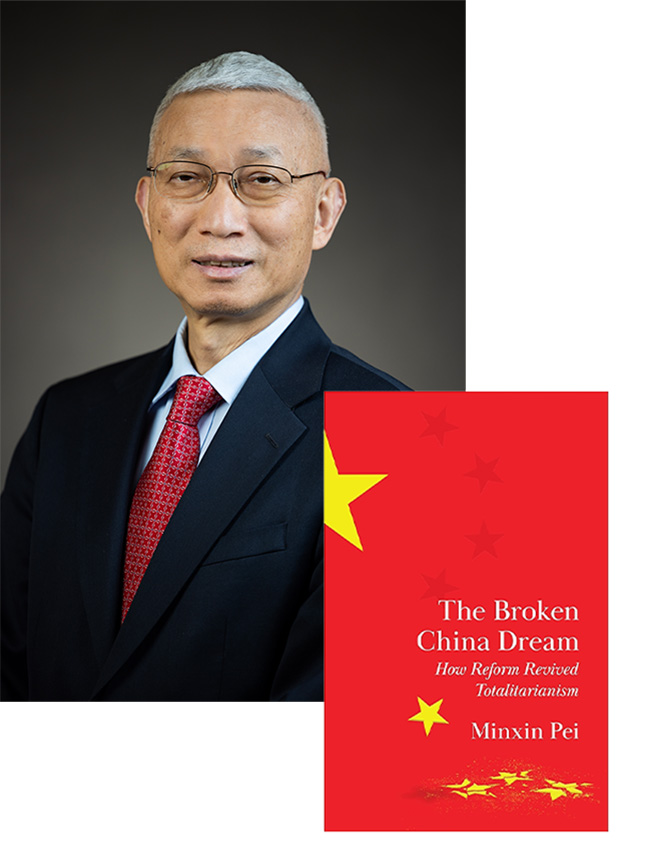
Minxin Pei, Tom and Margot Pritzker ’72 Professor of Government and George R. Roberts Fellow
Photos by Isaiah Tulanda ’20
The Communist Continuum
Professor Minxin Pei P’12 examines China’s pivotal moment
In his latest acclaimed book, The Broken China Dream: How Reform Revived Totalitarianism, CMC Government Professor Minxin Pei P’12 details the post-1979 history of China’s modernization journey, offering a crucial and comprehensive narrative.
Pei, an expert in China and the Pacific Rim, as well as U.S.-Asia relations, was inspired to write the book, in part, to fill a void on his own classroom syllabi.
“I’ve taught the course, ‘Chinese Politics,’ maybe 20 times at CMC, because in some semesters I would offer two sessions, and I felt that the story about China since 1979 could not be found in one single book,” said Pei, Tom and Margot Pritzker ’72 Professor of Government and George R. Roberts Fellow at CMC.
The Broken China Dream explores the pivotal moment when many hoped China’s turn toward capitalism would lead to abandonment of its totalitarian past. Instead of becoming an open society, Pei writes of an “authoritarian leap backward” under Chinese leader Xi Jinping, aiming to provide real-world insights for not only his students, but for policymakers, journalists, and businesspeople.
The Economist praised Pei’s “fresh perspective” and comparative analysis with Deng Xiaoping and his policy of “reform and opening up,” launched in 1978. “A handful of big decisions by Deng, China’s paramount leader until 1989, paved the way for Mr. Xi’s ascent,” the publication wrote. “Moreover, Mr. Pei’s book points to an essential continuity between the two leaders: a relentless focus on reinforcing the party’s grip on China, albeit in different contexts.” Similarly, in its “Best Books” review, The Financial Times noted that Pei “convincingly argues … it is more accurate to see Xi as part of a communist continuum rather than radical change. More to the point, the focus on change in China distracted attention from what stayed the same—the ruling party’s absolute determination to remain in power, and the fact that it never relinquished the tools to do so.”
While writing The Broken China Dream, Pei said he synthesized his own research over “the past three decades.” Published by Princeton University Press, the book joins several others Pei has authored on contemporary China, including: The Sentinel State: Surveillance and the Survival of Dictatorship in China; China’s Crony Capitalism: The Dynamics of Regime Decay; and China’s Trapped Transition: The Limits of Developmental Autocracy.
In spring 2025, CMC recognized Pei with the prestigious Faculty Scholarship Award, and he credits his productivity to the support he has received from the College. “I’ve been here for 16 years, and published three books, and I churned out articles, too,” said Pei, who also regularly appears as an expert in major publications or on news programs. “CMC is a friendly institution for scholars who are interested in doing research.”
Perhaps the best bonus: Pei said he truly loves teaching at CMC. “It’s the small setting … You actually know every student. You develop personal relationships. You know their strengths, their weaknesses, and you can conduct class discussions in a much livelier manner.”
Learn more about the latest faculty publications, achievements, and awards at CMC’s Faculty Accolades page.

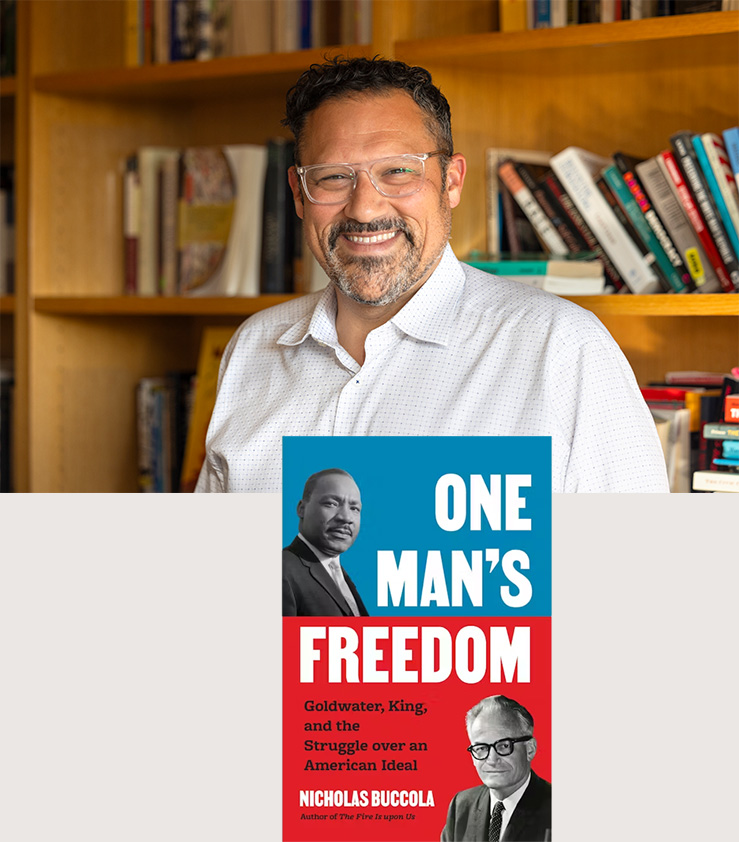
Nicholas Buccola, Government Department Chair and Dr. Jules L. Whitehill Professor of Humanism and Ethics
What is the American Ideal?
Professor Nicholas Buccola asks a key question that still divides us today
On the same day his new book, One Man’s Freedom: Goldwater, King, and the Struggle over an American Ideal published, Professor Nicholas Buccola spoke at CMC’s Athenaeum, detailing how he came to explore an “important period in political history.”
Buccola, Dr. Jules K. Whitehill Professor of Humanism & Ethics and Government at CMC, began by offering a brief background into how, from 1955-1964, Arizona Senator and former GOP presidential candidate Barry Goldwater, and civil rights trailblazer Martin Luther King Jr. “emerged as the leaders of two diametrically opposed freedom movements that changed the course of American history—and still divide American politics.”
In One Man’s Freedom, Buccola re-examines the very concept of freedom by comparing the legacies of both men. Similar to his previous book, The Fire Is upon Us: James Baldwin, William F. Buckley Jr, and the Debate over Race in America, Buccola took a “part dual biography, part history” approach to tell the story of Goldwater and King, who—like Baldwin and Buckley—held disparate views.
Since the book’s publication, Buccola—who specializes in American political thought—has discussed the book on NPR’s “Code Switch” podcast. In addition, The New York Times included One Man’s Freedom on a list of recommended books that “explore the promises and pitfalls of the U.S. economy” and the American dream, noting that “King’s civil rights coalition helped defeat Goldwater’s campaign, but Goldwater’s ideas coursed down both aisles of American politics, shaping the Reagan Revolution and the free-market globalism of the Clinton White House.”
“Both King and Goldwater think of themselves as leaders of freedom movements. They think of themselves as trying to figure out a way to make this a free society, and yet they view each other with mutual suspicion and even a kind of hostility,” Buccola said. “So, one of the questions at the heart of this book is, why? And what can we learn about ourselves from the story of Goldwater and King?”
—Anne Bergman