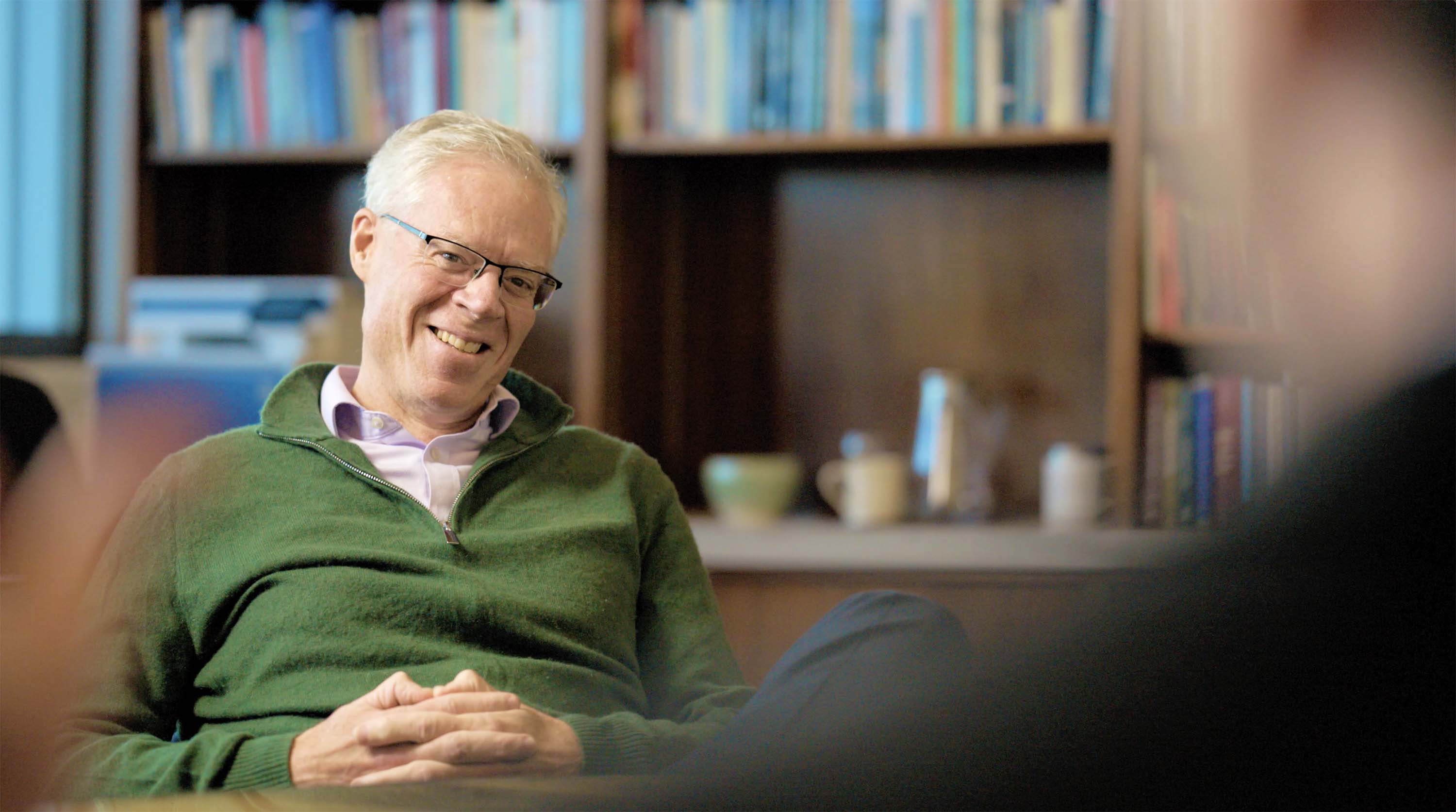
President Will Dudley.

Photos by Anibal Ortiz

Endless fascination: President Will Dudley’s journey to Claremont

Story by Thomas Rozwadowski

Swimming pools hold a special place in Will Dudley’s heart.

They’ve helped him find connection and competition. Purpose and promise.

As kids, some of Dudley’s favorite summers were spent with his younger sister, Susan, at the community pool near his parents’ home in Arlington, Va. It’s also where a coach for Overlee of the Northern Virginia Swimming League (NVSL) first saw seven-year-old Will swimming and asked if he’d like to join the summer team. Year-round practices and competitions followed, with brother and sister reveling in their routine, pushing each other to be stronger in the pool.

Dudley couldn’t stay out of the water in college, either. As both a swimmer and eventual captain of the Williams College water polo team, he spent much of his time away from the classroom at the athletic center on the bucolic Massachusetts campus. A cherished memory from those years: beating Amherst College for the New England water polo championship during his senior season.

The pool might also help explain more about Dudley’s higher education career than is immediately self-evident—and why, several decades later, a coach’s curiosity during a random swim still resonates. Someone saw potential in him. And once you know the lasting impact a gesture like that can have, it makes you want to do the same for others.

“I’m not sure it was anything more than being a seven-year-old who could already swim pretty well. But just being asked to be on a team … I mean, the NVSL is one of the oldest and best developed summer community swim leagues in the country. So, to do that to age 18, which is when you maxed out, wasn’t just about the sport of swimming. I truly appreciated the camaraderie it brought to my life—knowing that you have all of these bigger kids you look up to and want to be like one day. And then eventually, you are like them, and now little kids are looking up to you,” Dudley recalls fondly.

“That was an amazing atmosphere to be part of. One that became central to how I grew up and the person I wanted to be.”
All in the family

There’s something magical about making new discoveries—and how it can unlock inner, even hidden potential—that drives how Will Dudley views higher education.

Having dedicated much of his professional life to liberal arts colleges—twice as a president, at Washington and Lee in Lexington, Va., from 2017 to 2026, and now as the sixth president of Claremont McKenna since July—Dudley understands the power of an activated community. How through big and small gestures, the collective impact of faculty, staff, alumni, parents, and inspired supporters can uplift 18-to-22-year-olds at a formative—perhaps the formative—moment in their lives.

Just like being in the pool brought lasting community and character building, Dudley learned early on how the value of education could expand his horizons.

His late father, Earl, was a 12th-generation Virginian and the first in his family to go to college. He attended Amherst thanks to generous financial aid and was a successful lawyer in Washington, D.C., for more than two decades before embarking on a second career teaching law at the University of Virginia. His mother, Louise, is a third-generation Smith College alumna. A talented writer and editor, she worked in communications and media relations during two stints at UVA, the first while Earl was getting his law degree and the second when he began teaching years later. Now 86, she still lives in Charlottesville.

That his parents also met while in college—at an Amherst-Smith mixer, no less—speaks to how deeply and symbolically liberal arts roots anchor the Dudley story. Extend the family tree further, and the journey to Claremont almost begins to feel predestined. Dudley’s great-grandparents on his mom’s side met at Pomona College in 1901, with his great-grandmother breaking barriers as a biology instructor and women’s basketball coach there. Additionally, his great-aunt, Carolyn, was one of the pioneering members of the first class to attend Scripps College.

“I was lucky. My parents were well educated,” Dudley says. “Growing up, they were very hands-on with teaching me writing or long division at home, and didn’t just cede that responsibility to the school system. They were also big believers in holding yourself to very high standards.”

Dudley continues the train of thought with a memory from fifth grade when he confidently shared “an obvious A paper” with them. Feeling pleased, he expected a hearty pat on the back in return, maybe even a placement on the fridge for all to see. Instead, his parents told him it was a “nice first draft.”

“And I said, kind of shocked, ‘But I’m going to get an A on that,’” Dudley adds. “That wasn’t important to them, though. I think they knew I didn’t invest as much time in it as I could and that it felt like a superficial effort. They knew I could do better.”

Susan Stout, two years younger, doesn’t recall her older brother ever needing an extra push in school. But she also wasn’t surprised to hear that, even in grade school, their parents grounded young Will in academic rigor and the steady persistence of doing your best.

“You know how some younger siblings will walk into a room and they’ll get, ‘Oh, you’re so-and-so’s sister!’ from an adult or previous teacher? Well, I would get that because of Will, of course. But as I eventually learned, I would immediately have to follow with, ‘OK, OK, don’t get so excited. I’m good. I can do the class. But let’s set realistic expectations here,’” Stout says, laughing.

If Dudley cast a large shadow in the Arlington Public Schools, it wasn’t motivated by blind ambition. While admittedly a “very competitive” person—a trait that served him well as a multi-sport athlete in soccer, golf, swimming, and water polo—Dudley recalls growing up in a house that emphasized curiosity and kindness above all. Echoing back to his parents’ influence, Earl and Louise set a high bar for how to engage with others, a lesson in “universal respect for everybody” that he would carry into the rest of his life.

“Whether it was kids from the neighborhood or members of my swim team, my house was where all of my friends liked to be,” Dudley says. “My parents were genuinely interested in them. They talked to them. They wanted to know who they were and what they liked. To them, it was always a joy to learn something new about someone.”

Philosophy of teaching

The first philosophy course Jeff Kaplan ever signed up for at Williams was the History of Metaphysics and Epistemology with Professor Will Dudley.

It was 2005, Kaplan’s freshman year, and he can’t remember why he even picked the class: “Honestly, I didn’t even know there was a discipline called philosophy.”

Kaplan would go on to take 18 philosophy courses over four years at Williams—twice the number required for his eventual major. The reason: Professor Will Dudley.

“Will’s classroom was where I first discovered this entire discipline of smart people who had been working on really big questions for, at minimum, 2,400 years. Does God exist? How do you know God exists? What is the relationship between the human mind and the body? What happens after we die? Does my consciousness live on? What are my moral obligations to other people? How should society be arranged? What’s fair and unfair when it comes to politics? To interpersonal relations?” Kaplan says, rattling off life’s enduring complexities with ease.

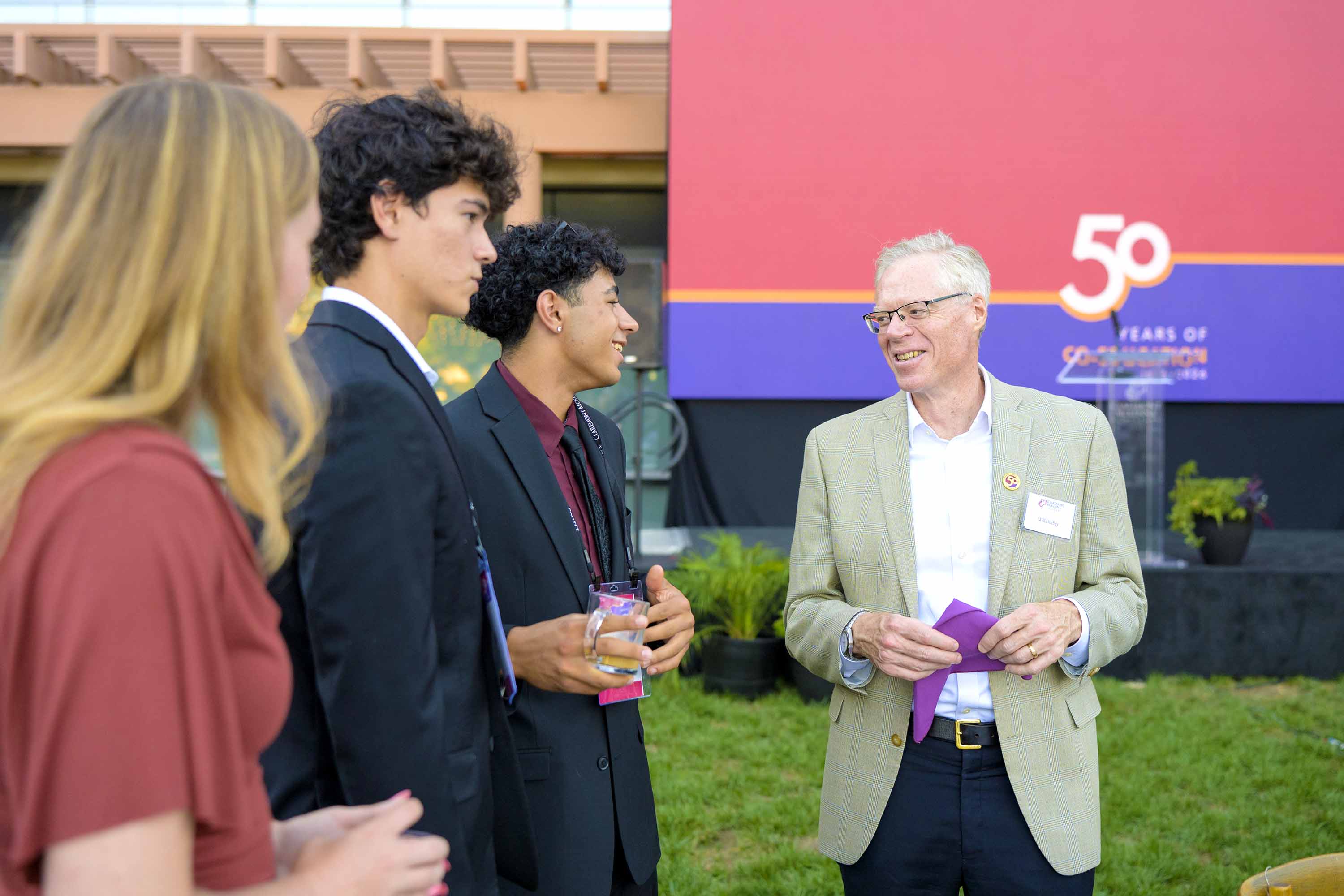
President Dudley (right) with students attending ImpactCMC 2026.

“To me, my goal as a teacher was always to help my students become better. Better writers. Better critical thinkers.”

“Once I realized that there were already people approaching these questions with much more clarity than I had ever been doing on my own, I knew where I needed to be. It was just a matter of trying to join them as best I could.”

Kaplan, now an associate professor of philosophy at the University of North Carolina at Greensboro, got an even deeper experience with Dudley than most. He was one of only two students in an Oxford-style tutorial at Williams called Philosophy of Education. As intimidating as it was to feel so exposed week in, week out in Dudley’s office, Kaplan says the real challenge was making sure he did right by his professor’s expectations for him.

“A teacher really has to know what they are doing in that environment. I had classmates who took similar-style tutorials at Oxford and Cambridge, and they would break down crying because they were just battered in there for not understanding John Rawls or whatever,” Kaplan recalls.

“Will didn’t do that. He was supportive. He was positive. He made the material exciting and personal. But he also wasn’t afraid to challenge me to think. When I later went to get my Ph.D. at Berkeley, I just remember feeling so prepared because I had already studied so closely with great teachers like Will.”

Dudley’s path to teaching was not unlike his former student’s. Entering Williams, he knew that math was a strength, but guided by his parents’ encouragement to “just study the things that you find most interesting and get the most out of college,” he rolled the dice on Introduction to Moral and Political Philosophy with Professor Alan White during his sophomore year. Like Kaplan, he also didn’t know what philosophy really meant as a discipline. But the material “clicked right away.”

“I was fascinated by the big questions and was really fortunate to have teachers that I admired,” says Dudley, who combined philosophy with his math major. “That was probably the first time I even thought about a career, too. Wait, a job where someone can read and think and talk and write about really interesting ideas? They were getting paid to do that? I honestly didn’t think anything could be better.”

After graduating magna cum laude from Williams in 1989 and attending Cambridge University as a Herchel Smith Fellow, Dudley took a brief detour as a planning analyst and finance manager at AES Corporation before deciding he was hungry to go back to school. Now he was certain: He wanted to teach. Dudley attended Northwestern University for his M.A. and Ph.D. in philosophy, ending up back at his alma mater in 1998 as a professor of philosophy.

A specialist in German thinkers like Kant, Hegel, and Nietzsche, Dudley has always remained fascinated by the social and political questions he was first exposed to in Professor White’s introductory class. While his career evolution eventually led him to the provost role at Williams and the presidencies at Washington and Lee and now CMC, Dudley says the impact of a teacher who instills both care and careful deliberation is still his North Star for higher education. It’s particularly special when done well in a small liberal arts environment.

“It could be any subject: economics, art history, anthropology, philosophy, you name it. If there’s a great teacher involved, it’s worthwhile,” Dudley says. “To me, my goal as a teacher was always to help my students become better. Better writers. Better critical thinkers. Training the habits of mind to always know that if you are going to say something, if you are going to write something, be able to justify what you are saying. And if you are also going to respectfully challenge other people’s assumptions, figure out how to ask the right questions in an appropriate way.

“I really believe these are the lessons that will make you more successful in life.”

To hear Stout tell it, of course her brother would become an accomplished academic, especially if it meant going back to Williams to teach. She not only remembers how fondly Dudley spoke of his undergraduate experience as one of “the best times in his life,” she chuckles while recalling how he once lamented never having had a great physics teacher.

“This was something that still bothered him as an adult. He saw it as a missed opportunity to learn more,” she says. “It’s why I’ve never met someone who loves and appreciates learning as much as Will. And not just in the way of, ‘I can do this. I’m good at it. Now let me go and be an investment banker.’ He really cares about how learning fundamentally changes you as a person.”

Stout’s description certainly held true for Kaplan, who credits Dudley with being one of his most significant mentors—someone he borrows from in his own teaching every day.

There’s one lesson that Kaplan might want to give Earl and Louise at least partial credit for, though. After being told that he was using too many rhetorical questions to cover for weak arguments in his writing, Kaplan was given a zero-tolerance policy for the rest of the semester.

“Will didn’t let me use them or it would affect my grade!” Kaplan says of the singular restriction. “But I took the challenge as a compliment. He knew I could do better.”

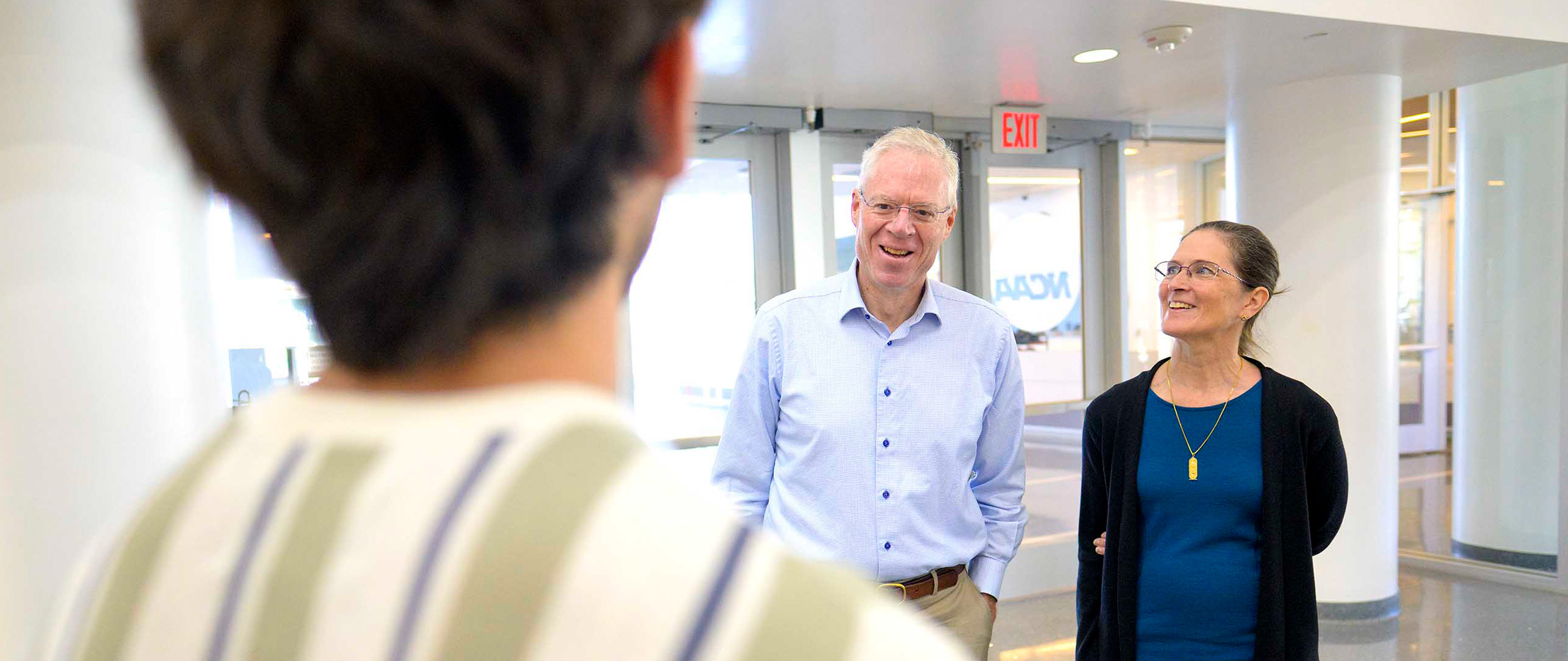
Will Dudley and Carola Tanna with a student tour guide.

Back in the pool

Carola Tanna has a fondness for swimming pools, too.

A diver at Williams, she and Dudley first met at a swim team party and became fast friends. Decades later—with first marriages, children, careers, and life in different cities filling the time and distance from college—Tanna and Dudley reconnected through shared memories about a beloved Hall of Fame coach, the late Carl Samuelson, on a Williams swimming and diving Facebook page.

A long-distance relationship—Dudley in Massachusetts and Tanna in Chicago—followed for several years, with both taking turns traveling to see the other on weekends. When Dudley became president at Washington and Lee, they continued to rack up the frequent-flier miles until 2020, when Tanna moved to Virginia. A wedding followed, albeit smaller than originally planned because of the pandemic. But after an “eight-year commute” as a couple, the real celebration was clear. They were finally in the same city together—something Tanna always believed would happen.

“Long distance is tough, so you have to know that it’s going to be worth your while,” she says. “And while I think both of us knew right away that it was for real, we also had our established lives with children—my four were raised with me in Chicago, Will had Cole and Ella—so we wanted to be sure to minimize disruptions. But we always knew the long-term goal.”

“He really cares about how learning fundamentally changes you as a person.”

For Tanna, being the wife of a college president has been a lesson in sturdy and steady support—something she has grown used to providing in her own career as a primary care physician. Originally from Oak Ridge, Tenn., Tanna and her family made two big moves in high school—first to Long Island, N.Y., and then Encinitas, Calif. For college, she headed back East to study English and biology at Williams before earning her M.D. at Columbia University College of Physicians & Surgeons.

Tanna then completed her internal medicine training at the National Naval Medical Center in Bethesda, Md., and served at Naval Hospital Great Lakes, Ill., achieving the rank of Lieutenant Commander. Her additional 18 years as a physician in Illinois and volunteer work with CASA (Court Appointed Special Advocates for Children) taught her “how much satisfaction I get from taking care of people.”

Rather than listing individual career highlights, Tanna prefers to think of her life path as the best conduit for “being a person of value to others.” It’s an underrated component of any kind of service-oriented or leadership work, she says, and a trait she saw her husband prioritize up close at Washington and Lee.

“That’s one of Will’s gifts. He’s very analytical and organized, and at some point, he knows he’s responsible for decisions and has to make them. But he also has both an intellectual and general humility that can be felt because of how he approaches the responsibility of those decisions. He really listens and cares,” Tanna says.

It’s also why, even though Tanna says her professional life is “so different from Will’s,” the couple’s approach is complementary on everything from big-picture decisions—like moving to California—to everyday choices like what to cook together on a weeknight. Or as she succinctly puts it: “I’m the tree person. He’s the forest person. And it works really well for us.”

As for pursuing the CMC presidency, Dudley says that while it was tough to leave family and comfort in Virginia, he also felt like there was “one big higher education challenge” still in him. And while being in California wasn’t a stated goal, some of the geographic perks still seem a little too good to be true. Tanna’s extended family in Encinitas coupled with the established excellence of CMC felt like the right place and right time at this period in their lives.

“Most days I still have those moments where I say to myself, ‘Holy cow, I live in California now. Look at those mountains! It’s sunny every day! I can wear shorts again!’” Dudley says with a smile. “I feel fortunate to have this opportunity with Carola here, and while it will still take some time for it to sink in that this is, in fact, our home, it feels right. CMC is already an incredible place with an incredible mission. Now it’s my job to make sure that it incrementally becomes even better.”

In addition to relying on each other, Dudley and Tanna also know they can take comfort in familiar routines that help them prepare for each new day in their new home.

Their favorite way to spend time together during these first few months in Claremont?

Swimming before work, of course.

CMC MAGAZINE

|

Endless fascination: President Will Dudley’s journey to Claremont

Back to Issue