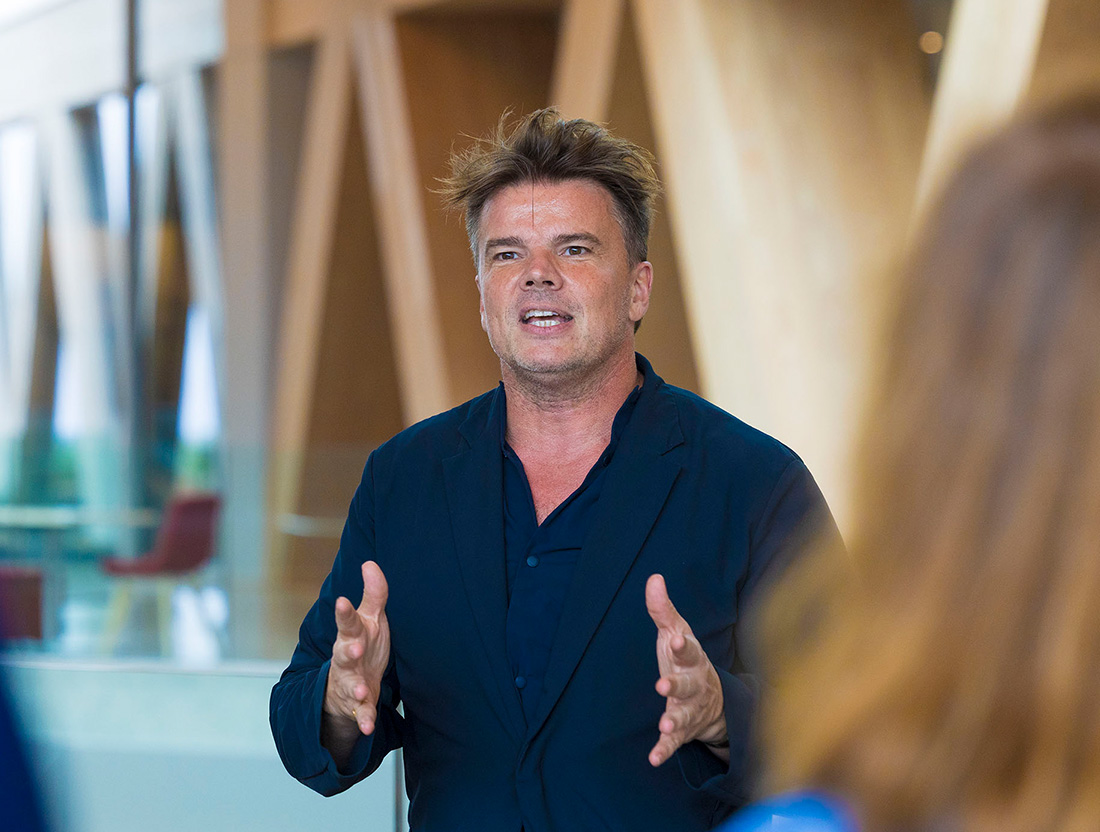
PURPOSE
“As you move around the building, it really changes character. Because every floor is like a sculptural volume that is oriented in a different direction. The more you get to know it, the more it dawns on you that there’s a reason for everything. That’s a bit like science—that when you look at the complexity of nature, everything seems overwhelming and confusing and random. But the more you dig into it, the more pieces of the puzzle fall into place, and you start realizing that what seemed like coincidence, you know, might instead have been providence. What seems random is actually causality.”
INTERACTION
“We actually spend time with our clients and collaborators trying to identify, ‘What is it that the standard solution cannot do that we would like this building to do?’ For this project, that means a three-dimensional space where you can see your fellow students and your teachers on multiple levels. Even if you’re not doing anything with a particular person (on a given day), you’re still going to catch a glimpse of them two floors up. And you can even give a shout out and say, ‘I wanted to give you this thing. Or can we talk about this later?’ So, in a way, it increases the invitation to exchange, which is what really drives innovation in these highly interdisciplinary spaces.”
WARMTH
“We ended up with a steel structure with timber cladding that brings beautiful warmth and texture … that somehow contradicts your expectation of what a science center or a data lab would look like. On one hand, it’s a very technical building. And it has a very disciplined idea. But it is materialized with warm, organic elements and patterns from the timber. There’s an informality, an organic quality, that you wouldn’t expect in this kind of project.”
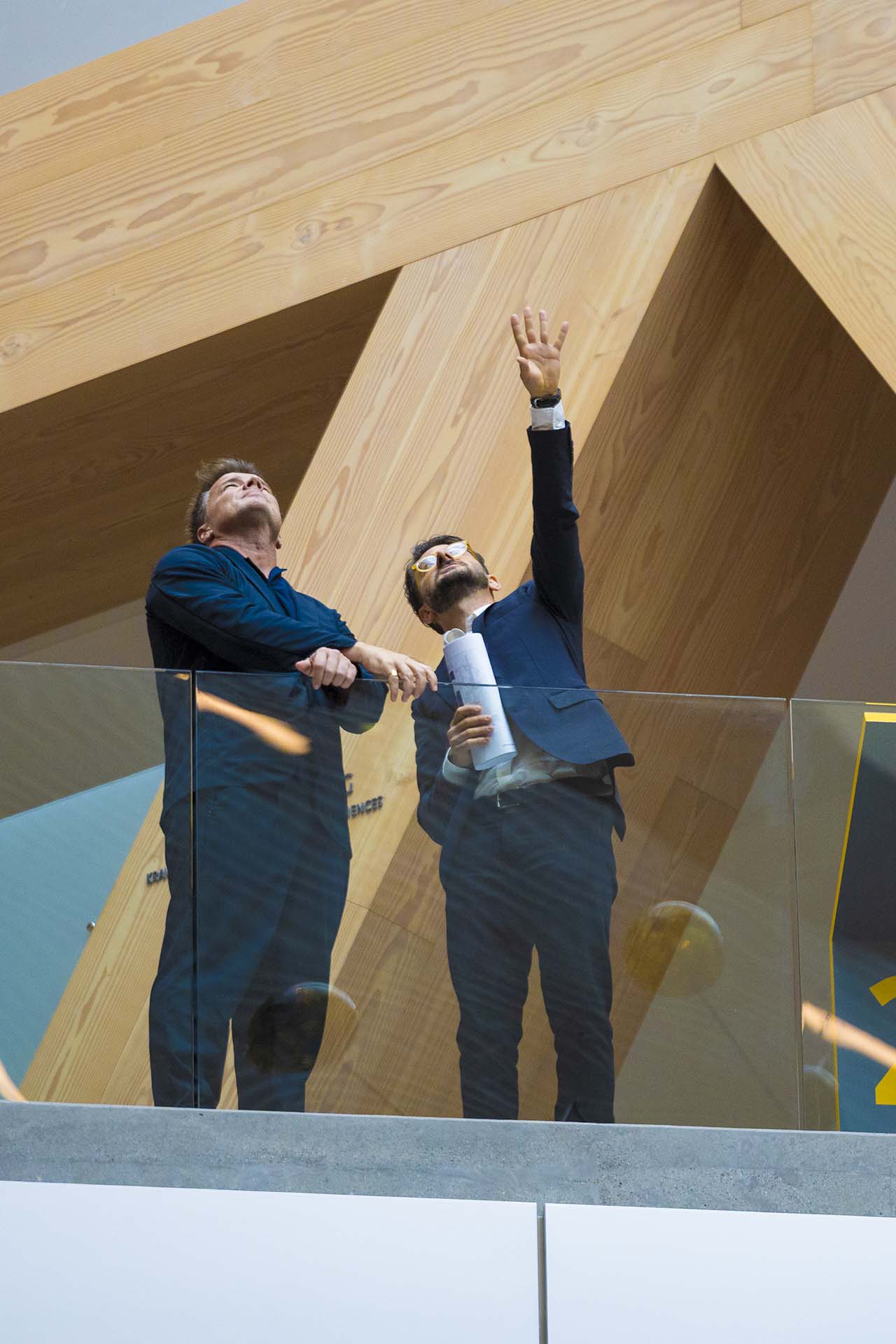
FLOW
“I see the building and its placement serving as a kind of ‘hinge’ in the orchestration of the kind of expanded master plan that we’ve created together with CMC—which is essentially taking the North Mall and turning it into a zigzag to become the South Mall. It’s essentially a series of parallel buildings that … stack on top of each other—facing east, west, north, south—so you end up with each floor oriented in a different direction. The building embraces and welcomes people arriving from multiple directions. It doesn’t really have a front or back to it. The building is really, quite literally, a distributor of flows. It’s a distributor of the flow of people. A distributor of the flow of knowledge of both student body and faculty. And it creates the most intuitive extension of the mall for this extended campus master plan.”
DUALITY
“That’s what I appreciate most … the contradiction of the performative and the playful, the rational and the experimental, that I think really speaks to the essence of the building. Speaks to the essence of CMC’s vision in putting this idea forward. Speaks to the essence of how we like to design and discover new ideas. It’s one thing to create the environment. To have the eureka moments. But like they say in the entrepreneurial environment, ideas and visions are cheap. What’s really hard is execution. And you know, as much as we love to make drawings and build cardboard models and make pretty pictures, the reason we do all of this is (for the moment) when fantasy becomes reality, when abstract vision becomes concrete reality.”
Founded in 2005 by Bjarke Ingels, BIG-Bjarke Ingels Group is a globally renowned architecture firm with design studios in several cities (Copenhagen, New York City, London, Barcelona, among others). CMC’s Robert Day Sciences Center marks BIG’s first built project in the Los Angeles area.