CMC Leads ascending arrow in maroon.

Developing Future Leaders
Part Two

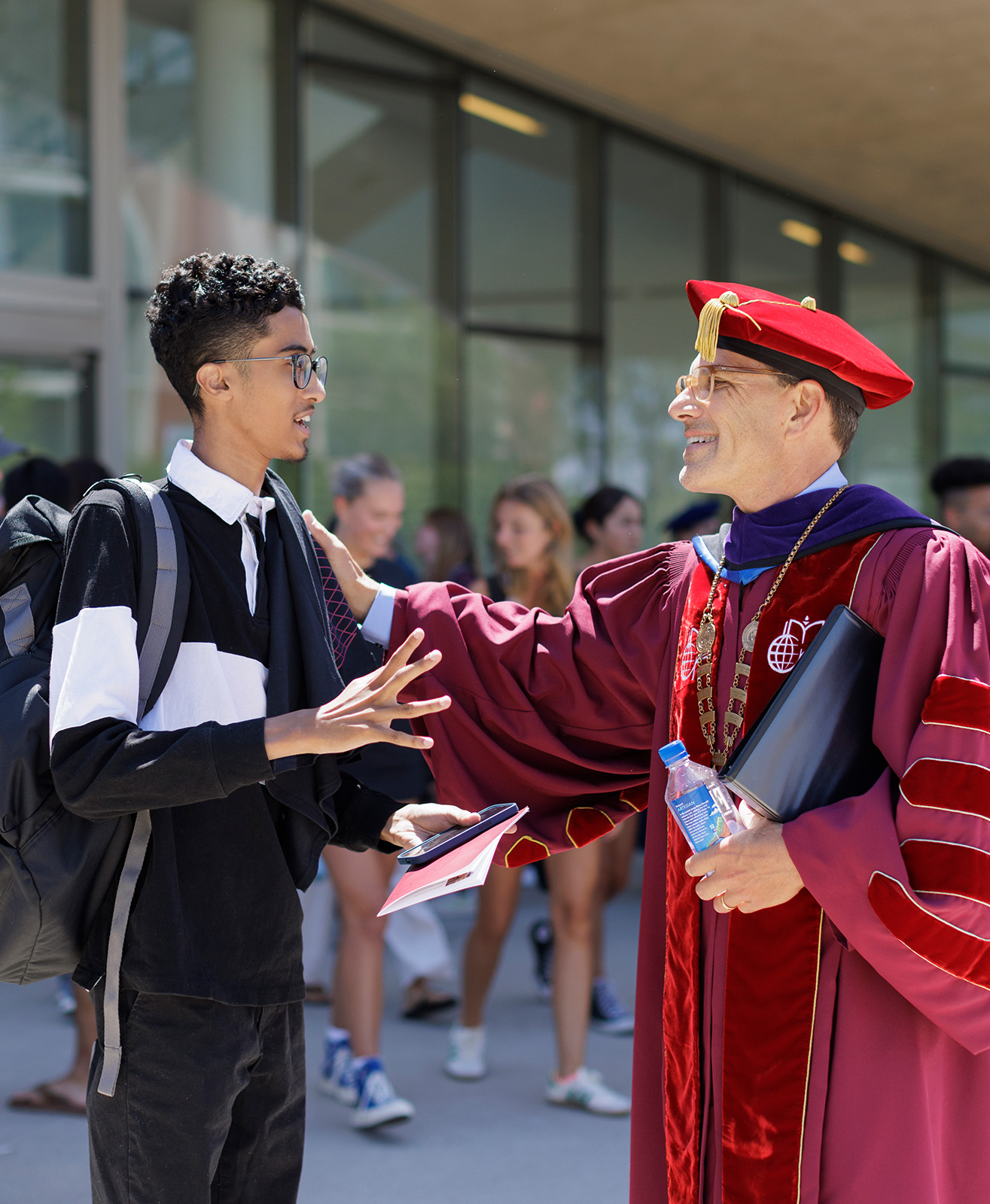
Hiram speaking with a student outside Roberts Pavilion.

Developing Future Leaders

Aadil Mohamed ’26
The first time I ever met Hiram was my first day on campus. There’s actually a picture on the CMC Instagram account. It was right after Convocation, and he had his hand on my shoulder. It’s a really nice picture.

He was offering me a few words of advice about approaching college with intention. It was a brief exchange, but a meaningful one. You know, it’s one of your first interactions on a new college campus, and it’s with your college president. And in that first interaction, he carried himself not as a distant administrator, but as a leader who was attentive to students at the beginning of their intellectual journey. Now, looking back on that memory, it captured something enduring about his presidency. He’s very present. He’s very grounded. He’s deeply invested in the formation of students as individuals

Dianna “DT” Graves ’98
Vice President for Student Affairs

Hiram takes the CMC mission very seriously, as do I. So, when we think about responsible leadership in business, government, and the professions, when we think about thoughtful and productive lives, to me, it feels almost audacious to say, “yes, that’s what we’re doing here!” I was a CMC student once too, and I have always appreciated that the mission of the College remains as salient as ever. As campus leaders, that motivated us to think about how we could train leadership skills—rhetorically and behaviorally—so that when our graduates enter the world, they can identify problems and have the skills to fix them.

Gabe Gardner ’28
Students are treated as contributors to the institution, not just recipients of it. Seeing that kind of leadership shapes how I understand my own role at CMC. Leadership here is not about authority or visibility. It is about showing up, listening seriously, and acting with care for the community.

Ava Kopp ’25
Hiram would marvel not only about the achievements of our students, but their kindness to those they didn’t know. He’d praise our faculty as unparalleled in their disciplines, or note how our staff consistently raised the bar for student support. Seeing the way he interacted with and spoke about our CMC community taught me more of what I needed to know about leading by example.

Nyree Gray
Vice President for Human Relations
Chief Civil Rights Officer

Whether I think about the CARE Center or The Open Academy or any major CMC initiative, really, there’s this undercurrent that is tied to deep, consistent training and what we know it takes for leaders to be effective. And so much of that is learning and understanding that people are different from yourself, having a better understanding of how you make decisions, and how you can come up with your own informed perspectives. Creating space for people to thrive at CMC is a huge part of our leadership mission.

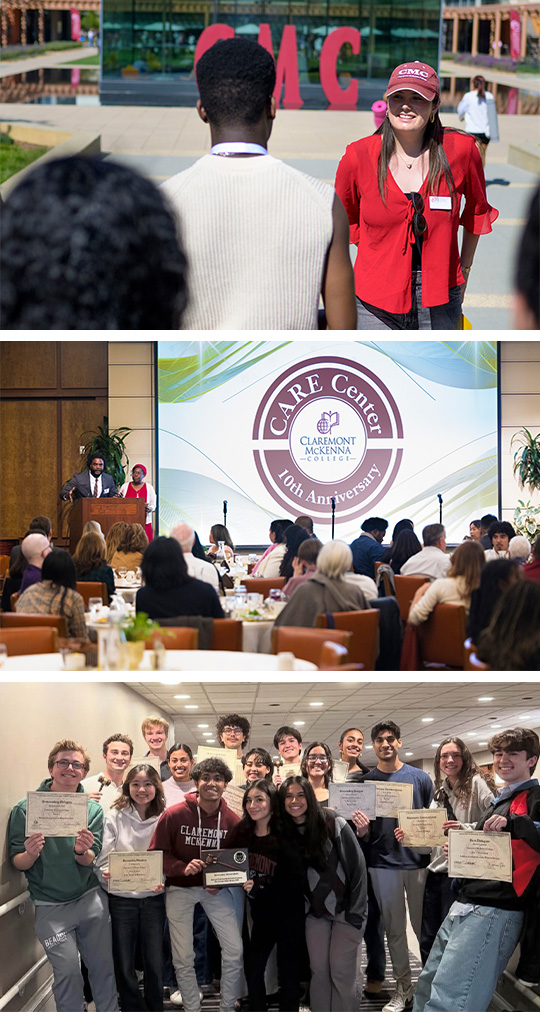
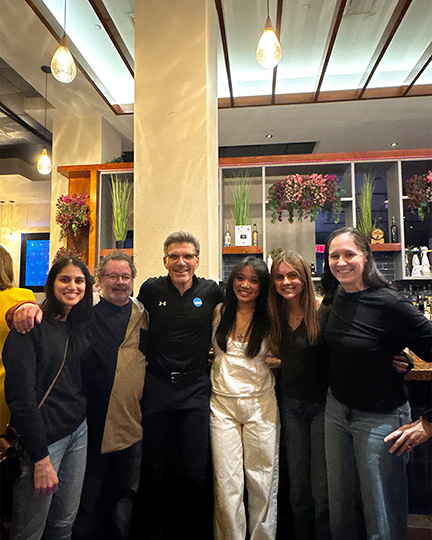
Collage of campus scenes: student-led tours, the CARE Center anniversary event, and the ModelUN win.

Vince Greer
Assistant Vice President of Student Affairs for Dialogue and Diversity

This year at the CARE Center, we’re celebrating a really awesome milestone of 10 years. It’s not lost on me as the inaugural director, the hills we’ve climbed, and where we’ve ended up now to become such a major part of the student experience. We really believe in the importance of empowering student voices, so we put a lot of training and effort into having them lead out a significant chunk of the CARE program.

Beyond that, we’ve also just been a haven for students, a place where they can come in between classes to study or hang out. It’s a place for so many of our student organizations to gather and meet; we’ve had professors host classes here. So, what may have started out as, “OK, will this be an insular space for a pocket of our community?” has become a place with so many critical partners involved. With CARE, we have really seen what happens here when you reach across the student body.

Dianna “DT” Graves ’98
CMC has built an environment where we let students know, “We’re going to pick you up, dust you off, and get you back on the leadership path again.” That’s empowering for students. Hiram has been a president who anticipates them making mistakes, and he wants to help them along the way. They can try things. They don’t have to be afraid. 

And that’s a culture Jack Stark started, in terms of just being a grown up and handling your business. Pamela Gann came in and built systems to further allow that to happen. She was incredible. She was organized. And now with Hiram, he’s brought so much ambition to our leadership mission, and just pulled the student body right along with him.

Josh Morganstein ’25
I engaged with Hiram most while leading CMC’s Model United Nations team. Through his incredible support, we achieved our highest ranking ever and brought home multiple national and international championships. Beyond financial support, Hiram was also a thought partner—meeting with leadership every year to offer wisdom and taking an active role in McKennaMUN, the annual conference CMC hosts for high schoolers.

Erica Jasper
William B. Arce Director of Athletics, Physical Education, and Recreation
George R. Roberts Fellow

The phrase “scholar-leader-athlete” has come up quite a bit during my time with CMS Athletics, and I think that’s reflective of our collective goals and our focus on leadership. It’s just a tremendous fit at CMC, the excellence we showcase in all three areas.

Maya Love ’20
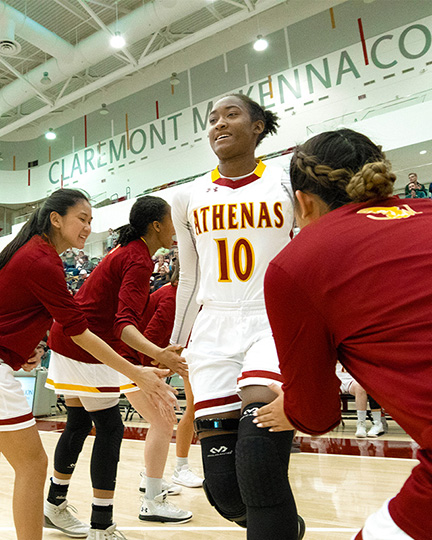
When I first arrived at CMC, the unveiling of Roberts Pavilion served as a powerful physical reminder that this was a place where excellence was expected across all dimensions. And I quickly learned that the scholar-leader-athlete motto wasn’t just a marketing slogan; it was an invitation to be a well-rounded leader. 

Because of CMC, I was inspired by our principle of preparing students for the world of affairs, and it encouraged me to pursue a rigorous professional path without sacrificing my identity as an Athena. I realized then that while other schools wanted me for my stats, CMC wanted me for my potential. This was my breakthrough: I stopped seeing my sport and my career as competing interests and began seeing them as a singular leadership journey. CMC taught me that I didn’t have to hang my hat on being an athlete. Instead, I could use the discipline of basketball to fuel my growth as a scholar.

Maya Love ’20 during her time as a basketball player.
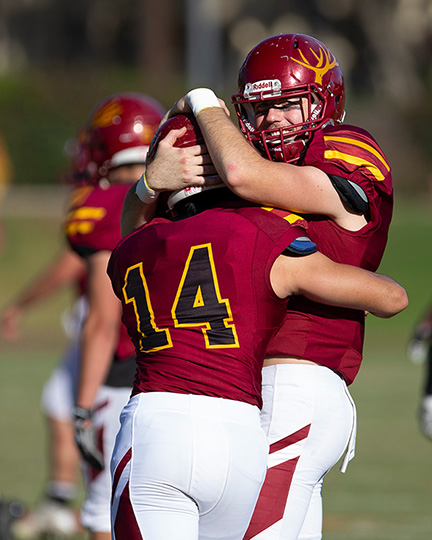
CMS Football players celebrate success.
President Chodosh, Erica Jasper (far right) and students at a NCAA convention.
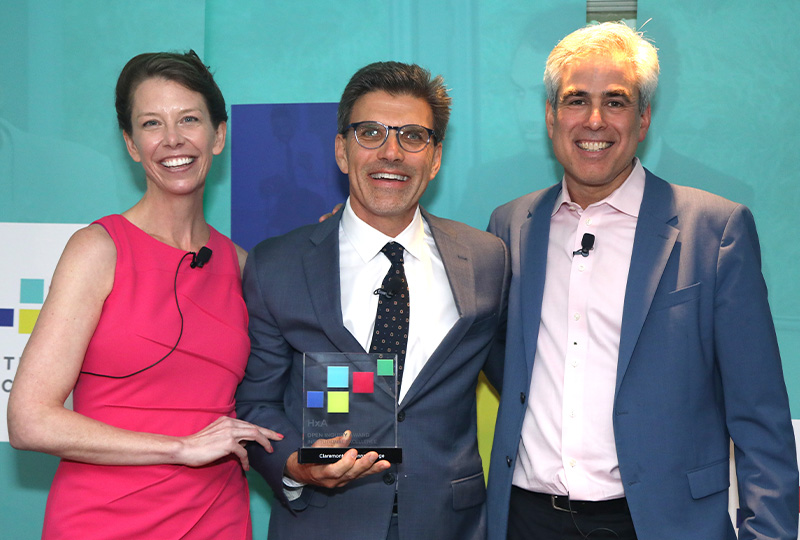
President Chodosh accepting Heterodox Academy's Institutional Excellence Award.

Erica Jasper
This semester, a few of us attended the NCAA Convention in Washington, D.C., with Hiram. Ella Brissett ’25 was there; she won the Impact Award, which is a very big deal—first CMS student-athlete and first CMC student to win a major NCAA award. We also had (fellow CMS athletes) Riley Capuano ’26 and Christine Yu ’27 there. And for Ella, Riley, and Christine, they got to see a little more of Hiram’s leadership holistically through informal one-on-one conversations. They saw how passionate he is about what they do on all fronts. He really made them feel valued for their efforts, for being scholar-leader-athletes who represent CMC and CMS so well.

Bob Nakasone ’69 P’98
CMC Trustee

As a former CMC baseball player, I will always appreciate Hiram’s commitment to athletics. While his prolific fundraising brought The Sports Bowl to fruition and his leadership on the NCAA Division III Presidents Council is widely recognized, his grassroots support of student-athletes was equally distinctive. He attended CMS games regularly and was a genuine fan who could regale you with details about each student-athlete—their background, interests, and aspirations. Some of my fondest memories include attending Athena volleyball matches during multiple NCAA championship runs and, more recently, a Stags vs. Pomona-Pitzer football game with Hiram and Priya.

Ken Valach ’82
Chair of the CMC Board of Trustees

In order for our students to thrive as responsible leaders, the College has to not only invest in the personalized culture that Hiram has helped cultivate, but also provide the resources and infrastructure necessary for success. When I look at how Hiram and the Board have successfully worked together on financial support and capital projects, I am incredibly excited about our future. We don’t need to imagine it: It’s here through the Robert Day Sciences Center, The Roberts Campus, and The Sports Bowl, which will take our campus and athletics program to the next level. I am filled with gratitude for what CMC did for me, and through my collaborations with Hiram, I’m especially grateful for how he has opened so many additional doors for future generations.

Gavin Landgraf ’14
I had the good fortune of being the Associated Students of Claremont McKenna College (ASCMC) President during Hiram’s first year. And it was evident early on that Hiram was someone who cared deeply about the acts of students, because those acts reflected who we were. Here was a president who would be students’ champion, but whom we could also disappoint. Here was a president who believed in accountability. One of Hiram’s many questions that has stuck with me is: To what standard do you hold yourself?

Paul Nathan ’80
CMC Trustee

Hiram quickly grasped the unique personalities and dynamics of both the alumni and the student body. He recognized and appreciated the differences among us, which contributed to his effectiveness as a leader. And he’s always full of innovative ideas, with The Open Academy standing out as one of his best.

Laura Grisolano ’86
CMC Trustee

Claremont McKenna College has been so blessed. The right president seems to land here at exactly the right moment and with the perfect skill set for our front-burner challenges. Even before Hiram was installed as president, it was clear that he understood the power of culture and inspirational leadership. The stories he shared about his family’s kitchen table helped us build a community around respect and conversation. Though we have always been a place of warm friendships across diverse political perspectives, Hiram named and leveraged the idea of an Open Academy to achieve buy-in to the notion that we can disagree about ideas without disrespect. More than that, we have a responsibility to listen, to be civil, to learn from each other in order to level up and improve solutions.

Jennifer Sandoval
Vice President for Admission and Financial Aid

It has always been in CMC’s DNA to construct an environment for Open Academy principles to flourish. In working with faculty and the Board, Hiram helped bring more to it programmatically across all of campus, and allow us, as staff, to walk students through what it means to be a member of our CMC community. And there is a desire for this among prospective students, especially. They know us because of these values. We have always been one of the few schools who could say it and mean it.

Adele English ’19
I am proud of CMC’s dedication to freedom of speech under Hiram. There is no better place to learn and grow than one where all voices are taken seriously, where ideas are challenged with intensity in the classroom, and friendships are strengthened over lighthearted conversation at our inclusive ASCMC or College Programming Board (CPB) events.

Tina Daniels
CMC Trustee

The CMC intersection of civil discourse, political engagement, and a culture of friendly community is an environment not seen on many other campuses or institutions in general.

CMC Leads: Through the Years

Notable CMC moments, initiatives, and accomplishments during the past 13 years of President Chodosh’s tenure.

View Milestones

Radhika Koul
Assistant Professor of Literature

Hiram’s campus commitment to constructive dialogue has been significant. I have tried, in my own seminar rooms, to create spaces where disagreement is productive rather than performative, where students learn to hold a position firmly enough to defend it and loosely enough to revise it. That pedagogical commitment resonates with how Hiram approached difficult conversations at the institutional level and how he has fostered programs for students to engage in such dialogue outside of the classroom as well.

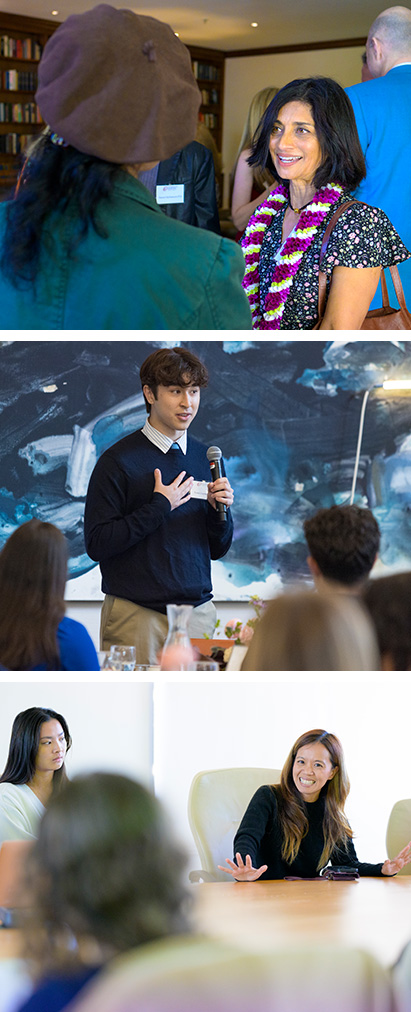
From top: Priya Junnar greeting guests at the Athenaeum, a student speaking during an Ath talk, and Stacey Doan leading a class.

Olivia Licata ’25
The Athenaeum was an extremely central part of my CMC leadership experience. As a former Ath fellow, it did so much for me. You could be sitting next to Hiram or next to a first-year student who has never been to the Ath before. It was a learning experience to figure out, “OK, what am I going to learn from the person next to me, or what can I provide to the person next to me? What cool insight do I have as a CMC student?” You always have to figure out where you fit into the puzzle, and that’s a fun adventure to go on.

Emma Goldfield ’22
Hiram reminded us—sometimes explicitly, often just by example—that ideas are meant to be engaged with, not hidden, and that disagreement can be generous. He showed our community the importance of listening, learning from peers and experiences, engaging in thoughtful intellectual exchange, and, in his words, taking on the challenges that might seem insuperable.

Priya’s presence also shaped the campus life in its own unforgettable way. Through her leadership of the Ath for over a decade, she turned dinners into conversations, and conversations into moments that stayed with us. The Ath was never just a stage, but a gathering place where ideas felt alive and accessible. Where students learned the importance of healthy discourse, and the small but essential courage of raising a hand and asking questions.

Ioannis Evrigenis
Alice Tweed Tuohy Professor of Government and Ethics

Hiram combines principle, good judgment, and a rare ability to resist doing things simply because everyone else is doing them. These qualities have served CMC very well, as most other institutions of higher education became mired in controversy and lost sight of their basic mission. Hiram’s commitment to student success is supplemented by his deep insight into what makes that happen. As a result of his efforts and attention to detail, CMC is an environment in which I learn every day, and an institution fully committed to the liberal arts, which are so necessary not only to us as individuals, but also to our society and the world.

Stacey Doan
Norwood and Frances Berger Professor of Psychology, Business, and Society

CMC has truly distinguished itself through a deep institutional commitment to the open exchange of ideas, fostering an intellectual environment where students are encouraged to engage with diverse perspectives rather than retreat from them. What I have found most compelling about Hiram is that he exemplifies the quality of comfort in the face of discomfort. In my teaching, I lean into the ethic that contrasts, conflicts, and discomforts are catalysts for development and change, and I can only do so knowing that Hiram and the College stand behind our commitment to rigorous inquiry and respectful discourse.

Aadil Mohamed ’26
To Hiram, free inquiry isn’t just about protecting speech in the abstract. Rather, it’s about cultivating a culture where difficult questions can be raised thoughtfully and handled with care.

Heather Antecol P’29
One moment that stands out for me was how the College came together through Open Academy salons when campus conversations across the U.S. felt especially fraught. Rather than avoiding hard issues—the Israel-Palestine conflict, the assassination of Charlie Kirk, or deep political disagreement—faculty, staff, and students created structured, serious, and human spaces for dialogue. Being part of those conversations showed me how CMC meets tension head on, choosing engagement over silence, and modeling what it looks like to master a moment as an academic community.

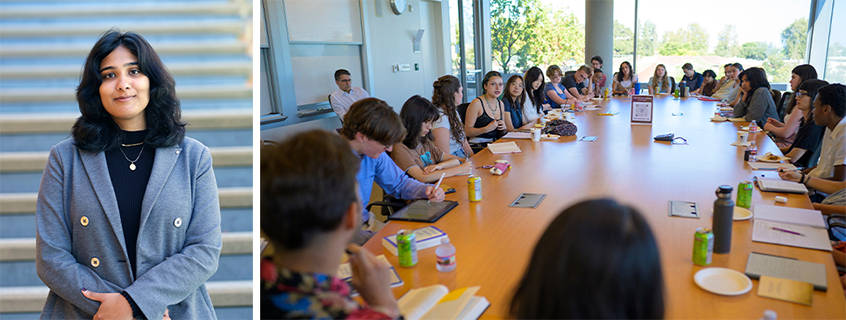
Open Academy student fellow Dhriti Jagadish ’27 (left); an Open Academy Saturday Salon.

CMC’s Answer: Opening the Academy

Humans are messy. The world, even messier—especially when difference becomes division.

But leaning into the mess with openness, curiosity, and authenticity is the college experience Dhriti Jagadish ’27 always hoped to find at CMC, even if the solutions to big societal challenges still feel out of reach to her.

Admittedly, that last part is OK with Jagadish as long as an intentional effort to understand complex problems and people is accessible through deeper learning, engagement, and constructive dialogue. Her conclusion sums up the valuable experiences she has discovered through CMC’s Open Academy, first as a student attendee of programs at the Athenaeum or Saturday Salons, and for the past two years, as a program assistant who helps plan and facilitate conversations alongside faculty advisors.

“I’ve realized through The Open Academy that building and constructing my viewpoints is a very iterative process. I can’t just stack myself into one box or another, because there are things I disagree with that aren’t aligned with the two political poles we’ve constructed for ourselves in the United States,” Jagadish said. “So, I constantly find myself through Open Academy programs and events asking, ‘What have I come away with here? And where do I want to go next?’ It becomes a very animating spark that keeps pushing you to learn more.”

A testament to its impact and reach since beginning in 2018: Earlier this year, the U.S. Department of Education awarded CMC a $2.4 million grant that will enable The Open Academy to sustain and expand its efforts locally and across the country. Awarded through a highly competitive process administered by the department’s Fund for the Improvement of Postsecondary Education—Special Projects (FIPSE-SP), the four-year grant, spanning 2026-2029, allows The Open Academy to “build on initiatives that have existed at CMC for some time, and continue to bring them together in a systematic way,” said Ioannis Evrigenis, Director of The Open Academy and Alice Tweed Tuohy Professor of Government and Ethics.

On campus, this includes programming like salons that foster intensive, small-group discussions on consequential topics; sponsored talks with leading experts at the Athenaeum; and a wealth of seminars, roundtables, reading groups, and film screenings; as well as other focused efforts like Admission essay prompts for prospective students or Orientation trainings and first-year/sophomore class dinners. Beyond campus, Department of Education grant funds will allow Open Academy efforts to be more significantly shared and modeled through stronger collaborations with external partners, including local school districts and the Institute for Citizens & Scholars, a national project focused on civic engagement and leadership skills.

“We take this award as a very strong indication that we are doing thoughtful and deliberate work in this critical area,” Evrigenis added. “We’ve always approached the principles of The Open Academy comprehensively, which is different from what you see in a lot of other institutions.”


Back to toparrow_upward

CMC MAGAZINE

|

Spring 2026

Back to Issue