


CMC Leads ascending arrow in gold.

Expanding Student Opportunities
Part Three

Expanding Student Opportunities

Allison Aldrich P’24
CMC is a place where Hiram would have been very much at home as a student. One can picture a college-aged Hiram walking on campus, learning in the classrooms, participating in the clubs, and leading initiatives. As the leader of CMC, he has been equally comfortable talking with students, staff, faculty, families, alumni, trustees, friends of the College, and other higher ed leaders. His feet have been planted firmly on the current paths of campus and just as securely in the landscape of the campus that will be here well into the future.

Donna Wengert Neff P’21
CMC Trustee

As I reflect on Hiram’s tenure at CMC, I am always impressed by his inclusive nature. He reaches out to all newcomers to set them at ease and encourages their participation within the CMC community.

Sharon Basso
Executive Vice President and Chief Operating Officer

Strategically, I think one of the things that was fundamentally important so that CMC could be a differentiator within liberal arts was building more opportunities for experiential learning. And one of the things we saw early on was, well, it’s expensive to do this—for example, to have students get paid internships. Those are not generally funded. And Hiram said, “Well, what if we could do all of that? What would it cost to build this experiential scenario?”

Ursula Diamond
Assistant Vice President for Student Opportunities

I came to campus when the Soll Center for Student Opportunity had been operating with a revised vision for about a year. And CMC’s mission—to prepare students for thoughtful and productive lives and responsible leadership in business, government, and the professions—came up often, but inside the Soll Center with an additional context of, “well, let’s truly support the mission by supporting career development for these students.” It’s such an important component on top of the amazing liberal arts education and co-curricular experience that they’re getting.

Bruce Soll ’79 P’12 P’15 P’17
CMC Trustee

When Hiram approached (me and my family) about funding what would become the Soll Center for Student Opportunity, it really resonated as a chance to drive the founding vision of CMC and put the mission and motto of the College into action: Crescit cum commercio civitas (Civilization prospers with commerce). With the passion of our Board and Hiram’s boundless energy, I knew that student opportunity would thrive.

Shaw Wagener ’81
CMC Trustee

Hiram emphasized listening carefully to what donors wanted to support. He tried to find ways to create a “win-win” for the College and the donor. As just one example, my family was inspired to create support for students who desired an experience abroad and a commitment to understanding global issues. We’re now 11 years into our Scholar Community program and have met so many wonderful CMCers that have developed a broader perspective of the world through curriculum and study abroad.
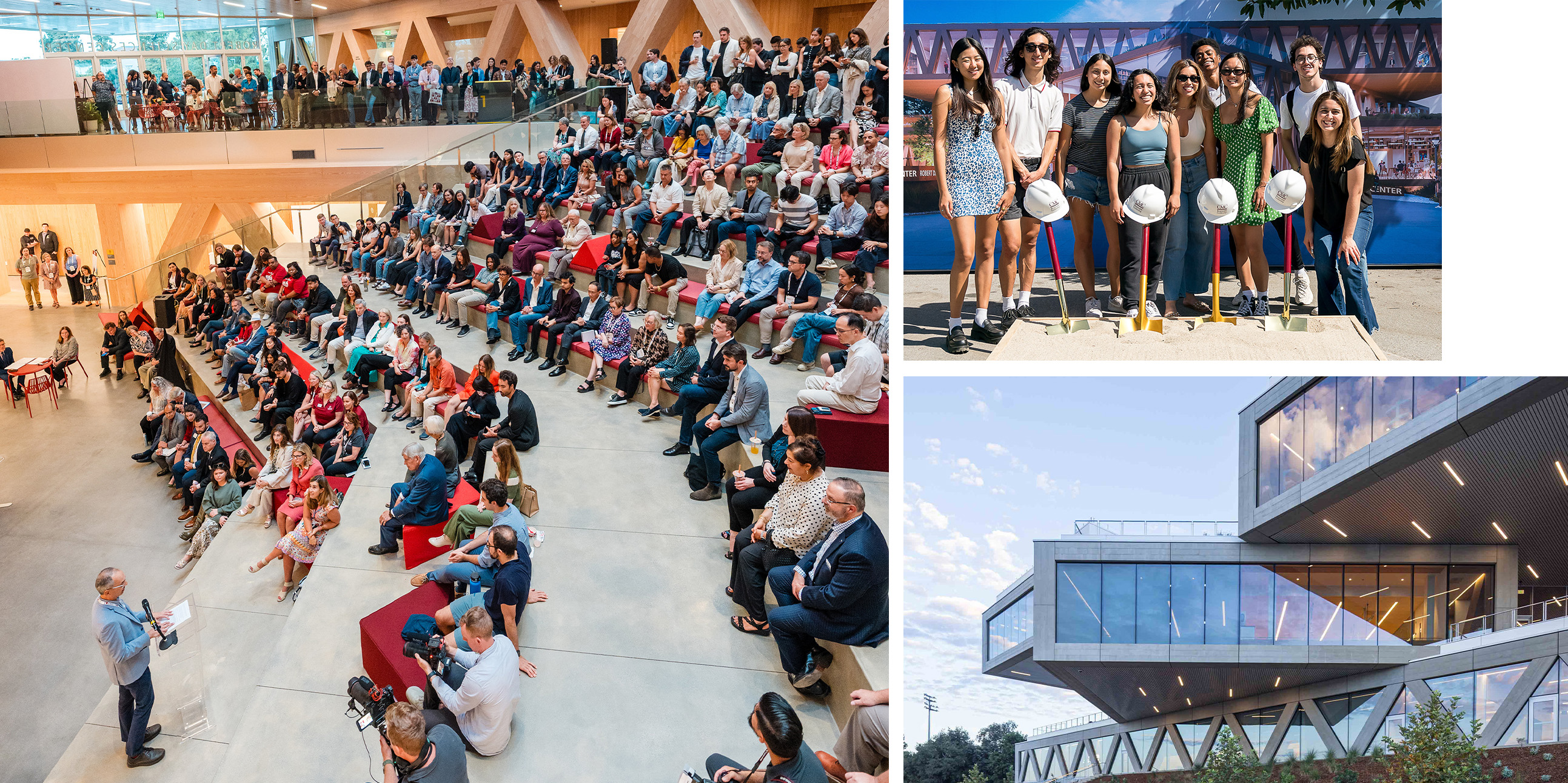
Collage of the RDSC groundbreaking and opening celebration.

Photo by Laurian Ghinitoiu

Joel Appel ’87 P’20
I wanted to follow my passion to be involved with humanities and writing at the College. Hiram said, “What if we sent students to have unique, life-changing experiences and write about them?” I said, “Done.” I didn’t even need to see the details. And supporting the Appel Fellowship (for first-year students) has turned out to be wonderful.

Mark Schwartz ’78
Experiential learning opportunities are a hallmark of the CMC undergraduate experience that help train responsible leaders to become a force for good in the world. As advisory board chair of the Randall Lewis Center for Innovation and Entrepreneurship (RLCIE), I watched Hiram secure the naming and assist in additional fundraising as the RLCIE grew into a center that engages 34% of the CMC student body, along with participation from all the other colleges in the consortium. Giving students the skills to become entrepreneurs, at some point during the arc of their professional careers, is highly valuable—especially as AI takes over more of the skills performed by college graduates. CMC is poised to become the leading entrepreneurially focused liberal arts college in the nation.

Nyree Gray
One of the things I’ve really appreciated is how CMC leadership wasn’t fearful of crisis. Because of Hiram and the strong leaders he encouraged at CMC, we just knew that if anything happened, we were going to circle up and figure it out together. It was automatic. So, that could have been the pandemic, it could have been a campus controversy, it could have been a major weather event—same rhythm. We’re going to get together in a room, identify the problem, and rely on that consistency. And that made such a difference when thinking about the potential impact on students, alumni, parents, faculty, you name it: Everybody is at the table. We all knew that nothing could be done in isolation. It’s all the same lens. We’re creating support and solutions for everyone here.

Laura Grisolano ’86
Hiram has a keen understanding of process and knows how to inspire people to be their best selves. At a time when students were being influenced by a national culture of unhealthy behaviors around alcohol, Hiram asked students to thoughtfully consider their own best interests and adopt a pledge of Personal and Social Responsibility. Through the Dean of Students office, CMC has since created a best-in-class personal development program that will serve our graduates throughout their lives. And when the consortial system limited our students’ education in the sciences, Hiram insisted we could do better. Even those of us along for the ride can’t quite believe he has delivered the revolutionary KDIS integrated sciences curriculum in one of the most magnificent academic buildings in the United States.

Esther Chung-Kim
If students are learning something in the classroom, how does it connect or integrate with what they’re learning on the sports field, at the Athenaeum, through co-curricular activities, through extracurricular activities, through the job that they have, through the internship that they do? Hiram has regularly encouraged students to integrate their learning. And I took inspiration from that. So, when students are writing the conclusion for their papers, I ask them not to repeat what they said in the first part of their paper, but to integrate what they learned: How does this relate to what you have learned elsewhere?

Mark Huber
I’m always struck by the support systems that run across the College. Whether student clubs, the writing center, dorm life, the (Murty Sunak) Quantitative and Computing Lab … CMC strives to build a place where students help one another, treat each other with respect, and work together towards common goals. Locations like the Athenaeum, Collins Dining Hall, and the aptly named Chodosh Social Stairs serve as examples of a “third place” where students can get together outside of classes and relax and meet to explore new ideas. These are always busy and make for fascinating interactions as students and faculty mingle far more than I’ve seen at other colleges and universities.

Sue Matteson King ’85 P’18
CMC Trustee

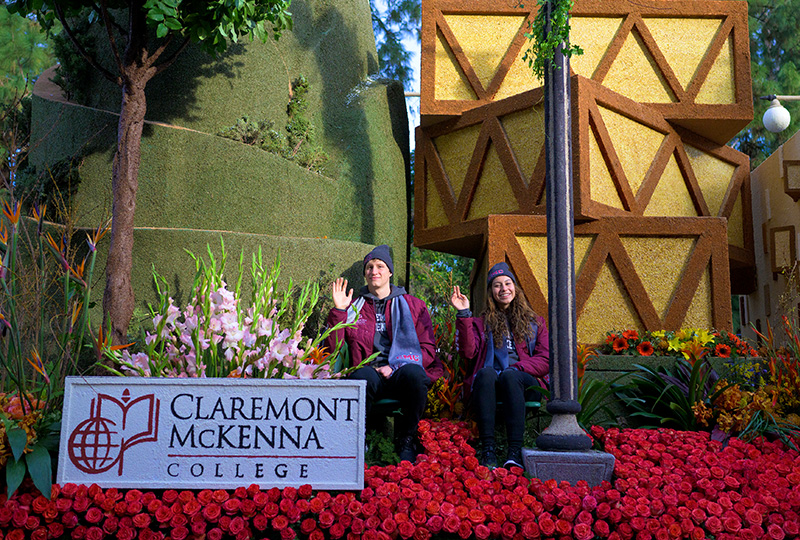
CMC is a community that comes together in support of everyone—especially its students. I was so thrilled to chair the committee for the College’s 75th Anniversary, which was an extraordinary time to be part of CMC. Hiram was highly supportive of ensuring as many members of our community were included in the celebrations, and that included the award-winning CMC float in the Rose Parade. He was engaged throughout the design, selection, and construction phase, and encouraged the team to select students to serve as riders on the float. The experience helped our current students feel immersed in the College’s history, connect to our leadership mission, and create new memories with faculty, staff, parents, and alumni across generations.

Gabe Gardner ’28
From Sponsored Internships and Experiences (SIE) funding, to accessible research opportunities, to financial aid packages that make an elite education achievable for students like me, CMC prioritizes preparation over prestige. The result is a campus where students graduate not only feeling accomplished, but they’re also confident, capable, and ready to lead.

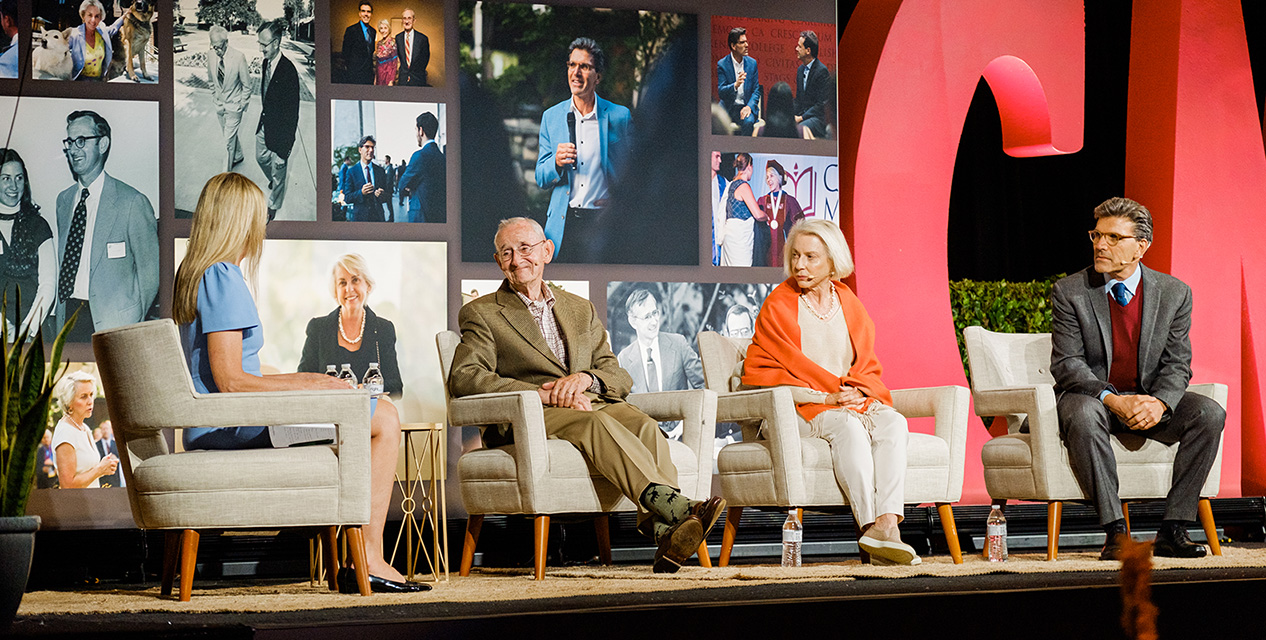
A panel of CMC's living presidents.

Building a CMC Home

President Chodosh often uses the phrase “social warmth” to describe the true essence of what it means to be part of CMC. We asked community members what the words meant to them—and why it might even be our “secret sauce.”

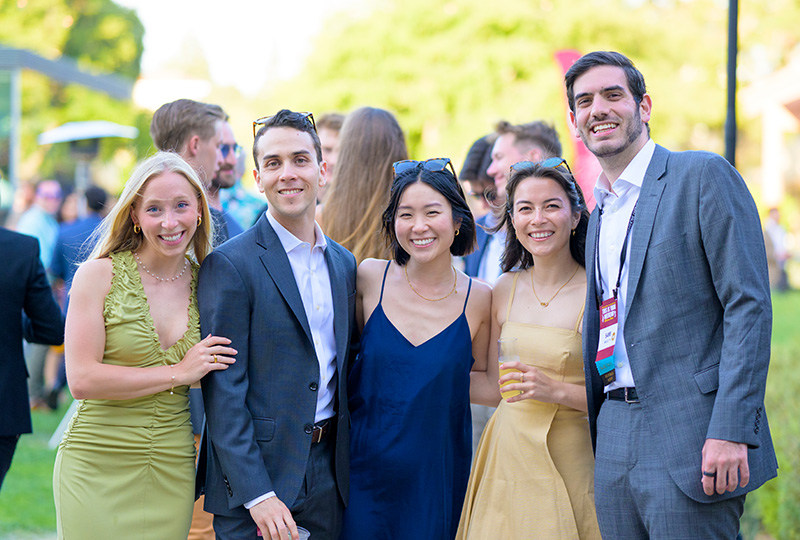
Social warmth is one of the greatest aspects of Hiram’s leadership and a defining strength of CMC. This means fostering a community where every student, faculty member, staff member, and family feels genuinely known, valued, and connected. Hiram epitomized this through his sincere, personal interest in people’s lives, creating a culture rooted in respect and belonging. Priya reflected that same warmth in her leadership at the Ath, where she greeted students and faculty each evening with such warmth and kindness, exemplifying the very best of CMC and making everyone feel truly at home.
Elyssa Elbaz ’94

I don’t think I’ve ever met a CMC student, an alum, or a faculty member that I didn’t like. They are all curious, smart, down to earth, and friendly. Introduce me to five students from the 5Cs, and I bet I can pick out the CMCer. Alumni are willing to spend time with students and to help them understand career options. Professors spend countless hours in one-on-one sessions with students. Staff stay late and arrive early to help out. That is what social warmth is all about, and Hiram and Priya epitomize it in the way they relate to those around them.
—Jeff Klein ’75 P’08 P’11 P’14

It is an overall coaching dynamic across all staff and faculty: That you can do this, we’re here to support you, and we have the resources to help. Dream big.
—Ursula Diamond

The CMC ecosystem exudes confidence, openness, collaborative energy, and respect. These qualities create a positive atmosphere of social warmth where people are cared for, listened to, and taken seriously.
—Adele English ’19

Hiram and Priya are often seen walking around campus with bright smiles, demonstrating warmth and care toward students and faculty through their actions. Their mutual interaction is impressive, with visible love and admiration in their eyes. They are deeply integrated into the fabric of CMC, and CMC is equally a part of them.
—Paul Nathan ’80

There is something about the way people extend themselves at CMC that I have not encountered in quite the same way elsewhere. Social warmth is what Hiram and Priya have modeled in their own hospitality, and what I experience from the community around me.
—Radhika Koul

It means being compassionate and caring while also being present and mindful with another person. I saw Hiram embrace a mother whose son died during his time at CMC. Hiram did not know the woman, but knew of the son and stopped everything he was doing at that moment, hugged the woman, comforted her, and expressed sincere sympathy for her loss. Nothing mattered to Hiram at that moment except being 100% present with that woman who came back to CMC to honor the memory of her son. His empathy was so genuine that it became a powerful learning experience for me. I will never forget it.
—Mark Schwartz ’78

Social warmth is the genuine connectedness among CMC students, staff, faculty, alumni, families, friends, and guests. It is felt right from the very first step one takes on campus, and it remains because of the value put on belonging and bonding. Social warmth allows freedom of expression, viewpoint diversity, and effective dialogue to take place. It facilitates the building of thoughtful and productive lives. It enables leaders to lead responsibly. Social warmth is at the core of what CMC is all about.
—Allison Aldrich P’24

Students on CMC's float for the 2023 Rose Parade.
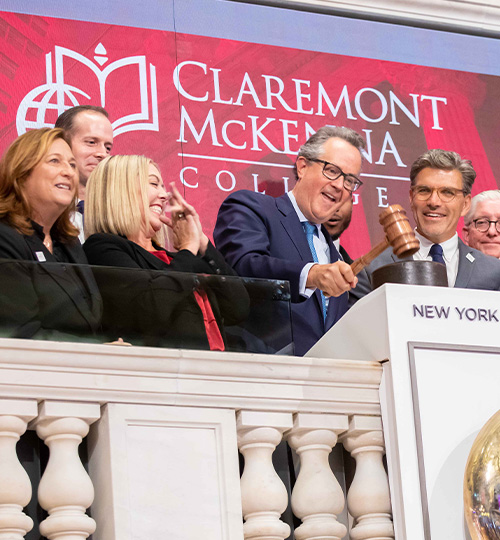
Students and members ring the New York Stock Exchange closing bell.
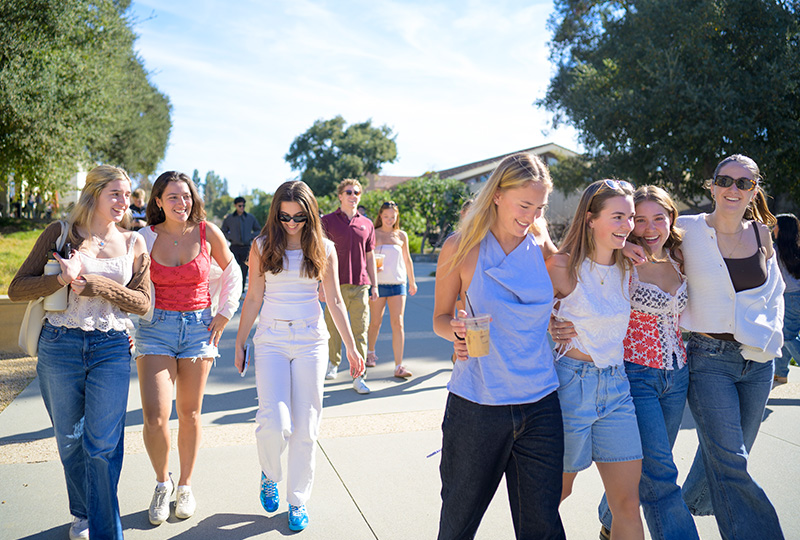
A group of students walking campus during the first day of Spring 2025.
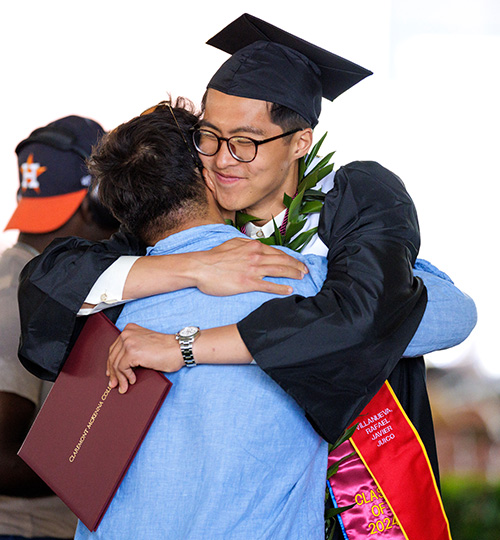
A student embraces a family member during Commencement.
Adele English ’19 (far left) and other alumni at Alumni Weekend.

Sharon Basso
Hiram has always emphasized access to opportunities. And he also cares about students talking with him and getting on his calendar. That access matters a lot. He does a lot of individual work with students and gets to know what they care about.

Jimmy Doan
Dean of Students

Joining CMC less than two years ago, I quickly learned that “student-centered” isn’t just a phrase here—it’s a daily practice. I deeply appreciate the ethos that Hiram has cultivated. There is a genuine commitment to listening to students and partnering with them to shape their experience. It’s what makes our community feel so special—and what helps every student know they truly belong.

Dianna “DT” Graves ’98
I remember Hiram asking us (in the Dean of Students office), “So, what would it look like if we were to eliminate all financial barriers for attendance at CMC?” I think my first reaction was, “What are you even saying right now?And he said, “No, seriously, I want you to do that exercise.”

Jennifer Sandoval
We were always asked to think about the full trajectory of a student. Not just from Admission, but Dean of Students, Dean of the Faculty, Advancement … Hiram called it the vertical experience, and he could see all the parts that needed to work together. To show that not everybody starts at the same place, so financial aid also means supporting parents to be able to visit during Family Weekend, for example—all of the things that the Kravis Opportunity Fund has done.

Dianna “DT” Graves ’98
So, we just started to list barriers: “Well, it’s really hard when you show up here and can’t afford sheets for the bed. Or you can’t buy a CMC sweatshirt, as that makes a big difference in your sense of belonging on campus. Or wouldn’t it be awesome if we could bring families to Family Weekend? Wouldn’t it be amazing if we could do kickoff grants so that a new student could walk in the door and have these core things? Wouldn’t it be amazing if everyone could get access to an internship?” Just throwing ideas out there. And we didn’t even realize that in the background, Hiram was working on the Kravis Opportunity Fund the whole time.

Ursula Diamond
It’s leveling the playing field right from the beginning. It’s creating a culture where first-year students understand that this funding is available if they choose to take advantage of it. And they understand that the earlier they get started, the better the results for them.

Gabe Gardner ’28
CMC took a chance on me and invested in me, and I am already thinking about how I can return that investment. I am incredibly proud to attend this College, to learn from these professors, and to do work that genuinely prepares me for the real world. CMC is a place where my aspirations become achievable because of intentional institutional support, a deeply engaged alumni network, and a culture that pushes students to grow.

Jennifer Sandoval
Whether you look at the Kravis Opportunity Fund, The Open Academy, the Soll Center, the CARE Center, building up the Kravis Department of Integrated Sciences, or the opening of the Robert Day Sciences Center … there are so many examples of student support and CMC thriving. Next, we’ll have The Roberts Campus and The Sports Bowl. Whenever I’m talking to students and their families, talking to counselors, I can be really honest in saying, “OK, I just have to make sure you understand where we are now, and then I’m going to tell you where we’re going.” Because the story just gets more and more exciting to tell every day.

A wide, aerial view of the current progress on the Sports Bowl.

Back to toparrow_upward

CMC MAGAZINE

|

Spring 2026

Back to Issue