

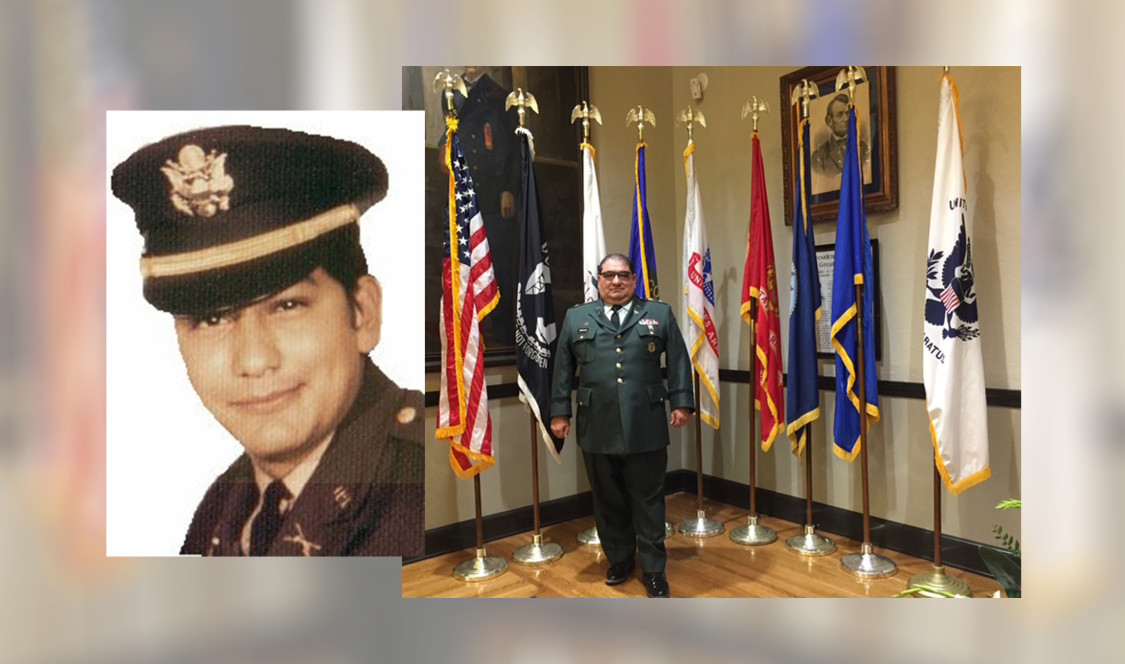
It’s Impossible. These are the words that have always motivated Jesse Gonzalez ’72. Throughout his 26-year military career he was told time and again “it’s impossible to do that.” But those words created his commitment to find a way to make the impossible possible. He never gave up hope. For Jesse, the phrase “impossible truly meant I’m (I am) possible.”
Attending CMC in 1968, during the escalation of the Vietnam War, Jesse’s draft board suddenly selected his number and set his military career in motion. Wishing to continue his education, Jesse attempted to join the two-year ROTC program. The program accepted his application with skepticism. He was told by the ROTC Department that “it was highly unlikely and almost impossible that he would be accepted into a two-year program during war time. No one had ever been able to enroll in the two-year program.” But Jesse did not give up hope. He remembered his favorite phrase: “impossible truly means “I’m (I am) possible.”
To everyone’s surprise, Jesse miraculously obtained conditional permission to enroll in CMC’s two-year ROTC program. Conditional entry required him to pass the Military Science I Course at Fort Knox, Kentucky that summer. The ROTC staff reminded him that passing the course “seemed impossible” because of his lack of military knowledge and prior experience in the program. Determined to pass against all odds, Jesse faced each of the course challenges with confidence and passed when many others had failed and returned to CMC as a third year ROTC cadet.
Transition to the regular ROTC program at CMC also turned out to be another “impossible” challenge. Because he had not participated in the first two years of the program, he was given the lowest rank of Cadet Private. But Jesse worked hard to excel and even volunteered to join the ROTC recruiting team. Recruiting prospective ROTC cadets in 1969 posed a tremendous challenge. No one wanted to join ROTC because the Vietnam War was at its height. Somehow Jesse managed to enroll students and accomplish his mission.
At the end of the junior academic year, each cadet was sent to summer camp for training at Fort Lewis, Washington. There were rigorous physical and academic challenges. Applying himself again, Jesse passed with the high honors and received the RECONDO Badge. Few cadets received this prestigious national award. Even with this recognition Jesse remained at the rank of Cadet Private.
When commissioned as a Second Lieutenant in 1972, he received an assignment to the Infantry Branch of the Army. At the time, this assignment typically came with a fast-track trip to the jungles of Vietnam and a potentially hazardous duty assignment. He applied to Claremont Graduate School (CGS) requesting a deferment from active duty. The CGS Admissions Department said that he failed to meet their academic standards as he was one credit short of graduation from CMC. Determined to be accepted, Jesse turned for help to the President of CMC, Jack Stark. He explained he had been enrolled at CMC as a Special Direct Studies (PSDS) student. This was a five-year program that he had completed in four. He petitioned the CMC Board proposing that the leadership and academic experience he had achieved passing the Military Science I Course at Ft. Knox should qualify him for a one course credit. His petition was approved, and he graduated with his peers and was admitted to CGS with a deferment delay of his active-duty assignment.
While in graduate school Jesse applied for a transfer to the Medical Service Corps (MSC) from the Infantry. The Army granted the transfer after a review of his published thesis about Folklore Medicine. In 1974, he received a Master of Arts in Education and applied for teaching jobs in many school districts in the area. His CGS Advisor told him it was impossible for him to get a paid teaching position without a teaching credential. Once again, Jesse faced the impossible. He had no money, was unemployed, and was living in a shack. He applied for an internship position through CGS and against all odds, without a teaching credential was selected for a paid teaching position. The tenacity acquired from his many military challenges paid off. For the next forty years Jesse taught various grades and classes.
At the end of his first term of teaching Jesse received orders to report to the Academy of Health Science (AHS), Fort Sam Houston, Texas, to attend MSC Officer Basic Training. A commission in the Army Reserves required a six-year commitment. So simultaneously while continuing to teach, Jesse sought to complete his MSC assignment with a local reserve hospital. His first attempt met with failure. The commander of the 349th Hospital, in Bell, California, said, “Son, we don’t hire your kind.” Fellow reservists informed him that trying to obtain a reserve officer’s assignment in California being of Mexican descent, plus being a “newbie-butter bar” was an impossibility.
Jesse used the knowledge and experience from Officer Basic Training to find an appointment. He walked in cold to the 916th Field Depot that was a Logistics Command and presented his case. He was hired on condition that he must solve the impossible task of organizing all the materials in an old supply warehouse located at Los Alamitos Naval Air Station and do so according to Army regulations. After breaking up a theft operation he discovered at the warehouse and doing such an excellent job of organizing the warehouse, the command transferred him to their subordinate unit, the 693rd Supply and Logistics Company, to bring that unit into compliance. Jesse became the unit’s Property Book Officer, accountable for all the unit’s equipment. He was also appointed as the motor pool officer, a task that had the reputation of always ending in failure, relief of duty, and reassignment back to inactive Army Reserves. This he knew was a real career stopper. But Jesse again persevered and successfully managed the work.

His promotion to First Lieutenant ended his assignment to the 693d. Once again, he faced the impossible task of finding a new reserve assignment. His diligence, organizational ability, success at bringing units into compliance, and managing the complex job of Property Book Officer caught the attention of the 309th Army Security Agency (ASA) - Military Intelligence (MI) Battalion. They offered him a position if he could meet the obligations and standards of an Intelligence Officer. Jesse passed an intensive background check and qualified for a Top-Secret Security Clearance. He took immense pride in his accomplishment and having the attitude of: “I’m going to do the impossible.”
Jesse’s next stop was the 176 Medical Group in the S3 Shop (Operations). This was the training section of the unit and carried with it a promotion to Captain. He tackled his next impossible task which was to arrange for the allocation of funds so that medical professionals in the command could attend advanced training opportunities and schools. Before Jesse took ownership of the job, these opportunities were nonexistent to west coast medical officers and NCOs. He reached out to the US Army Medical Command and learned there had been no previous petitions for funds for medical specialty training classes. His solution was to survey the medical units for their needs to attend medical training. The survey results provided documentation for funds requests and school assignments for the entire command. He personally benefited by completing the Medical Service Corps Advance Course at Fort Sam Houston. Completion of this course made Jesse eligible for promotion to Major and admission to Command General and Staff College (CGSC). Another perceived impossible task was completed! However, with no slot available at his current assignment for a Major, Jesse began a new search for an assignment.
This time he landed at the 311th Corps Support Command (COSCOM). Fellow reserve officers advised him not to waste his time or energy on the impossible chance of being selected for an assignment to the 311th, but Jesse knew that his experience with general logistics, medical logistics, advanced electronic warfare training, his security investigation skills, intelligence knowledge, together with a TOP SECRET security clearance made him a perfect fit for the Lieutenant Colonel position in the Materials Section. Once again, his persistence, perseverance and acquired skills helped him achieve the impossible! After promotion to Major, he took on a Colonel’s assignment as Assistant Chief of Staff (ACS) of the Materials Section.
Jesse always aspired to achieve field grade rank, but command informed him that while he demonstrated the skills and was on track to be promoted first to Lieutenant Colonel and then to Colonel regulations required that he could only be promoted while serving as a MSC officer. This news was devastating to his career plan and finding a Major’s assignment within a medical unit seemed impossible.
The USAR Command Center learned of his success at the 311th COSCOM and was finally able to find a Major’s position at a hospital in his Military Occupational Specialty (MOS). In time, he took over command of the Headquarters and Headquarters Company of the 349th General Hospital, graduated from Command and General Staff College, was promoted to Lieutenant Colonel and achieved his career goal. In this position, Jesse managed the medical physicals and documentation for soldiers being deployed to Operations Desert Shield and Desert Storm. At the conclusion of the Gulf War his position came to its conclusion, and he was about to be transferred to the inactive reserves. This would end his search to find an opportunity for promotion to Colonel within the Area Reserve Command (ARCOM).
Resigned to the fact that he had finally met the ultimate impossible challenge, Jesse prepared for retirement. Moments before transferring to the inactive reserves, he received a game changing phone call. The Commander of the 113th Medical Company wanted to confirm he had received a Bachelor of Arts (BA) in Psychology. Jesse assured the commander he had and found he was to be reassigned to the position of Efficiency Report Evaluation and Reviewing Officer. His new assignment resulted in the delivery of outstanding performance evaluations for Officers and Non-Commissioned Officers (NCOs) to higher headquarters and increased promotions among qualified personnel. The commander of Jesse’s unit stated, “I have never witnessed this level of success in my entire military career.”
Jesse had accomplished what every commander believed to be an unattainable achievement in the Army Reserves. Continuing in this position until his retirement after twenty-six years of service in the Army Jesse received a Meritorious Service Medal for all his many years of service and dedication to the United States Army.
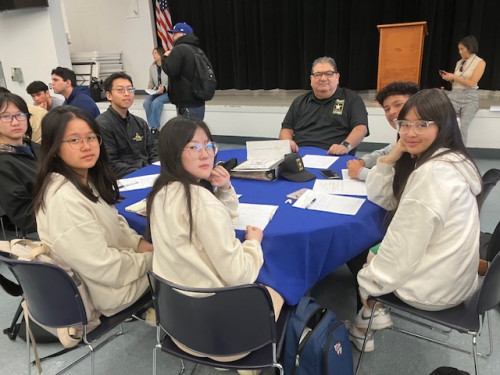
Achieving the impossible has made Jesse’s life a journey of rewarding experiences both in and out of military service. But after retirement Jesse was still not finished with his service to the armed forces and in 2015 he started a non-profit Organization called the “Military Armed Forces Offering Life Collaboration (MAFOLC).” The mission statement for the new organization was to “Strive to give dignity to those that served and those who support military personnel.” From personal experience, Jesse witnessed many veterans from all backgrounds who were in dire need and without access to the resources required to meet life’s daily challenges. Reaching out to local organizations for donations, support, and participation, he adopted a personal mission to assist veterans that were homeless or in need. Today, throughout the greater Los Angeles area, Jesse’s organization provides resources such as food, housing support, arranging for medical care, and guidance to proper channels for those in need of more complex services.
Jesse cites the following Life Lesson Learned as his personal mantra: “Impossible for me is making the impossible possible. For me it has meant ‘I’m (I am) possible.’”