
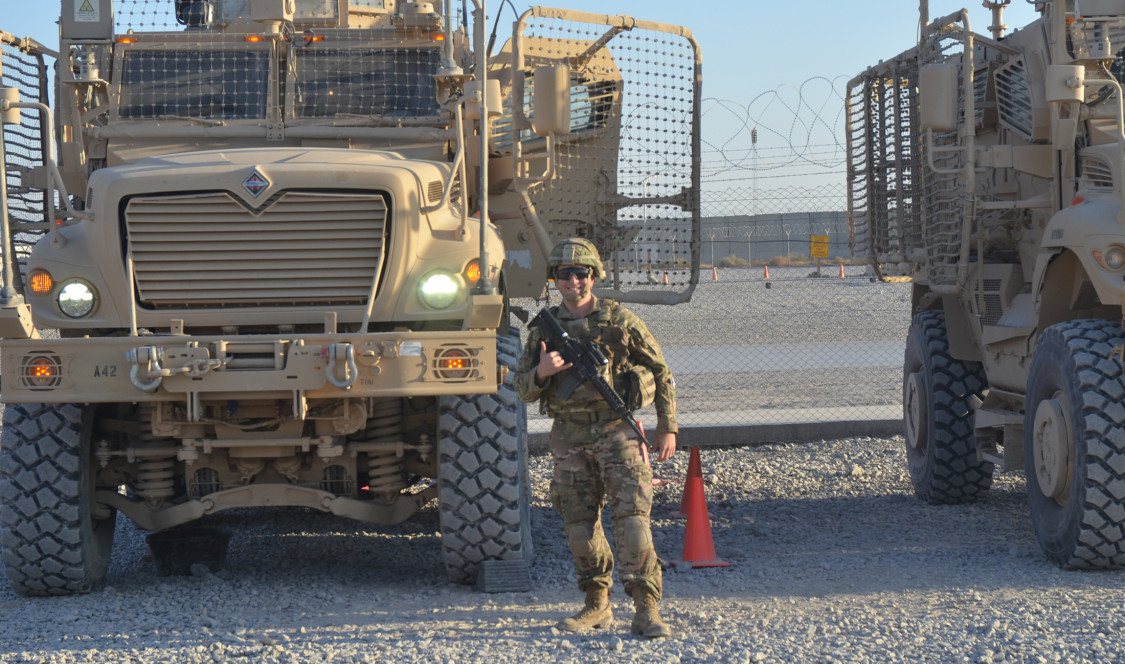
John Marshall ’16 appreciated variety in his military career. He chose the Engineering branch because it afforded him the opportunity to experience a wide variety of challenges in different areas and under different circumstances. John learned the value of being able to establish relationships and have meaningful conversations with many types of people from different backgrounds. He cherished the opportunity to provide advice and counsel about areas where he was knowledgeable. John loved adventure, jumping out of airplanes, facing danger, and being a leader.
John Marshall ’16 grew up in Southern California and in high school, he knew he wanted to attend college and be a leader in the military. He was accepted at CMC, but finances were an obstacle. He began planning to attend less expensive institutions when good fortune shown upon him; another admitted student gave up his ROTC scholarship and John was next in line to receive it.
He was a natural fit in the ROTC program and in his senior year became the Cadet Battalion Executive Officer. This responsibility allowed him to appreciate the planning and preparation that went into the ROTC training program; skills that served him well in the rest of his military and civilian careers. John was enamored by the Engineer branch because of the wide variety of job opportunities: construction, building bridges, roads, demolitions, water crossings and advising senior leaders. He was chosen as the “Outstanding Cadet of the Year” and was presented with a souvenir saber.
There was a wait of six months before he was ordered to active duty and John used this time to work for a political candidate running for the State Senate. He went door to door opening conversations with people, another skill set that stuck with him throughout his careers. Finally in January 2017, he received orders to attend the Engineering Officers Basic Course at Ft. Leonard Wood, Missouri (AKA Ft. Lost In the Woods). This was a big trip for John as he had not ventured out of Southern California very often. In his first week he experienced a horrific storm that left everything covered with two inches of ice. “I’m not in California anymore,” he thought to himself.
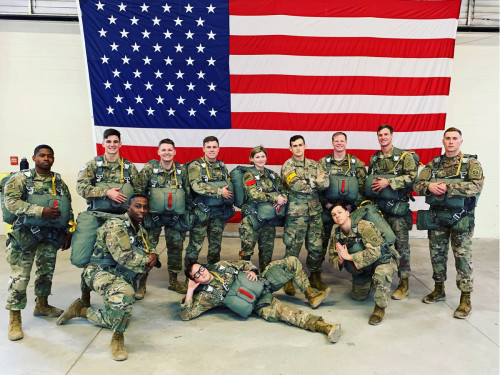
John enjoyed the variety of training and got little taste for everything: learning about concrete, construction, mobile bridges, building roads, mines, and explosives. He volunteered for combat engineers and became mixed martial arts certified in the Modern Army Combatives Program. In the spring of 2017, he received his first choice of duty assignment to the famed 82nd Airborne Division. Soon thereafter he found himself at Ft. Benning, Georgia undergoing the three week Jump School Course (Paratrooper). Then it was off to Ft. Bragg, North Carolina arriving two weeks after the 1st Brigade had deployed to Afghanistan. Assigned to the rear detachment for two months, he was suddenly told he would be on the next plane to Kandahar.
Arriving in Afghanistan he was assigned as a liaison officer to support of the NATO partners participating as allies to the American forces, which included Bulgarian and Romanian battalions. John’s job was to be in charge of maintenance, supply, and making sure these soldiers were issued the proper heavy weapons, gear, and equipment: radios, vehicles, night vision devices and battle gear. He spent time ensuring the vehicles and equipment were prepared to operate under combat conditions, including response to the threat of “vehicle born improvised explosive devices” (VBIED). Most of his time was spent around the Kandahar airfield, but he did go out on a handfull of combat patrols. A highlight of his tour was to be invited to participate in Christmas celebrations with his Romanian partners when they had native dishes flown in for the special occasion.
After a six-month deployment, John returned to Ft. Bragg and was assigned as a Route Clearance Platoon Leader using specialized Armored Personnel Carriers called “MRAPS” and “Huskies” equipped with sophisticated mine detection scanners. With 30 soldiers assigned to his responsibility, the heavy vehicles were not air transportable and subsequently were of little use in airborne operations. Consequently, his platoon was given an ad-hoc designation as an Engineering Reconnaissance Platoon and attached to 3rd Squadron, 73rd Cavalry Regiment. His mission became bridge evaluation for tank crossings, identification of water crossings for heavy vehicle deployment, creating and removing mine fields and planning for use of explosives. He became a trusted advisor to his Battalion Commander. John comments that, “It was a tremendous learning experience and fortunately I had some great NCOs who had lots of experience and helped me perform well. I’m still in touch with several of them.”
John’s leadership skills crystallized during this period as he addressed new problems. He learned to plan, prepare, and achieve so that the people under him could perform and succeed. In one case he had a young soldier who threatened suicide. As the soldiers under his care looked for his guidance, John took immediate steps to resolve the situation. He kept the soldier talking on the phone. He brought other resources into the situation to help solve the problem: the military police and chaplain were dispatched, and his Commanding Officer was informed. Fortunately, the situation was resolved safely and after a few days in the hospital the soldier was returned to duty.
John also learned the importance of thorough planning. When preparing for a live fire machinegun exercise his commander asked him if he had remembered to bring the machine gun tripods. “Do they need tripods?” he asked, revealing his ignorance of the exercise requirements. From the verbal tongue lashing that followed, John quickly learned that “if you were going to ask someone to do a job, you need to know how to do it yourself.”
On another night field exercise, John thought he had planned all aspects thoroughly. His driver made a wrong turn and ran the vehicle into a ditch. John was stuck 10 miles from base in deep mud and had failed to bring a recovery vehicle along with the convoy. Sheepishly, he called for rescue and was finally pulled out several hours later. This time he learned to always plan for all contingencies.
John loved being a paratrooper. He looked forward to every jump and volunteered for Jumpmaster School. He learned how to inspect parachutes and prepare the soldiers to jump from various types of aircraft. He made 15 day and 10 night jumps during his tour of duty and has continued to skydive after leaving the service. But in 2020 after 3.5 years of active duty he decided he would like to go back to school. His last 18 months in the Army were spent at a recruiting office in Suffolk County, New York. John says that he was “shocked at the lack of interest 17 to 25 year olds had in the military opportunities he offered. These people were content in their lives – no one wanted to volunteer.”
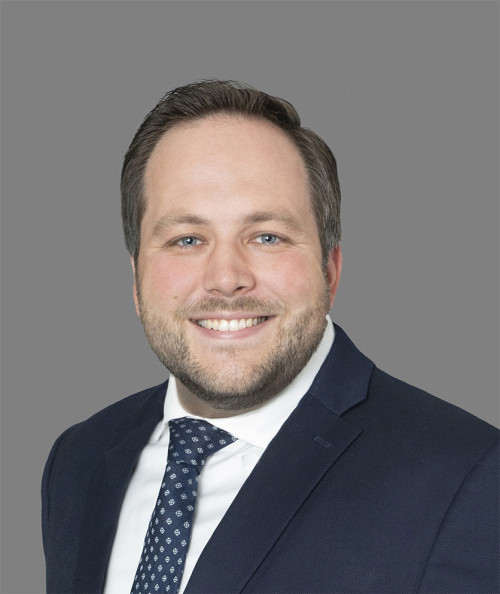
In 2022 he was mustered out of the service and was fortunate to earn a Fertitta Family Scholarship to attend New York University’s MBA Program. This became a wonderful transition from the military to civilian life with the introduction of numerous internship opportunities presented to him. During his second year, John attended a veteran recruiting conference in Atlanta and landed a full-time role with Alvarez & Marsal, a restructuring and turnaround consulting firm. They appreciated the real-world leadership and planning experience that veterans bring to the table, and their familiarity with the stress that comes with solving complex problems. John enjoys his role as a trusted advisor, helping companies to resolve difficult liquidity and operational problems and assisting executives in developing organizations that solve their own problems.
He worked on two significant projects from 2024-2025. The first was helping an auto parts company close 500 stores and do so while maximizing returns and minimizing the effects of store closure on the remaining business operations. The second was helping a real estate company that built affordable housing to evaluate future liquidity needs and identify opportunities for reorganization. These consulting jobs helped John learn to solve problems, resolve friction, keep executives informed when tackling big problems and be a trusted advisor…all similar experiences to what he had encountered in the Army.
John has suggested the following Life Lessons Learned he picked up from his various roles as an advisor in the Army and in civilian life:
- Value your liberal arts education. You meet a wide variety of people in the Army and civilian life. Your education allows you to find something in common with everyone.
- Attack the problem not the person. If there is a problem, don’t shoot the messenger. Sit down, discuss and create a plan to resolve it and avoid it in the future.
- Be where the action is. Take the initiative and insert yourself at the point of decision making. Come to your boss with a solution not a problem. This sets you apart.