
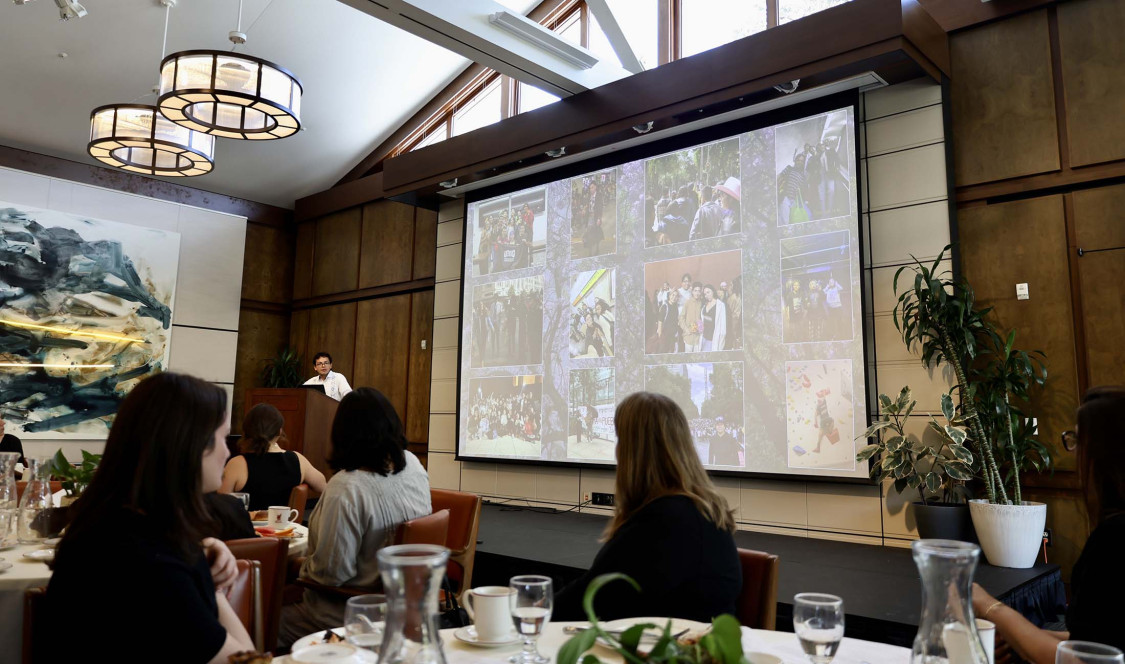
Familiar faces returned to campus to join current students and faculty at this year’s Elbaz Family Post-Graduate Fellowship presentation.
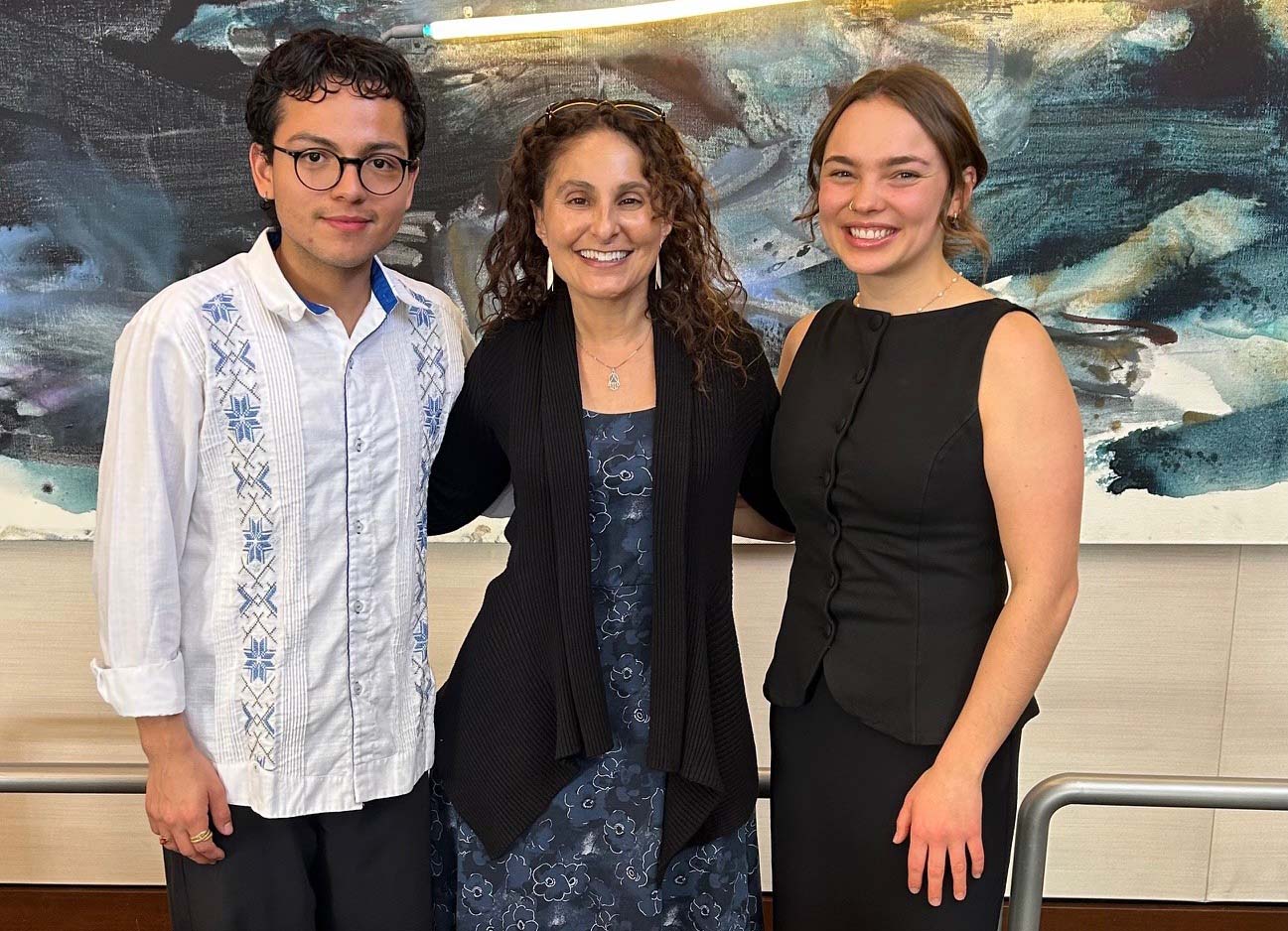
CMC alumni and Elbaz Fellows José Chiquito ’24 and Riley Green ’24 took part in a celebration held in the Marian Miner Cook Athenaeum on Feb. 6, which highlighted their accomplishments and offered a glimpse into what lies ahead.
The Elbaz Family Post-Graduate Fellowships are awarded to graduating CMC seniors interested in pursuing careers in human rights. Since its founding in 2018, the fellowship has supported 15 CMCers.
The Elbaz Fellowship is funded by the Elbaz Family Foundation, which is managed by CMC Trustee Elyssa Elbaz ’94, who attended the event. The fellowship is offered in collaboration with the Mgrublian Center for Human Rights, which provides students with hands-on experience in addressing global human rights issues through research fellowships, academic programs, internships, and engagement with leading experts.
The fellowship is awarded for one year following graduation during which the recipient receives funding for a position within a major human rights organization (to be identified by the fellow or through partnerships maintained by the Mgrublian Center).
Upon conclusion of the fellowship, each Elbaz Fellow returns to CMC to present a public lecture. Chiquito presented first, reflecting on his work with Sin Fronteras, a civil society organization that provides free legal and psychosocial services to migrants settling in Mexico City. What began as administrative support soon evolved into more direct advocacy, as he eventually led consultations with migrants under the supervision of attorneys.
His work was deeply shaped by his personal background. Born in Wyoming and raised in part in Mexico, Chiquito spoke about personal experiences that helped inform both his professional interests and his commitment to migration justice.
“I was really interested in seeing what migration policy looked like in a non-U.S. context,” Chiquito said. “I wanted to understand how migration shows up in classrooms, on the streets, and in policy circles. Thanks to the Elbaz family and the Mgrublian Center, I was able to explore those questions and live that experience in Mexico City.”
Looking ahead, Chiquito, who majored in International Relations, will remain committed to human rights work and is actively exploring new paths forward. He has applied to graduate schools and continues to stay connected to transnational social justice networks, carrying the lessons and relationships from his time in Mexico City into the next stage of his career.
Speaking next was Green, who reflected on her experience working for The Sentry in Washington, D.C., an investigative and policy organization dedicated to disrupting multinational networks that profit from violent conflict, repression, and kleptocracy. Her work placed her at the intersection of human rights and global accountability, offering a behind-the-scenes look at how financial systems can fuel, or prevent, abuse.
Green, who majored in International Relations and History, now works with the Association of Certified Anti-Money Laundering Specialists (ACAMS), the world’s largest global body of professionals combating financial crime. In her role, she helps coordinate and design ACAMS’ research agenda alongside its thought leadership team and serves as secretary for the International Task Force, which focuses on anti-fraud initiatives and emerging technologies.
Through the Elbaz Family Post-Graduate Fellowship, Green said she was able to broaden her understanding of what a career in human rights can look like beyond traditional advocacy organizations and into spaces where financial accountability plays a critical role.
“When I was sitting in these chairs as an undergraduate, I really had one idea of what a career in human rights would look like,” Green told the Ath audience. “What I’ve come to see is that there are so many opportunities beyond traditional human rights organizations, in fields like anti-financial crime. At the end of the day, we’re protecting people’s fundamental human rights.”
By sharing both their challenges and successes, Chiquito and Green offered current students a candid look at life after CMC and the many paths a human rights career can take. Their reflections emphasized the fellowship’s role in empowering graduates to pursue meaningful work across borders, disciplines, and sectors, wherever the pursuit of justice may lead.