
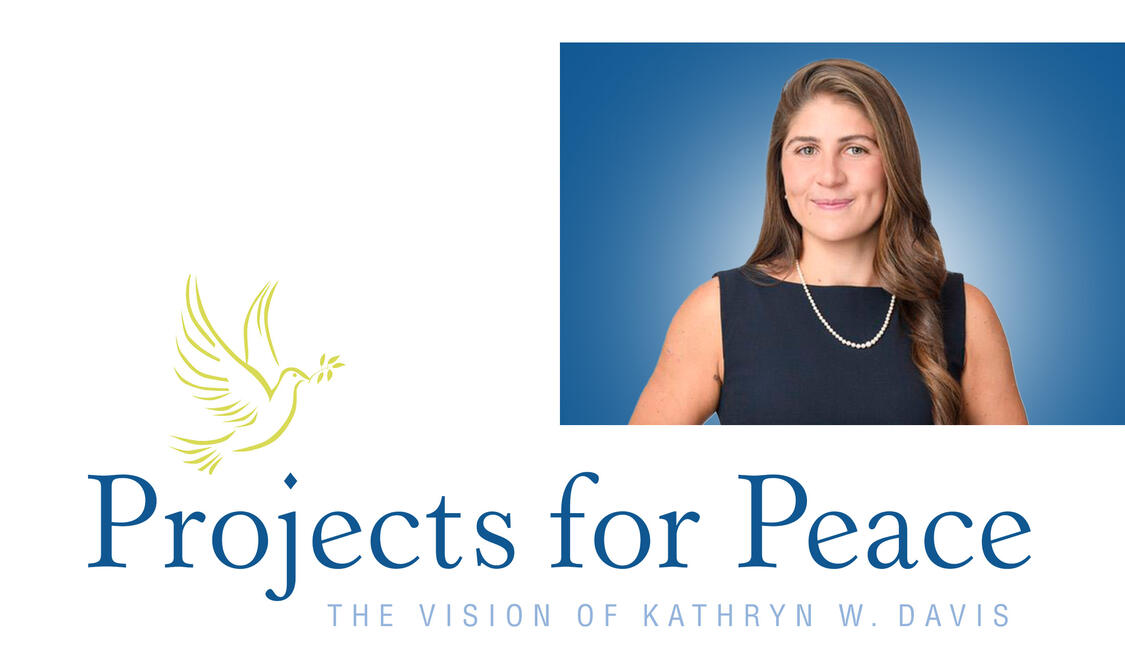
Anoush Baghdassarian ’17 will be written into CMC history as the first graduate to earn the Projects for Peace Alumni Award. The 2026 honoree, Baghdassarian is the fourth awardee since the program’s 2023 inception at the Kathryn Wasserman Davis Collaborative in Conflict Transformation at Middlebury College.
“It was a fantastic surprise and such a special moment. I had no words,” said Baghdassarian, a human rights lawyer and litigation associate with Boies Schiller Flexner LLP in New York.
The award provides $50,000 for past Projects for Peace grantees whose original projects as undergraduates have continued to expand in scope, deepen in community partnership, and offer new pathways for transforming conflict.
As a CMC senior studying Psychology and Spanish and completing a sequence in Human Rights, Genocide, and Holocaust Studies, Baghdassarian received a 2017 Projects for Peace grant for “Restorative Memory: Eternalizing and Empowering Narratives of Syrian-Armenian Refugees.”
The project took Baghdassarian and her collaborator, Ani Schug POM ’17, to Armenia where they interviewed Syrian-Armenians who had resettled in Armenia during the Syrian conflict. They recorded 80 stories but were quickly inspired to create a publicly accessible digital archive for further research, justice, and preservation efforts.
“We have to find a way to allow anybody who wants to tell their story to tell it, because there’s something cathartic and powerful in that sharing,” said Baghdassarian. “Justice exists even in just allowing someone a space and a platform to tell their story.”
The dream of expansion became the reality of Rerooted, a nonprofit centered on the idea that no matter how many times Armenians have been rerouted by conflict, they have persevered and resettled (or “rerooted”) in strong communities. Through Rerooted, Baghdassarian has led efforts to capture more than 500 testimonies of Armenians, with team members—including interns from CMC—conducting interviews worldwide.
With only a fraction of the 500 stories translated, transcribed, and published on the Rerooted website, Baghdassarian plans to use Project for Peace funds to tackle the backlog and “bring the resources to life.” This includes her vision to curate an interactive exhibit that would rotate among museums around the globe.
Baghdassarian first listened to—and shared—the stories of Armenian people in her youth. Growing up in an Armenian family in New York, she regularly visited an Armenian senior home as a curious, impassioned middle school student.
“I would just go and spend time with the residents, asking them questions about their lives and listening to their stories, to their memories of the Armenian Genocide,” said Baghdassarian, adding that “every year since sixth grade” she asked her history and social studies teachers, “Can I please present about the genocide?”
Baghdassarian also recalls attending annual commemorations on Armenian Genocide Remembrance Day—April 24—which honors victims of the 1915 massacre of more than 1.5 million Armenians. Witnessing genocide deniers host their own assembly “literally on the block next to us” became a defining moment for Baghdassarian, one that led her to dedicate her academic and professional life to seeking “accountability for atrocity crimes.”
“It was so striking, that open wound, that pain of denial, of people acting like it never happened, and I wanted to help heal it,” said Baghdassarian, who earned a J.D. at Harvard Law School and a master’s degree in human rights studies at Columbia University. She has also litigated criminal and civil cases of atrocity crimes and terrorism in the U.S. and internationally.
Baghdassarian’s CMC experience helped crystallize and actualize her ambitions in ways that remain meaningful to her. She recounted a week-one conversation with Kirsti Zitar ’97 P’26, then a staff member in CMC’s Mgrublian Center for Human Rights, that evolved into staging “Found,” a “play based on hope” she wrote in high school about the Armenian Genocide. It was presented at CMC’s Athenaeum in spring of her first year and, later, at Pomona College.
Many opportunities followed, including leadership roles with the Mgrublian Center and the Keck Center for International and Strategic Studies, as well as historically annotating the memoir of CMC Professor Emeritus Roderic Camp’s grandfather, Surviving the Forgotten Genocide, An Armenian Memoir, and co-writing the introduction with Wendy Lower, John K. Roth Professor of History and George R. Roberts Fellow.
“The consistent trust and responsibility I was given at CMC shaped my trajectory in a very real way. I was presented with opportunities I didn’t even seek out, and every idea I wanted to bring to life, they helped me do it,” she said.
Gratitude for CMC’s impact on her life and career has compelled Baghdassarian to stay involved, from returning to the Athenaeum as a speaker—in 2018 and 2021, with plans to return this fall—to serving on the Mgrublian Center Advisory Board.
“What an amazing honor to be part of an institution that shaped me so much.”