

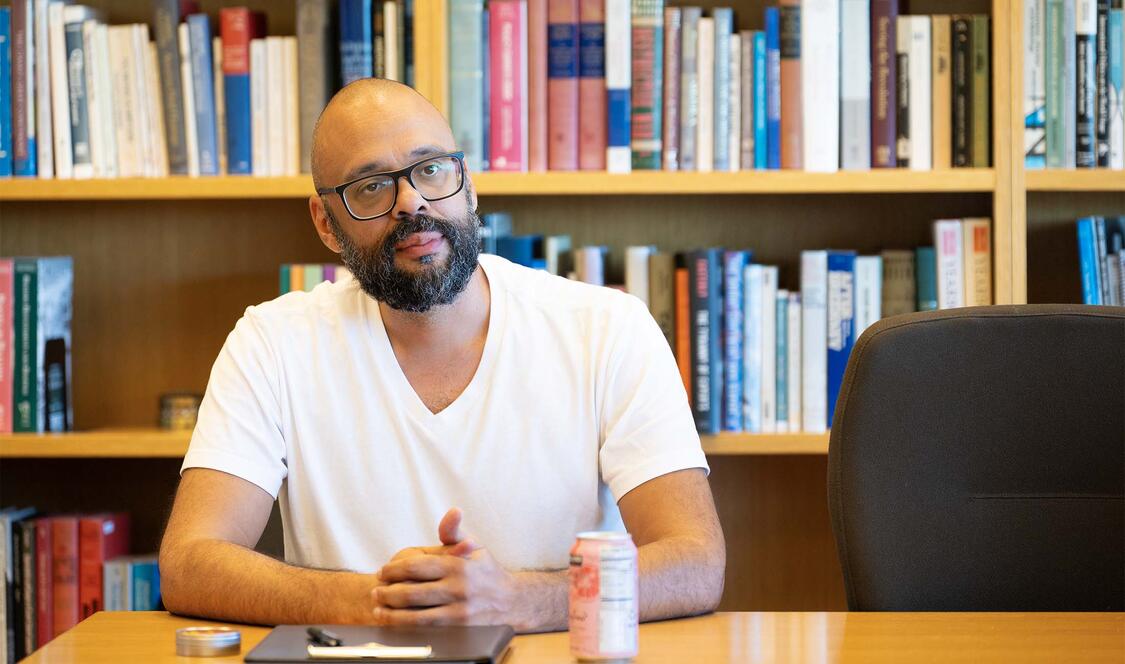
In a compelling display of constructive dialogue and thoughtful engagement, CMC students, faculty, and community members packed the Athenaeum on Sept. 30 for a conversation between Musa al-Gharbi, author of We Have Never Been Woke: The Cultural Contradictions of a New Elite, and Government Professor Jon Shields. Co-sponsored by The Open Academy, Salvatori Center, and Dreier Roundtable, the event invited attendees to engage with challenging ideas and perspectives through open, substantive conversation.
Currently an Assistant Professor in the School of Communication and Journalism at Stony Brook University and a columnist for The Guardian, al-Gharbi explained how controversies following some of his published articles prompted him to reconsider the way he communicated his ideas.
.jpg)
What changed was not necessarily what he wanted to say, but how he said it. During a period away from academia, al-Gharbi began pitching his liberal-leaning work to conservative publications. Writing for audiences he expected might disagree with him pushed him to examine assumptions he had previously taken for granted, explain arguments he once considered self-evident, and engage more seriously with opposing viewpoints.
When Elijah Williams ’30 asked how to successfully put that reframing into practice, al-Gharbi emphasized that reaching people with different perspectives required more than extensive research. It also meant reconsidering how he approached the people he hoped to persuade.
“It’s really important to extend moral and intellectual charity to the people that you disagree with. This is maybe the most important thing. So, you have to start by assuming the people you’re trying to persuade are reasonable people, are decent people, and are worth reaching out to in the first place,” said al-Gharbi.
That approach, while difficult on politically and emotionally charged topics, opened the door to conversations al-Gharbi had not expected. He found many conservatives eager to engage with someone who approached their views with genuine curiosity, rather than treating the exchange as a competition or an opportunity to steer them toward a predetermined conclusion.
For al-Gharbi, the impact of that approach has extended beyond better conversations. He described how his efforts to understand and persuade different audiences have allowed his work to reach into policymaking, pointing to an instance when the Chairman of the Joint Chiefs of Staff, the nation’s highest-ranking military officer, cited his research while considering U.S. policy toward intervention in Syria.
“I’ve actually helped move the meter on policy issues as a result of trying to persuade people, and this wouldn’t have been possible if I had been continuing to just preach the fire and publish things that were really satisfying for me to publish,” said al-Gharbi.