

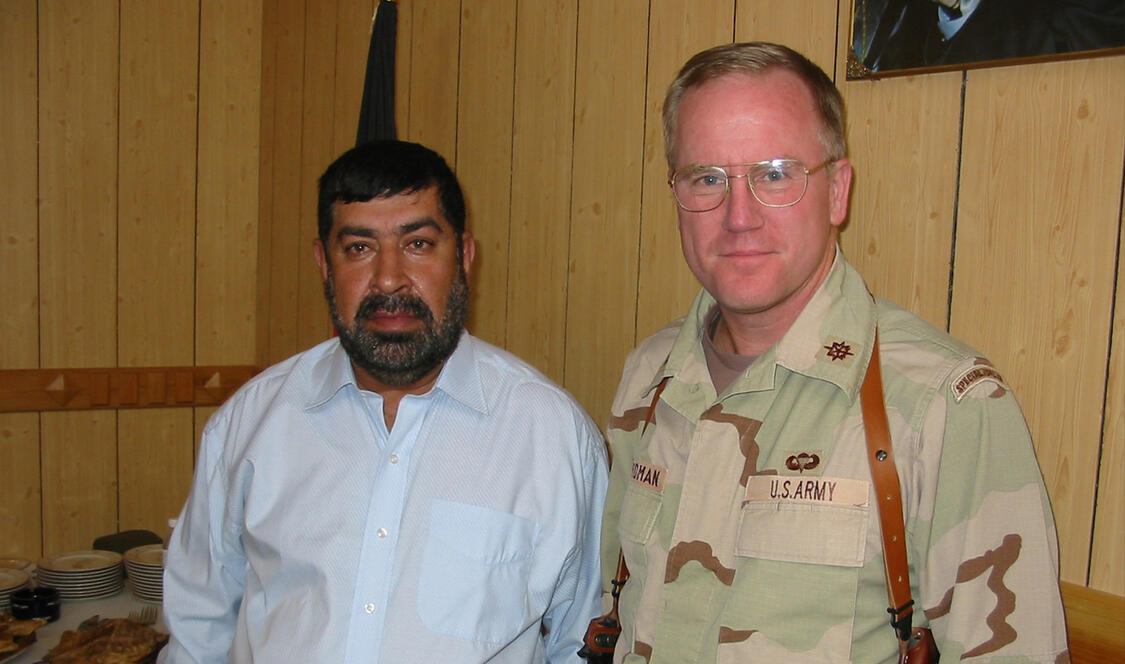
Mike Boardman ‘74 is a Runner!
At Mead High School in Spokane, Washington, Mike Bordman ‘74 was Captain of both his Debate and Cross Country Teams with a specialty of running 1- and 2-mile events in Spring Track and 3.5 miles in Fall Cross Country. He was sold on CMC from the very beginning, and it was the only college he applied to because of the emphasis on International Relations and Public Affairs. Debate was a strong influence, focusing his future intention on attending law school. At CMC and throughout his amazing military career, running has kept him in good shape and helped him pass the most rigorous fitness and qualification tests the Army has to offer!
Mike’s father retired as an Air Force Major, so joining ROTC was second nature to him. He was designated as the Outstanding Cadet at the end of his Freshman Year and accepted a 3-year ROTC Scholarship. Although he had been an A student in high school, he found he was woefully unprepared for CMC academics, and many of his classmates seemed far smarter, or at least better prepared. He found it necessary to study hard to keep up and consequently had little time for sports or debate.
Mike liked to hang out at the ROTC Headquarters to study and spend time looking through an amazing collection of military history books. In 1969, the anti-war movement had picked up on campus, and the outside of the ROTC Headquarters was firebombed, scorching the wall of the Bauer Center. Word circulated that another attempt would be made to do more significant damage, and Mike and several ROTC cadets drew spotting scopes and radios from ROTC and watched the office at night from the rooftop of one of the towers, rotating in 3-hour shifts. Suddenly, one night a flame was spotted outside the office and campus police were alerted only to discover one of the campus cops using his zippo lighter to light a large cigar. Word got out that the building was well guarded and watched, and no further night shifts were required.
From the beginning, Mike was focused on attending law school. Influenced by Professors Rood and Haley, Mike thoroughly enjoyed the small classes in his Junior and Senior year. He spent a semester at the University of Heidelberg in Germany and received both credit from CMC and continuing pay from his ROTC Scholarship. He became fluent, and in his senior year, he lived in the Oldenborg Language Dorm on the Pomona Campus, in the German wing, speaking German exclusively with the other students. While he found it necessary to study hard to get good grades, he thoroughly enjoyed his time at CMC and hated to leave it behind.
Upon graduation, he was commissioned as a Second Lieutenant. He had wanted to be assigned to the JAG Corps (Judge Advocate General) but passing the bar was a prerequisite for that branch. So, he chose Military Intelligence and received a deferment to attend Law School at Willamette University (a three-year program). He found law school to be a humbling experience and again found himself studying intensely to stay in the upper third of the class.
Having been commissioned a Second Lieutenant in the Army Reserve in 1974, after 3 years the Army promoted him to First Lieutenant even though he was still a student and had never seen a day of active service - it was an “up or out” system, and since he owed the Army 4 years of active duty because of his ROTC scholarship, they weren’t going to let him out without getting their pint of blood. In his third year, he took a prep course for the Bar Exam and worked with a sole practitioner, gaining practical experience. He found the job stimulating and enjoyed working on some petty criminal misdemeanors under the supervision of the attorney. Mike’s experience in debate helped him become a strong civil litigator. He was quick on his feet and learned to think strategically while applying the rules of civil procedure. As a law student, he was permitted to practice in court as long as he was supervised by a practicing attorney and preparing to take the Bar Exam. He was often selected as the court appointed attorney and worked on several cases defending indigents.
After 3 years of Law School, Mike passed the Bar on his first try and began practicing law with another attorney. His boss didn’t like courtroom work, so Mike took on all the trial and litigation work for the firm, as well as frequently serving as a Court-appointed defense counsel in criminal cases. After only 8 months of law practice, his salary doubled. He continued to work for the sole practitioner and took on his first felony defending a third offense of a DUI client.
As the trial unfolded, Mike tried to arrange a meeting with the prosecutor, who refused to return the calls of a rookie attorney and showed him no respect, assuming this was an open-and-shut case with a sentence of at least one year in jail. Mike did his homework and discovered that the friends his client had been drinking with on the evening of the DUI had also been smoking pot. The prosecution called these friends to the stand to confirm the client had been drinking, but on cross-examination, Mike was able to discredit their testimony, confirming that their memories had clouded from the influence of “demon weed.” The jury took only a short while to acquit Mike’s client, saving him from a painful sentence.
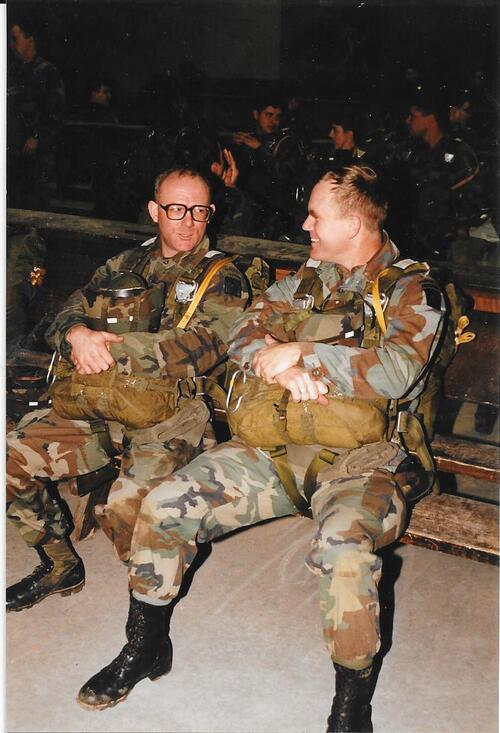
In February 1978, the Army contacted Mike and informed him that it was time for him to begin active duty—no more stalling. He tried to transfer to the JAG Corps but was informed that JAG was full and no slots were available. Mike found himself headed to Fort Huachuca in southern Arizona to attend the Intelligence Officer Basic Course. This was the first step in the Army’s professional training program for Intelligence Officers. Six months were required to pursue the basic Military Intelligence Corps curriculum. By this time, he was good at memorization and compared with law school, the course work was easy. Mike finished at the top of his class. At the time, Mike’s plan was to complete his four-years of active duty and return to practice law in Oregon where he was able to maintain his license even though he was not practicing law while on active duty in the Army.
Mike’s first assignment was to Fort Knox, Kentucky, with a job in the Armor and Engineer Board of the US Army Armor Center (Tanks R Us!) As the only Intelligence officer, he prepared analyses on all aspects of “The Threat,” meaning the capabilities of the old Soviet forces in East Germany, the Warsaw Pact, and the North Korean military. It was interesting technical work, but no place for a brand-new Lieutenant, so after two years he moved over to the 194th Separate Armor Brigade, also stationed at Ft. Knox, to command the Military Intelligence Detachment. He was also promoted to Captain.
As Detachment Commander with less than two years in the Army, Mike found he was not well prepared for the command, but fortunately had a large Warrant Officer contingent working for him who did know what they were doing. Mike states that “the smartest thing I did was to listen to my Warrant Officers.” He held this job for 28 months and came away with some valuable lessons learned about leadership and working with Warrant and Noncommissioned Officers.
Now it was time for Mike to return to civilian life, but he discovered he was having too much fun. He enjoyed his work and the success he achieved, developing morale among his troops and turning his unit into a top functioning organization. Mike decided he would put in for a challenging assignment. He applied for and was accepted into the Special Forces (Green Beret) training program! When asked about why he had chosen such a challenging assignment, Mike responded, “The Special Forces Soldiers were the most professional in the Army, post-Vietnam.” He wanted to be assigned to Germany and work with the best soldiers in the service. Special Forces was (and still is) an elite, highly selective specialty with an orientation toward studying and understanding the culture and local forces in countries to which they might be deployed.
To be a Green Beret, he had to be Airborne qualified, so jump school at Ft Benning, Georgia, was the next stop in his training. After getting his airborne wings (at the ripe age of 30—one of the oldest in the Airborne class), he started the Special Forces training at Ft. Bragg, NC. Mike went through the course with officers and NCOs of all specialties, but mostly Infantry, including some former Rangers and several foreign students. He found the 6-month course to be physically intense and intellectually challenging, but got through it without breaking anything and became one of the few Intelligence Officers in the Army to earn the Green Beret. Mike came away from training impressed with several important lessons that paid off in subsequent career assignments: the self-discipline needed to achieve successful accomplishment of a mission; the importance of being exactly on time (right down to the second when necessary); demanding land navigation, map and compass skills; learning how to push your physical limits far past what you thought possible, and the supreme value of initiative and creative problem solving.
At the end of the course, when assignments were being made, Mike, who spoke fluent German, found that he was being assigned to Panama. Another Captain, who was fluent in Spanish, was being assigned to Germany. Go figure. They called the Army’s assignments office and, by a miracle of common sense, were able to get the assignments swapped. Married at the time, he took his new wife and stepdaughter to Bad Toelz, Germany, and was assigned as the S2 (Intelligence Officer) of 1st Battalion, 10th Special Forces Group. He again found himself doing a job with good training but little experience. Mike comments: “That’s frequently the way it goes for an Officer in the Army—every new assignment is different, and you either sink or swim. The swimmers eventually get promoted, and the sinkers find something else to do.”
The S2 job was to provide intelligence to support Army Special Forces missions all over the European Command, with an area of responsibility from Norway to South Africa. The work was highly classified and involved continuous travel and field exercises. Mike worked with all the U.S. three-letter intelligence agencies and numerous foreign military forces. He loved the intel job but found it extremely hard on his family, and his first marriage ended in divorce.
In 1985, Mike was dragged out of the job at Bad Toelz (who would want to leave a picturesque spa resort town in the Bavarian Alps?) to attend the Captain’s Course at Ft Huachuca—the second step in the Army’s officer professional education program. He completed the course and requested to stay at Ft. Huachuca as an instructor in the intelligence school. In 1987, he was promoted to Major and selected to attend the next step in Army Officer education, the Command and General Staff College at Fort Leavenworth, Kansas. So he moved with his new wife to Leavenworth KS to attend the year-long course, designed to prepare rising officers for Division and Corps-level staff positions. His first daughter was born at Leavenworth, and at the end of the course, Mike was again assigned to Germany. He found himself on the Division Intelligence staff of the 3rd Armored Division in Frankfurt, Germany, responsible for developing the intelligence information to support the 20,000 heavy-handed tankers and artillerymen of the Division. The historic significance of the Fulda Gap became an everyday reality. The understanding of European history that Mike got at CMC was invaluable.
Then in 1990 Desert Storm happened, and the 3d Armored Division was deployed in December to Saudi Arabia to help run the Iraqis out of Kuwait. The US intel system wasn’t working very well for the 3rd Armored, so as the Division left for Saudi, Mike flew to the Pentagon to beg for information. He had some friends working inside the Beltway, and everyone wanted to help, so after a few days he flew back to Saudi carrying the latest Top Secret imagery, analyses, maps, and assessments, all rolled up in a big mailer tube sealed with duct tape. It was unorthodox (and possibly illegal), but that is what the times called for. At Dharan, the imagery analysts in Mike’s shop pasted all the satellite photos together in a wall-sized collage that showed the current enemy dispositions in all of Kuwait and halfway to the Jordanian border. Many unit commanders and senior intelligence officers stopped to study the images. Mike was pleased that the 3rd Armored Division had the best intelligence on the Iraqi Army in Kuwait and southern Iraq of any Army unit before the ground war started.
After the war, Mike returned with the 3rd Armored to Frankfurt, where the Division was deactivated as part of an overall Army downsizing. Mike found another job in Frankfurt as Executive Officer of Intelligence Battalion. The new commander was a female Lieutenant Colonel, who, while highly capable, lacked tactical experience in mobile operations, vehicle maintenance, and field communications. So every time the battalion deployed on a training exercise, Mike organized the convoys, set up the command post, including dozens of heavy expando-van trucks, large generators, tents, and got the communications systems up. Then he called back for the Commander to come out and take over. It worked well for both of them and was an excellent partnership.
After a year as Battalion Executive Officer and four years in Germany, Mike was reassigned to the Intelligence staff (G2) of the XVIII Airborne Corps at Fort Bragg, North Carolina. It was another tough job, full of field exercises, travel, night parachute jumps, and deployments. Long hours but rewarding work with first-class teammates. He was promoted to Lieutenant Colonel and selected for battalion command—an extremely competitive assignment and granted to only a few.
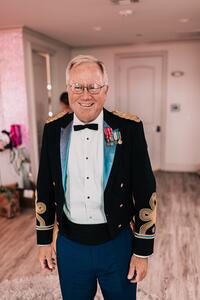
In 1994, the Army moved Mike and his family to Fort Gordon, Georgia, to assume command of an intelligence battalion—a two-year assignment. He fondly remembers it as the best job he ever had…a pinnacle experience. Unlike previous times in the Army (notably Vietnam), when battalion commanders rotated after so short a time as 6 months, a two-year command meant you had to live with your mistakes. But it also meant that the commander gets to savor successes. No other job in the Army offers such an opportunity for initiative, personal interaction, and a hands-on ability to generate both unit success and to foster the success of subordinates. Mike's wife, a pharmacist, found work in the pharmacy of the hospital on Fort Gordon, and his second daughter was born in Augusta. Life was good.
Having “successfully” commanded a battalion, Mike was selected for “Senior Service College”— in this case, the Army War College at Carlisle, PA. This is a yearlong academic course of training designed to prepare officers for Brigade Command as a Colonel, or senior staff positions in the Pentagon or the other large organizations of the Defense Department. Desiring a different experience, Mike requested to attend the Navy War College in Newport, RI instead. His reasoning was that most of the instructors there were Ivy League professors on loan or sabbatical, so the academic demands were rigorous, but Mike’s time at CMC and in law school had prepared him for that. He also found it to be an opportunity to delve into the Navy culture, one so different from the Army that Navy officers often seemed to spring from a different gene pool. No doubt they thought the same of Army officers.
Finishing that course in June of 1997, Mike requested a return to Europe and was assigned as the Intelligence Officer (J2) of the Special Operations Command, Europe, at the US European Command Headquarters in Stuttgart, Germany. That organization supervised all United States Special Operations Forces in Europe—Army Green Berets, Navy SEALS, Air Force Special Operations, and a few token Marines (who claim that all Marines are “special”). Mike found it to be a fascinating job, with routine access to the most sensitive war plans, high levels of intelligence, and involvement in all the most critical military operations in Europe at the time. He often traveled to Sarajevo in Bosnia, working on a NATO program to find and arrest indicted war criminals from the Yugoslav civil war. At the NATO level, military and political considerations often merge, and the background from his CMC degree in International Relations was gold.
While in Stuttgart, he and his family were able to take vacations in France, Spain, Greece, and Italy, but most of his travel was on “official” business, usually in civilian clothes to places he couldn’t discuss with the family. That created a stressful home life. Mike was promoted to full Colonel and was selected for Brigade Command—again, a competitive assignment. In 1997, only 6 out of around 200 eligible Colonels were selected for command in the Military Intelligence Branch. He asked for and received command of the Garrison at Fort Huachuca, AZ. This was a job similar to being a civilian city manager: supervision of the engineering, housing, public safety, recreation, civilian and military personnel management, and public affairs for the entire Installation. The work also had nothing to do with Military Intelligence, so it came with an extremely steep learning curve again. For that reason, the Army made Garrison Command a three-year job, the only brigade-level command in the Army so designated.
The first year amounted to drinking from a fire hose, but life was good. Fort Huachuca is a designated National Historic Monument; the houses in the old “officers’ row” (where the Garrison Commander’s house was) were huge two-story adobe homes, built in the 1880s, with a fireplace in every room. Tucked up against the Huachuca Mountains, the grassy yards and parade ground of the Old Fort were like a petting zoo every night: deer, javelina, black bears, mountain lions, raccoons, ring-tailed cats, and, of course, skunks, all wandering around looking for something to eat. The social life among the Colonels who lived there was gracious, and Mike’s next-door neighbor (a Colonel Medical Doctor who commanded the Fort hospital), brewed excellent beer and ran the Bavarian beer flag up every weekend.
After 3 years of Garrison Command, it was time to move on, but Mike wanted stability for his kids, and his wife was tired of moving, so they bought a house in the local town of Sierra Vista, moved the family there, and Mike took a job in the Pentagon by himself as a “geographic bachelor.” The separation was difficult, but it was just as well, because Mike worked directly for one of the principal generals on the Army staff. The Pentagon was a pressure cooker; all the senior staff were under tremendous stress all the time, the hours were atrocious, and Mike’s boss turned out to be “toxic.”
The environment was so bad that Mike volunteered after 9 months to fill a one-year position as the Senior Intelligence Officer (J2) in Afghanistan. This turned out to be real operational intelligence work, looking for Osama bin Laden and trying to keep the Taliban under control. As the senior Army intelligence officer in Afghanistan, Mike worked constantly with the representatives of the other 34 nations in the Coalition, the CIA station, the Defense Attache in the Embassy, the United Nations security office, and the major Non-Governmental Organizations (NGO’s) in the country. In a Coalition of 34 nations, political considerations merged with the military, and Mike again recognized the value of his training in CMC international relations and in international law courses at Willamette.
Unfortunately, Mike’s mother, who lived in Tucson, AZ, developed cancer, and Mike came back on emergency leave. She died 25 days later. Meanwhile, the Army had replaced him in Afghanistan, so he was reassigned to Fort Huachuca for the final years of his Army career. His final assignment was to command the Army’s Intelligence and Electronic Warefare Test
Directorate. Testing new systems under realistic field conditions is the last step in the Defense R&D process before a procurement decision is made. All new systems having to do with military intelligence or electronic warfare came to this Directorate for testing. Some were small one-off gizmos, like tiny cameras or electronic tracing tags, but many were multi-year, multi-billion dollar programs developed by the largest defense contractors in the country. Systems such as communications interceptors and jammers, drone sensors, biometric surveillance systems, and more.
Some of the tests took years to develop. The systems under test were usually state-of-the-art, so the testing equipment and methodologies had to be state-of-the-art as well. Sometimes the systems exceeded performance expectations, but sometimes they just weren’t ready for prime time, and it was Mike’s job to sort them out. Poor test results on major systems got intense scrutiny all the way to the Defense Department, with contractors always reciting the mantra, “It’s a poor test, not a poor system.” Mike learned that if you are going to poke somebody like Boeing or General Dynamics in the eye, you better be spot on. Mike survived, although it sometimes took personal trips to the Department of Defense to justify the results.
Unless you are a General, the Army has a mandatory officer retirement at 30 years of active service. Mike reached that in February of 2008 at Fort Huachuca, the place where he started his Army career 30 years prior. He took a few years off, then went back to work at Fort Huachuca, as a senior civil servant, doing much the same type of R&D work as before. That position lasted until 2016, when his youngest daughter graduated from the University of Arizona in Tucson (debt-free!), and Mike fully retired. Since then, he’s kept himself busy teaching international law at the U of A as an adjunct professor, doing volunteer public service work in Sierra Vista, and traveling the backroads of the American West.
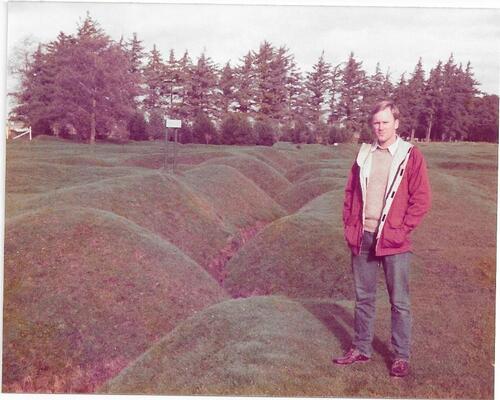
Thinking back, Mike is proud of his service to the United States. He was part of the historic effort that ended the Cold War and brought down the Bolshevik Soviet empire, part of restoring Kuwaiti sovereignty after the Iraqi invasion of 1990; part of ending the genocide and ethnic cleansing in Bosnia; and part of the hunt to bring Osama bin Ladin to justice for 9/11. Here are the Life Lessons that Mike had learned:
- The value of selfless leadership. Effective leadership means your subordinates know you are in it to get the job done while caring for them, not yourself. They will quickly sense whether you are in it for the mission or your own self-benefit. If they know you are there to accomplish the mission and take care of them, you’ll get their very best effort and 100% loyalty.
- The value of reputation. It precedes you in every new job, both for integrity and for competence. It’s the most valuable asset a military officer can build, and once tarnished, it's about impossible to repair.
- The value of persistence. Few of us will always be the smartest in the room (although many will think so. After all, 90% of people consider themselves above average); few will be the most experienced, or the most competent, or the best trained. But if you can be the most persistent, that will always get you to the top of the hill.
- The value of a small college liberal arts education. Mike’s entire career, both in law and the Army, highlighted the invaluable experience of his Claremont years. He says, “I wouldn’t trade those four years for anything. Wish I could go around and do it again…”