

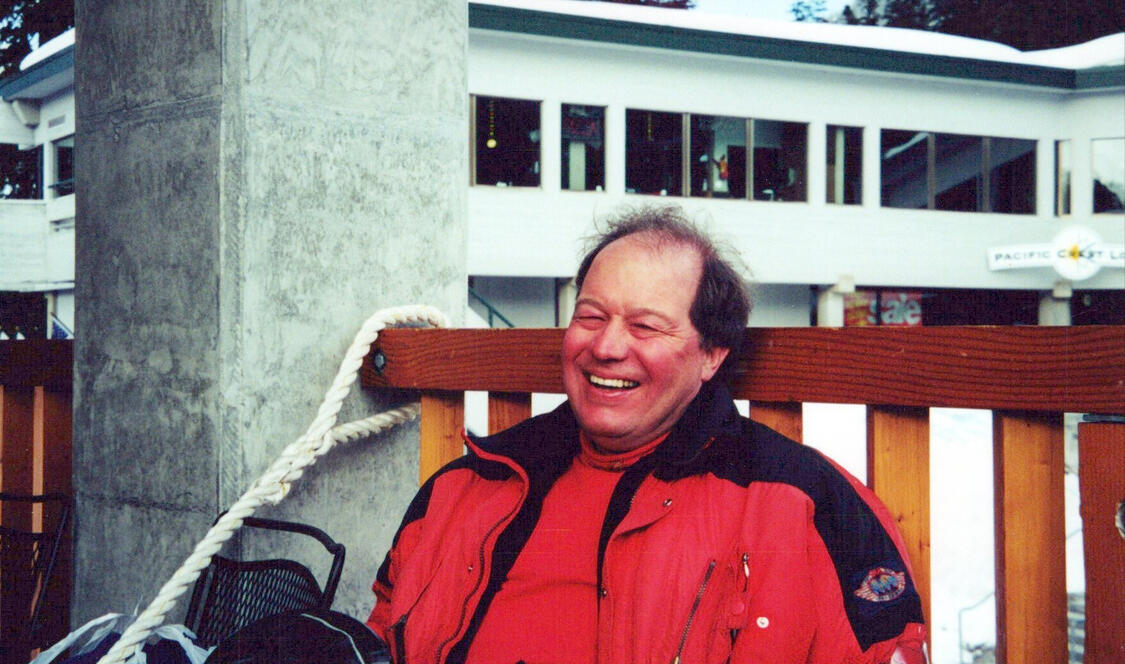
George Smith ’73 is a self-described outdoor nature nut. George Smith ’73 is a self-described outdoor nature nut.
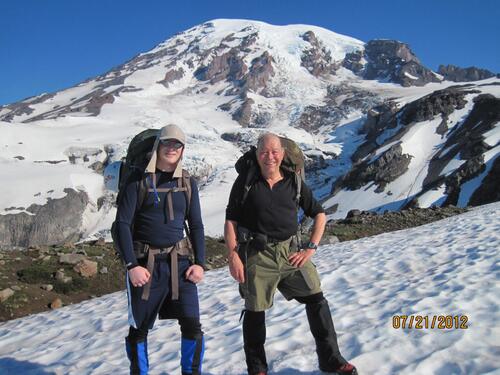
George Smith ‘73 loves to be outdoors, hiking, skiing, climbing mountains, and studying nature. It started in high school when he worked at a Boy Scout Camp in the Redwoods and led the camp's nature staff. He was active in the California Academy of Sciences student section in San Francisco and joined the Sierra Club as a Service Trip Leader. There he discovered mountain climbing in the Sierra Nevada range and never looked back. During law school he climbed in the British Columbia Coast Range and Mt. McKinley (AKA Denali) in Alaska, and during his four-year military service at Fort Lewis, Washington, he became active in The Mountaineers and climbed throughout the Cascades and Olympics. He met his wife, Pat, a Seattle native, in a Mountaineers climbing course he was teaching. They celebrated their honeymoon climbing Mt. Shuksan in the Pacific Northwest and, when George completed his military commitment in 1982, they spent two months trekking in Kashmir, Ladakh and Nepal.
George was a serious student at CMC focused on getting good grades to get into law school but managed to get up Mt. Baldy or drive to the Sierras to climb or ski occasionally during the school year. Proctor Thompson, who became his advisor, and Martin Diamond, who introduced him to the Federalist Papers and brought two US Senators to speak to his freshman government class were his favorite profs and most influential along with Stu Briggs and Winston Fisk.
In his sophomore year he had a part time job working for the Center for California Public Affairs indexing California newspaper articles for librarians (before computers). Later he did an internship with Ward & Son Inc (that became Elixer Industries, Inc.) confirming his interest in accounting. In the spring of his senior year, he somehow managed to work full-time for Touche Ross & Company, one of the Big 8 accounting firms, in their Los Angeles office throughout the semester while taking his last course as an independent study and completing his senior thesis.
As an Army brat, George originally considered applying to West Point but decided he wanted a more routine college experience with members of the feminine persuasion. He applied for and received an ROTC Scholarship with CMC in mind. His father was a career Army officer who had served in Germany, Korea, Japan, Washington State, Alaska, the Presidio of San Francisco, and Taiwan before retiring in San Francisco. George loved history and closely followed the Vietnam War. Initially he was a staunch supporter but flipped toward the end when he decided it was not worth more American lives if the US was not willing to do what it took to prevail.
When he joined ROTC in fall 1969,, there were only about 10 classmates in the program, including several other scholarship cadets. The program was a much different experience during the anti-Vietnam War years and cadets kept a low profile on campus. Public and campus protests of the war were at their height in 1969-1972. Some colleges had expelled ROTC programs, and CMC did not want that to happen, so cadets did not wear uniforms, and there were few outside formations or drills. ROTC was almost exclusively a classroom experience. George remembers the night the lottery draft began in 1969-1970, after which many ROTC students with high numbers immediately dropped out, and others with low numbers signed up. George recalls only one field exercise – a trip to 29 Palms Marine Base to practice firing. He attended Summer Camp at Ft. Lewis Washington between his junior and senior years.
George graduated from CMC magna cum laude in 1973, and since the Army was downsizing as the Vietnam War began to wind down, he received an educational delay to attend law school. He briefly considered going to Columbia Law School in New York but chose UC Davis since it was cheaper and closer to his beloved Sierra Nevada mountains. Since the Army guaranteed his “employment” following law school, he was able to spend his summers climbing mountains in the Sierra, the Cascades, British Columbia, and Alaska rather than toiling in summer law clerkships. He enjoyed some particularly good times at his favorite pastime.
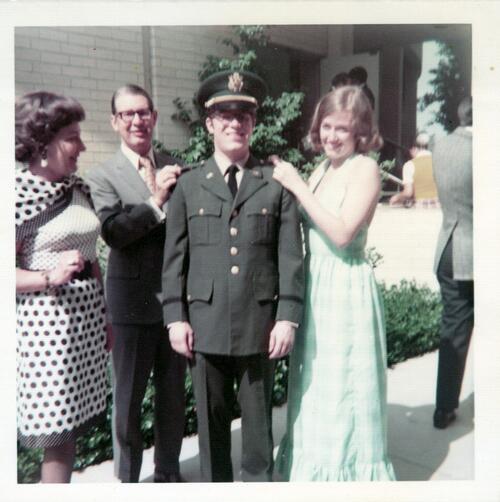
George decided to pursue a CPA and took and passed the exam while in law school. He graduated from UC Davis law school in 1976 and passed the California Bar that summer. The Army confirmed his acceptance to the Judge Advocate General’s Corps (JAGC), but he resumed working for Touche Ross & Co. in San Francisco while awaiting his California bar results. That fall, while working at Touche Ross, he met a girl and decided he was in no hurry to leave so he petitioned the Army JAGC to allow him to delay his active duty service for another year and a half to enable him to complete the two-year work experience requirement to earn a California CPA license. To his immense joy, the Army approved his request “as an exception to policy.”
When his exceptional delay ended and the Army finally caught up with him in the fall of 1978, George drove across the US to the JAG School at the University of Virginia in Charlottsville for his Officer’s Branch training. There he was immersed in studying the UCMJ (Uniform Code of Military Justice), the Geneva Conventions and “law of war,” and met other young JAGC officers from around the US. He also had the opportunity to explore the nation’s capital, Blue Ridge Mountains, and Smokey Mountain National Park in his free time.
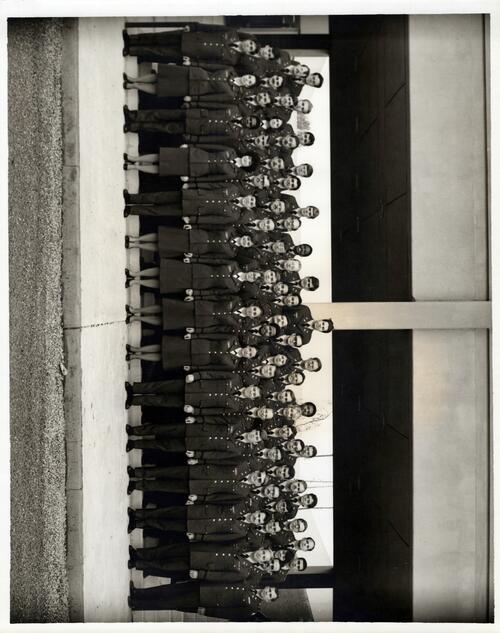
In December 1978, George received orders assigning him to Ft. Lewis, Washington, to support FORCECOM and the 9th Infantry Division stationed there. Ft. Lewis was an exceptionally large facility and included the 2/75 Ranger Battalion, the home of I Corps Headquarters and the Army’s Stryker vehicle test bed program. The JAG office had 25 military attorneys and an additional 25 enlisted and civilian staff. The office was run by a full Colonel who had served as the JAG for the 101st Airborne Division in Vietnam. He was a Washington state native and an avid outdoorsman, so George found him to be a friend from the start. Unlike most military units, the JAG office was an informal environment. Rank was respected, but strict military discipline was not observed in the office. The JAG office had a wide mix of officers with many single and young married attorneys. They were mostly Captains, a couple of Harvard grads, some West Pointers, and several Ranger qualified officers who had transferred to JAGC after completing law school. It was a friendly, collegial environment with everyone committed to doing the best job they could. The office enjoyed something like the atmosphere depicted in the popular “Mash” TV series. George spent his first couple of years advising soldiers and retired personnel on their personal legal problems and then spent a couple of years doing administrative law and government contracts. Given his tax accounting experience, the Colonel also arranged for George to advise the post’s General Officers concerning their tax and real estate investments on several occasions.
Among the many interesting cases that landed on George’s desk during his time at Ft. Lewis were the following:
- A young immigrant soldier received notice that he was to be deported from the United States. His Company Commander called George to say this was one of the best soldiers in his unit, and asked George to try to help him. Together George and the commander accompanied the soldier to the Seattle INS office and were successful in enabling the soldier to stay in the country.
- Another soldier from the deep south was accused of damaging a million-dollar piece of equipment which he was responsible for maintainingning, and pursuant to a Report of Survey was being held financially responsible for the damage. To his amazement George realized that this conscientious soldier-mechanic knew the equipment well but couldn’t read the instructions manual. George proved that the soldier couldn’t be held responsible for the damage and shouldn’t be held financially liable.
- Another young enlisted soldier who worked in the JAG office as the Colonel’s driver and general assistant once asked George for a recommendation of local hiking trails. George gave him a photocopy of pages from a hiking guidebook with driving directions to each trailhead but was subsequently amazed to realize that this fine young soldier couldn’t read.
And there were some more serious cases as well:
- While serving as the on-call JAG officer one night he received a midnight call from a distraught Company Commander at the hospital where a young soldier had been injured in an accident, was near death but was refusing a blood transfusion to save his life because he was a Christian Scientist. Having been trained that “the Army owns us while we serve,” George took a chance and advised the commander he could order the transfusion to save the man’s life.
George met and worked with people from diverse levels of society and from all over the country. This experience was quite different from his time at CMC. His clients ranged from “Private Snuffy” to Generals. He met and advised one retired soldier who had fought as a jungle guerilla fighter on Corregidor all through WWII. Another time he met and advised a retired soldier who had endured seven in a tiger cage in Vietnam as a prisoner of the Viet Cong. The man had been tortured and the bones in his hands had been broken.
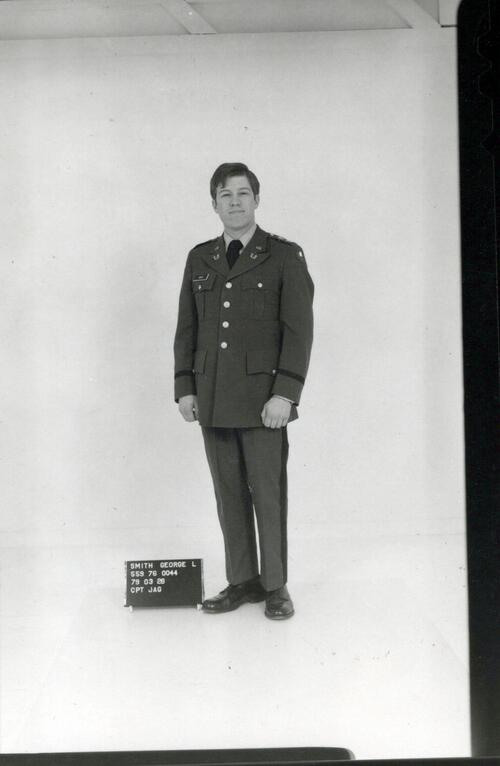
George found his work both stimulating and enjoyable, and his four-year active-duty commitment went by quickly. In addition to making lifelong friends, George’s years in the Army gave him insight into the military and the quality of both short-term civilian soldiers and “lifers” committed to making the Army their career. He feels strongly that civilian military service leads to a more informed citizenry. George completed his active-duty obligation in September 1982, leaving the service as a Captain, but he has maintained lifelong personal friendships with many of his JAG colleagues as well as the JAG Colonel for whom he worked.
Before leaving the service George accepted an offer from a well-established Seattle business law firm of about sixty attorneys, Graham & Dunn, P.S. The partners encouraged him to take the extended trip to southwest Asia that George and his wife were considering before starting work at the firm. So, George and Pat spent a couple of months traveling through northern India, Kashmir, Ladakh, and Nepal, where they trekked 180 miles around the Annapurna Massif. However, no sooner had he started working at Graham & Dunn than the firm downsized and laid off 10% of the partners, 10% of the associates, and retracted offers to all new associates and summer clerks. Miraculously, George was kept on despite being the newest kid on the block. For the next four years his law practice focused on tax-oriented business and personal planning, and the syndicated tax-shelter limited partnerships popular during that era. In 1986 George decided to return to school to obtain an advanced tax law LL.M. (Tax) degree at the University of Florida. Although he felt that CMC, law school, and his tax accounting experience with Touche Ross & Company (now Deloitte & Touche) had given him a good foundation in tax law, he wanted to strengthen and round out his tax knowledge.
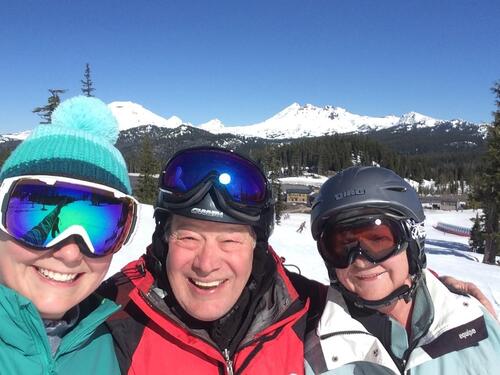
After completing the LL.M. (Tax) program in 1987, he followed several of his Graham & Dunn colleagues to another leading Seattle business law firm of about a hundred and twenty attorneys, Foster Pepper & Riviera (later known as Foster Pepper & Shefelman LLP and today known as Foster Garvey PC). Here he engaged in a similar tax-oriented business and personal planning law practice for the next eight years, becoming a partner in the firm in 1990.
In 1995 he left Foster Pepper & Shefelman to form a tax-planning boutique law firm, Smith & Zuccarini, P.S., in Bellevue, Washington, where he has practiced for 25 years until retiring at the end of 2019 at age 68. Over the years, his firm had between five and fifteen tax attorneys focused exclusively on business and personal planning for closely held companies and high net worth individuals and their family entities. The firm prospered just as Microsoft and other tech firms that proliferated in the Seattle-Bellevue-Redmond area did in those years.
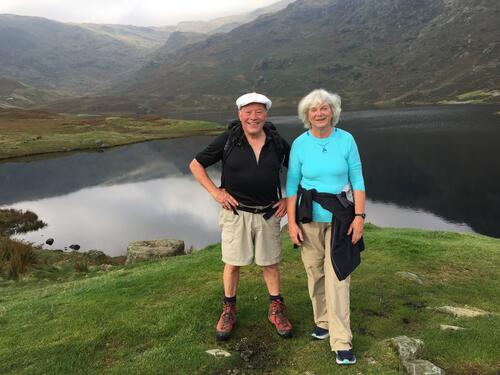
George retired from law practice at the end of 2019, and in the last six years he and his wife have enjoyed hiking, skiing, birding, and boating in the beautiful Pacific Northwest. They spend time working on their vacation homes in the Cascade Mountains and on an island in Puget Sound. They have traveled extensively to Canada, Alaska, England, Austria, Spain, Mexico and, most recently, to Patagonia. They have also spent time with two grandchildren trying to instill their love of nature and the great outdoors.
As he reflects on his Army service, George offers several Life Lessons Learned during those formative years:
- Exposure. He benefited from exposure to all types of people from all over the country, with backgrounds, educations, and experiences vastly different from his own, who were good people and good Americans.
- Challenges. He came to appreciate the nature (and challenges) of military service and the civil servants who support them and understands that institutional leadership is complicated, and success is never certain. Moreover, no matter how dedicated and well-trained our military is, you cannot expect to turn an aircraft carrier around on a dime.
- Citizen Soldiers. He became more convinced than ever that “citizen soldiers” are vitally important in a democracy. Military service is an invaluable education even for citizens who get out and pursue a civilian career since the experience makes them wiser, better citizens for the rest of their lives. The military also benefits from short-term citizen soldiers of all abilities and backgrounds who do not plan to make the military a career. Many who were “drafted” in former years (or volunteered in the face of the draft) do not serve today, which is the country’s loss.
- Time Well Spent. The years he served in the military provided George an invaluable opportunity to mature and think about life, careers, and family. It was a profitable period in his life.