

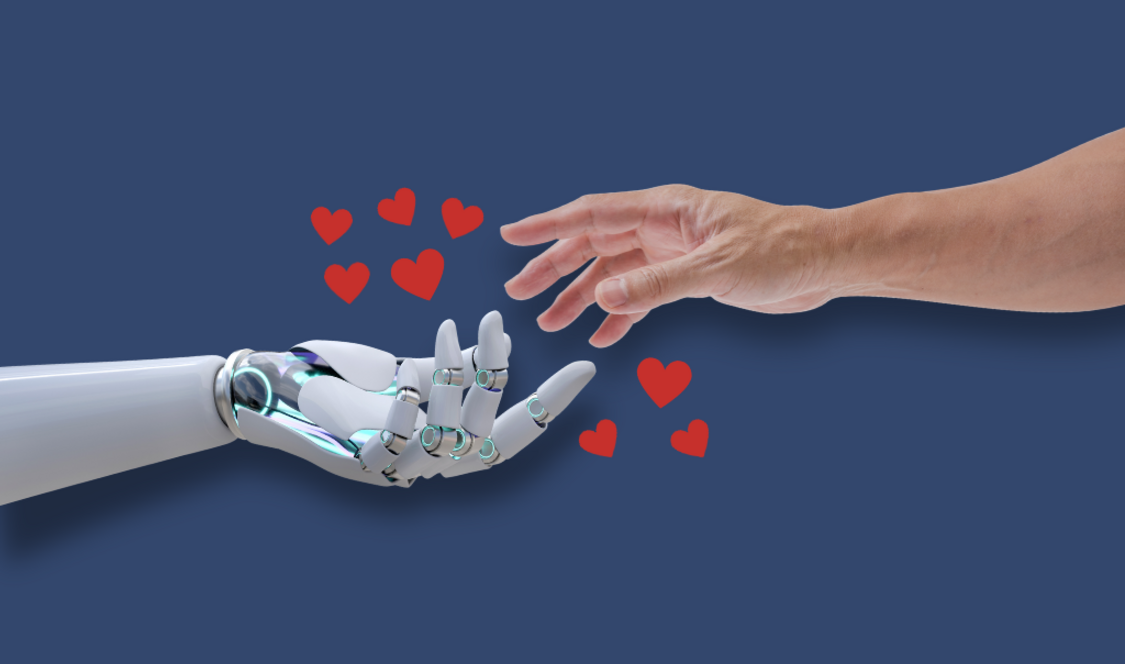
In a November 2025 New York Times article, Abbey, a 45-year-old woman from North Carolina, describes her romantic interest in an AI chatbot this way: “The more we talked, the more I realized the model was having a physiological effect on me; I was developing a crush. Then Lucian chose his name, and I realized I was falling in love.” The idea of an emotional bond between a human and artificial intelligence was once unheard of, but modern AI models make this a reality by providing constant and personalized companionship.
While serious romantic connections with AI might be an extreme case, using AI to talk through problems, help with schoolwork, or serve as an always-available, always-present friendly thought partner is much more common, particularly among young adults. According to Common Sense Media, 72% of U.S. adolescents have used an AI companion, 50% use one regularly, and one in three adolescents turn to AI rather than a peer for a serious conversation.
First-year college students may be particularly more likely to use AI for both functional and relational purposes. Moving away from home can be exciting but highly stressful. They then must seek out and build new relationships and friendships in an entirely new environment where academic pressure may be even more intense. Many incoming students are already familiar with the capabilities of large language models, including ChatGPT, Claude, and Gemini due to use during high school. These conditions may make first-year students predisposed to relational AI use.
Dr. Stacey Doan (Claremont McKenna College), Dr. Saida Heshmati (Claremont Graduate University), and Dr. Jessica Stern (Pomona College) are beginning to investigate how AI use affects the transition to college and how it impacts their ability to form a new social network within their university. Their study, “Relational AI Use, Stress Physiology, and the College Transition: A Pilot Study of AI Substitution of Human Attachment,” is funded by the BLAIS Challenge grant, which uniquely encourages cross-institutional collaboration between CGU and the undergraduate Claremont Colleges. Additional support is provided by the Berger Institute for Individual and Social Development.
The study will follow first-year students across the five undergraduate Claremont Colleges. They will focus on how students use AI and investigate both the potential benefits and detrimental effects of AI usage on academic, social, and emotional outcomes. Using advanced methods such as ecological momentary assessment (EMA), a technique that samples real-time experiences in daily life, this study will examine how everyday events drive moment-to-moment AI use. In turn, it will trace the resulting effects of these usage patterns on subsequent individual outcomes.
Ultimately, the team hopes to understand relational AI’s impact on first-year students. The study aims to provide the Claremont Colleges with resources to support first-year students' social emotional wellbeing in the age of AI.
_________
Kraft, C. (2025, November 5). They fell in love with A.I. chatbots – and found something real. The New York Times. https://www.nytimes.com/interactive/2025/11/05/magazine/ai-chatbot-marriage-love-romance-sex.html