
Since the Beinecke Scholarship Program began just over a half-century ago, only three CMC students have been recognized for their “intellectual ability, scholastic achievement, and personal promise during their undergraduate career” through the prestigious scholarship award.
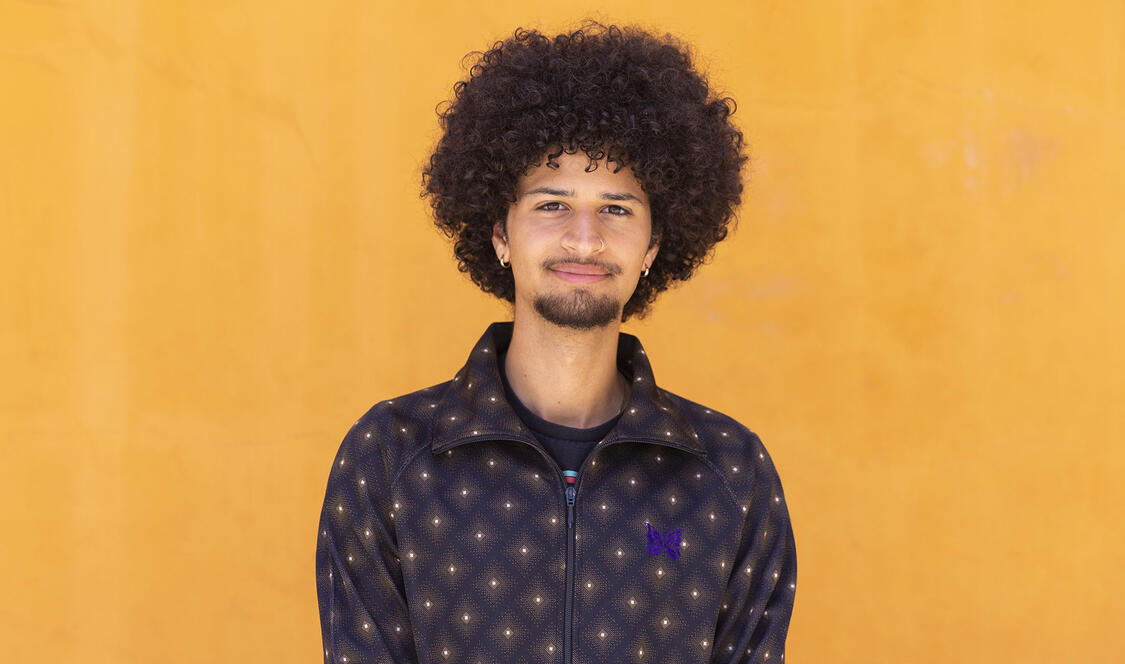
Shiraz Smith ’27, of Upland, Calif., is now the fourth.
Smith is one of 16 students in this year’s Beinecke Scholar cohort, chosen from a pool of 93 nominations from approximately 145 institutions invited to nominate one exceptional junior for the award. The $35,000 scholarship is intended to “encourage and enable highly motivated students to pursue opportunities available to them and to be courageous in the selection of a graduate course of study in the arts, humanities and social sciences.” Previous CMC winners are Toluwani Roberts ’22, Michelle Lynn Kahn ’12, and Brian Ostrowski ’96.
Grateful that the Beinecke Scholarship will increase his viability as a Ph.D. candidate, Smith’s graduate work will build upon research he conducted his junior year as a Mellon Mays Undergraduate Fellow (MMUF). Smith centered his research around the “site and substance” of pedagogy in social transformation, particularly “how the Black Freedom Struggle can help us think more clearly about how and where the kind of classroom, formal or otherwise, can become capable of not only critiquing oppressive structures, but of training people to build beautiful new ones.”
At CMC, inside the California Rehabilitation Center (CRC), and in his own neighborhood, Smith has put this theory into practice. As a CARE Center Fellow, he has facilitated community dialogues that explore such questions as “How can we reinvigorate traditional pathways or imagine new levers for social change?” In a less traditional setting, Smith co-taught a college-prep course to men incarcerated at CRC through the 5C Prison Education Project, an experience that reinforced his belief in the life-changing power of education.
Smith’s devotion to improving the human condition also extends to his own neighborhood, where he draws from an educational framework rooted in the Bahai’ faith—with which he closely identifies—to organize grassroots activities that focus on both intellectual and moral development.
“We’re trying to provide a space and an infrastructure for the young people to work on some rudimentary life skills—literacy, numeracy, for example—but also reflect deeply on those more abstract, spiritual questions about purpose and direction and meaning,” said Smith, a Philosophy, Politics, and Economics (PPE) major.
This summer, in a research assistantship that aligns closely with both his personal and academic passions, Smith will help Professor Prashant Loyalka at Stanford’s Graduate School of Education examine how the interplay between education and community-building influences outcomes for young people.
As details for post-CMC graduate study and continued service in his community solidify, Smith exists in a state of calm and confidence about his future.
“I’ve noticed in my life that when I keep this question about serving humanity at the center of my life, things unfold the way they should.”