
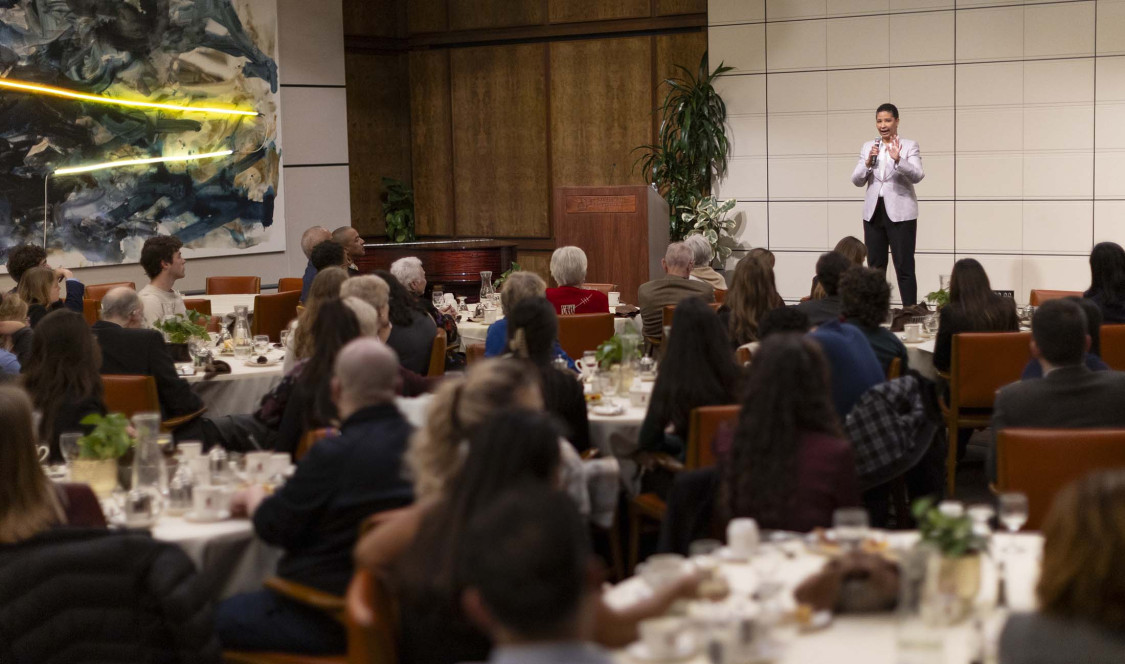
Danielle Allen arrived at the Marian Miner Cook Athenaeum with a joyful purpose.
“I invite you all to a birthday celebration,” Allen announced at the beginning of her presentation. “We’re going to spend our time together thinking about what it means to celebrate the founding of this nation and to celebrate the Declaration of Independence.”
Allen’s talk, “250 Years of Our Declaration of Independence: Why an Old Text Still Serves Us Now,” felt of-the-moment, as the renowned scholar spoke extemporaneously, incorporating into her remarks tidbits she gleaned from the earlier dinner discussion with CMC students.
Many of the CMCers in attendance were eager for the opportunity to engage with the prominent political theorist in person, thanks to familiarity with Allen’s book, Our Declaration: A Reading of the Declaration of Independence in Defense of Equality, which is frequently assigned in Gov 20, as well as First-Year Humanities Seminars.
In addition to being a prolific author (her books include Justice by Means of Democracy, as well as the forthcoming The Radical Duke, a biography of an 18th-century British political reformer), Allen is the James Bryant Conant University Professor at Harvard University; Director of the Allen Lab for Democracy Renovation at the Harvard Kennedy School; and Director of the Democratic Knowledge Project, a research lab focused on civic education at the Harvard Graduate School of Education.
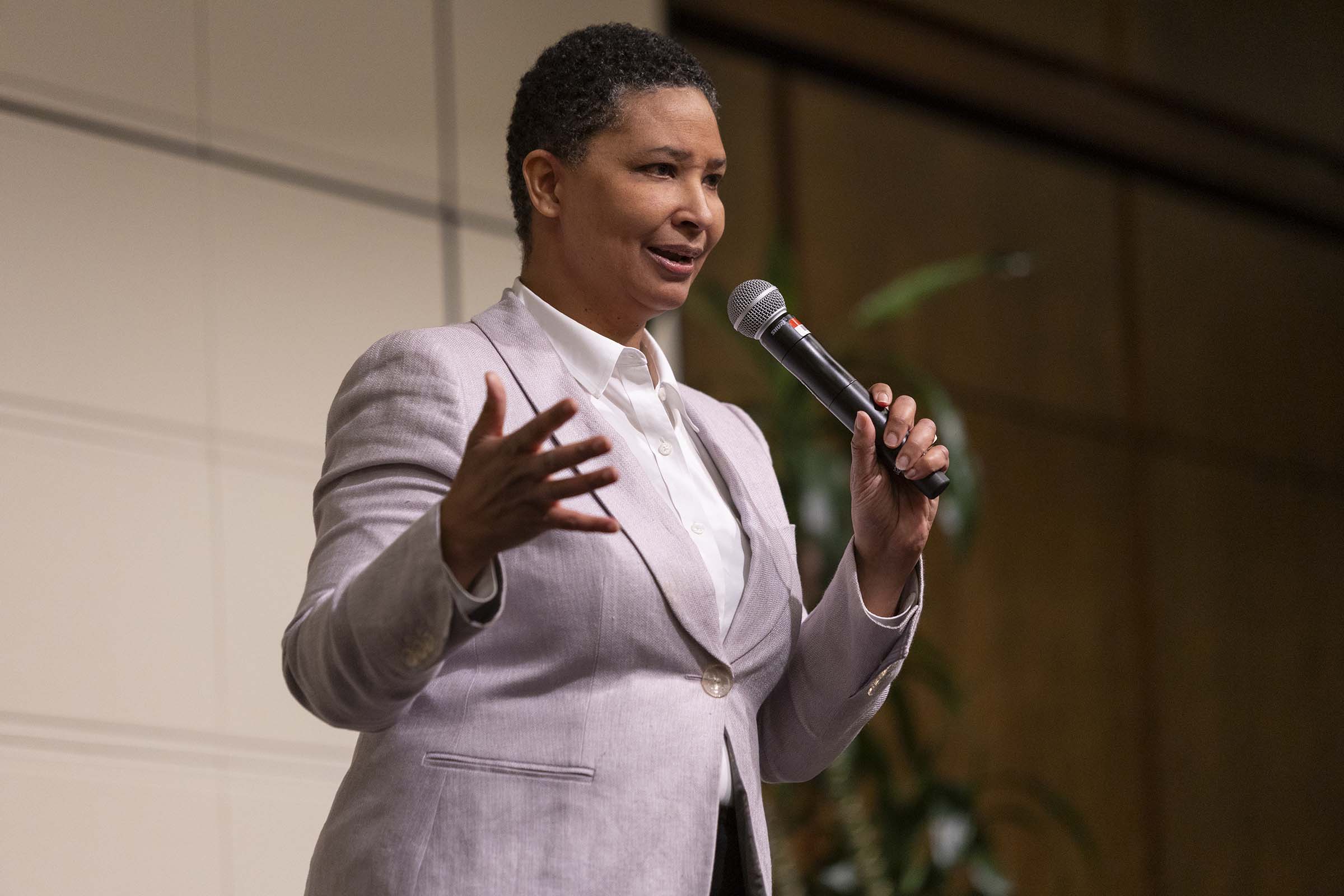
Adding to her prestigious credentials, Allen has won both the 2025 Barry Prize and the 2020 Library of Congress’ Kluge Prize, which recognizes scholarly achievement in the disciplines not covered by the Nobel Prize. She received the Kluge “for her internationally recognized scholarship in political theory and her commitment to improving democratic practice and civics education.”
At the top of her talk, Allen addressed the Declaration’s universal significance (which, notably, is also the theme for this year’s Open Academy programming at CMC): “The celebration that we’re having is not just our nation’s celebration, but it’s a celebration for each and every one of us in this room. We are all—regardless of whether we are American citizens by birth or naturalized American citizens or visitors here—heirs to the patrimony encoded in the Declaration of Independence. Why are we all heirs? Because the text … expressed itself as available to all humanity. That expression was a commitment to the idea that the United States is founded on ideas, and that all of humanity has access to ideas.”
She then requested that members of the audience close their eyes to better absorb the portion of the Declaration’s preamble, which she recited by heart:
“We hold these truths to be self-evident, that all men are created equal, that they are endowed by their Creator with certain unalienable Rights, that among these are Life, Liberty, and the pursuit of Happiness. That to secure these rights, Governments are instituted among Men, deriving their just powers for the consent of the governed, that whenever any Form of Government becomes destructive of these ends, it is the Right of the People to alter or to abolish it and to institute new Government, laying its foundation on such principles and organizing its powers in such form as to them shall seem most likely to effect their Safety and Happiness.”
Allen, who currently concentrates on democracy renovation, next drew upon her deep expertise to showcase the founding document’s enduring relevance, analyzing the text phrase-by-phrase. She also acknowledged criticism that the Declaration “celebrates patriarchy, celebrates enslavement, celebrates domination” before explicating the intentions of the founders and extolling the Declaration’s many virtues, including its core principles of equality; rights to life, liberty, and the pursuit of happiness; and the role of government as a tool to protect those rights.
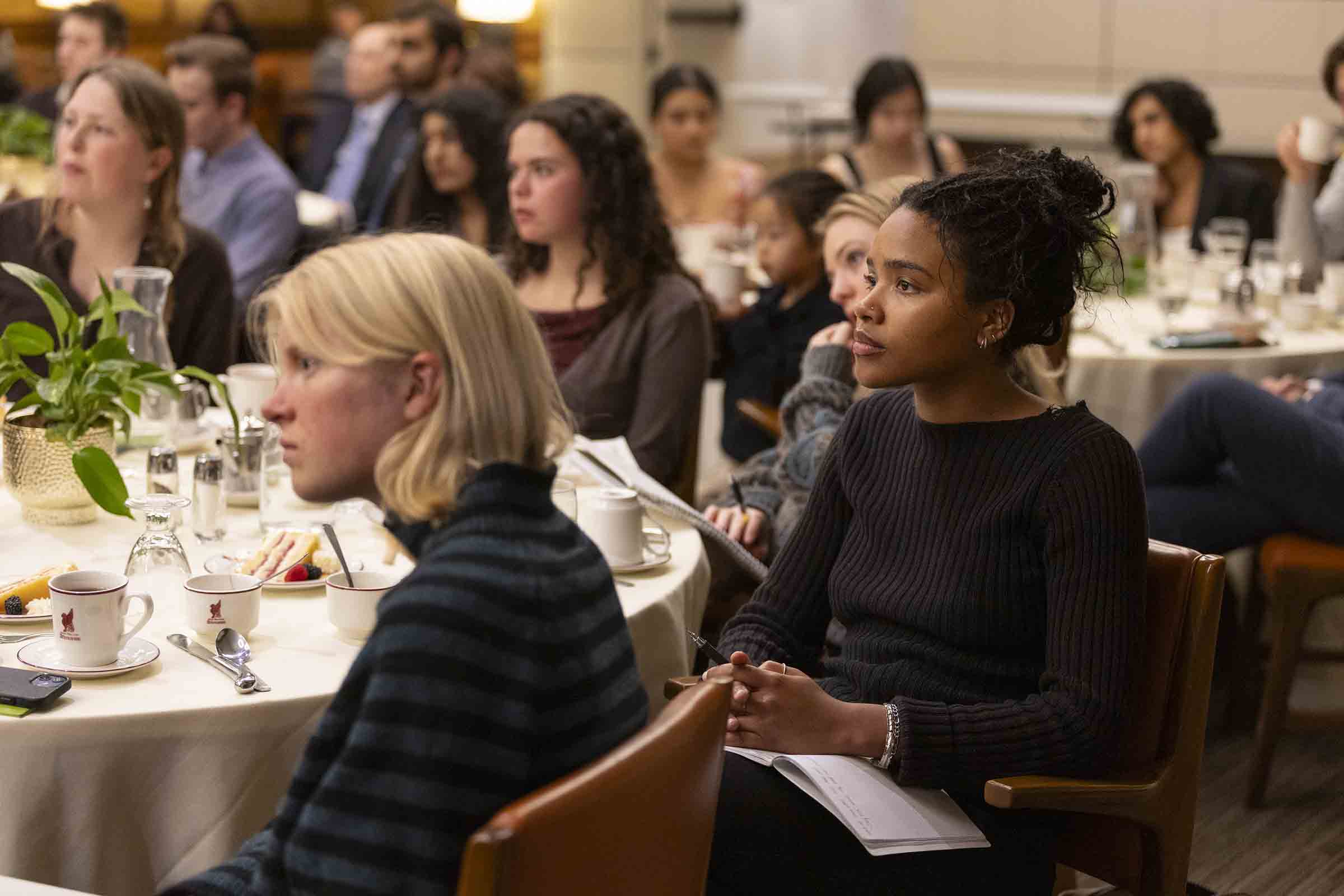
Jasper Langley-Hawthorne ’27, a PPE major, asked Allen to follow up on their earlier dinner conversation about liberty: “When reading the Declaration and looking at American life, it seems to me that sometimes liberty can be at odds with the cultivation of virtue. My question is, how can democratic governments produce virtuous citizens while leaving their liberty fully intact?”
Allen responded: “We all receive an education and character through numerous channels, through our families, through our communities, through our churches, through the media (or lack thereof). And, in that regard… virtue never has been and shouldn’t be, something that the state, in some sense, as a single actor, is responsible for. The question you’re raising is really a question about how we, as a people, educate ourselves for character. It’s when we educate ourselves for character that that education unfolds in a way with liberties intact.
“So, I put the question back to you in a certain sense, given that we’re in a moment where it seems fairly clear that as a people, we are deprioritizing questions of character. How do we, as a people, reboot an interest in character for ourselves? That’s what I would ask.”
For Allen, who attended Claremont High School, her return to Claremont felt like a “homecoming,” and marked the second time she’s spoken at the Athenaeum. The large audience for her Feb. 17 talk—co-sponsored by the Kravis Lab for Civic Leadership, The Open Academy, the Salvatori Center, and the President’s Leadership Fund—included CMC President Hiram Chodosh and Priya Junnar; former CMC President Jack Stark ’57 GP’11, and his wife, Jil Stark ’58 GP’11; Harvey Mudd College President and CMC alumna Harriet Nembhard ’91, as well as students, staff, and faculty from across the 7Cs.
Learn more and register for upcoming talks at the Athenaeum.