
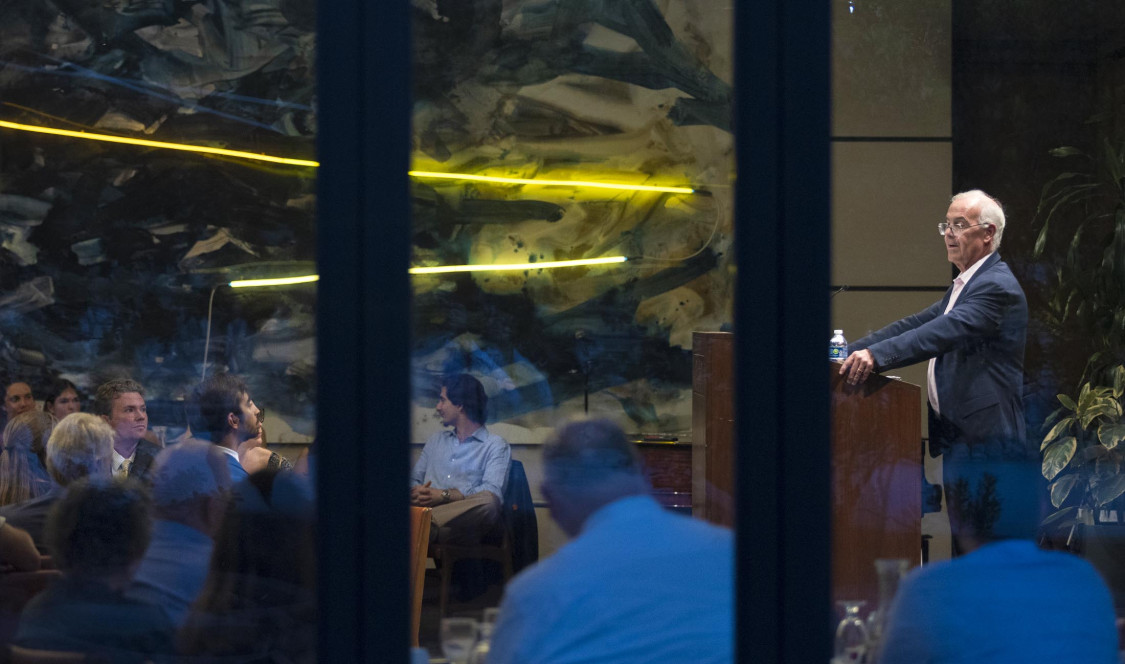
David Brooks, a leading commentator on American political, social, and cultural trends, writes 1,200 words every morning.
“Seven days a week, 365 days a year, doing what I was put on this earth to do,” he emphasized in a March 24 Athenaeum talk.
To a capacity crowd, Brooks imparted a treasure trove of wisdom for finding your calling, or, what a former professor at his University of Chicago alma mater called the “ruling passion of your soul.” For Brooks, “My core identity, from age 4 or 7 when I read Paddington Bear, was … to be a writer.”
Young Brooks knew. He has since written for, among other publications, National Review, The Wall Street Journal, and The New York Times, where he recently concluded 22 years as an op-ed columnist to join The Atlantic as a staff writer. A longtime political analyst on the PBS NewsHour, he has also authored numerous books, including The Road to Character; The Social Animal: The Hidden Sources of Love, Character, and Achievement; and How to Know a Person: The Art of Seeing Others Deeply and Being Deeply Seen.
Brooks began his talk by contextualizing his advice in “my version of conservatism,” which emphasizes the importance of “sentiments”—for instance, emotion and passion—over reason. But importantly, sentiments rooted in a moral ecology cultivated and refined in “institutions, family, faith, all the things that form your heart,” said Brooks, “and that’s the more conservative side.”
He was influenced early on by 18th-century thinker and politician Edmund Burke—first in radical opposition to him as a leftist revolutionary (he wrote “three papers about what a moron he was” in college), and later as a proponent (“Holy s**t, Burke was right!”)—who believed pure reason is insufficient for building a better society.
“What I liked about Burkean conservatism was (a) the ‘epistemological modesty’—I really don’t take reason as trustworthy as our emotions, (b) the emphasis on the heart, on the sentiments, and the vision of good life built around that, and (c) the idea that life is essentially a moral struggle, that you can’t build a society in which the people in it don’t have to be good. And so moral formation, giving people the right moral sentiments, is super important.
“So, conservatism gave me access to a world view that transcended politics,” Brooks continued. “It was about all of life, but what a good life looks like, what knowledge is, what moral beauty looks like, how to be a decent person.”
From this premise, Brooks offered students—as well as retirees or any seekers of purpose—“not-so-easy-to-do steps for how to find your calling,” noting that “whether it’s a hobby or a career or a vocation, you’re looking for things to love.”
“You want a poetic frame of mind: What do I love? What has delighted me? What gives me joy? And you have to have a capacity to be seized. You have to be willing to swoon,” he said.
To be seized, to invite the swoon, Brooks urged a return to childhood: “Somewhere inside of us, the child is still running enthusiastically to a horizon it once glimpsed,” he paraphrased poet David Whyte. Take three adventures a decade, he encouraged: “Go to a lot of different places, experience things…you can’t speculate your way into a calling. You have to try it, see how it feels, see if it rings your bell.”
But seeking adventure isn’t enough. Brooks also assigns primacy to finding a secure base. “All of life is a series of daring explorations from a secure base. You need to have a secure emotional base, hopefully a secure financial base, but also a moral base, a sense that you know what’s right and wrong,” said Brooks, who recently founded Weave: The Social Fabric Project to help address common needs and broken social trust.
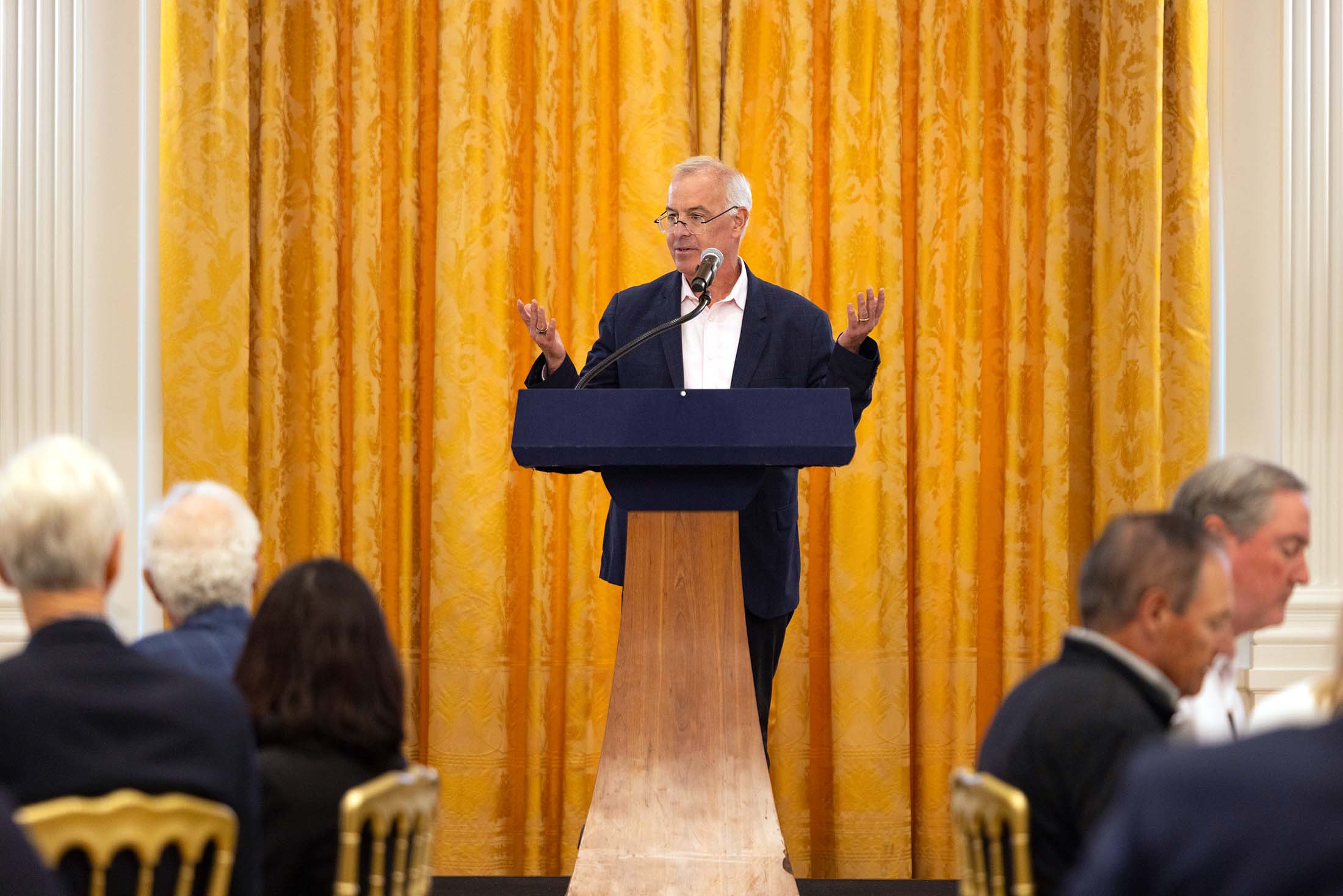
Before discussing passion and purpose with Ath-goers, Brooks spoke earlier in the day to members of CMC’s Res Publica Society, Crown Society, and 1946 Legacy Partners at the Richard Nixon Presidential Library and Museum in Yorba Linda. Co-sponsored by the Valach Speaker Series and The Open Academy, his talk sketched out cultural guideposts across each decade since World War II, offering expert insight into how each period responded to the challenges of what preceded it.
“Having David Brooks with us today is a dream come true,” President Hiram Chodosh said in his introductory remarks. “I’m moved this afternoon by the powerful intersection of two parallel paths: The institutional leadership journey of our College as one of the most inspired stories in higher education … and the intellectual leadership journey of David Brooks, as one of the most important public intellectuals of our time.”
President Chodosh highlighted the shared commitment to core values in responsible leadership at CMC and in Brooks’ writing: “Leadership built on strong individual character, leadership that serves the wellbeing of the people around us, and leadership that focuses on building strong, trusting, respectful relationships.” In conclusion, he noted that “David Brooks is cut of the same cloth that we all seek to reweave here.”