
Sustainability

Get to Know our Campus Birds!
Did you know we over 100 birds on campus? View the full list.
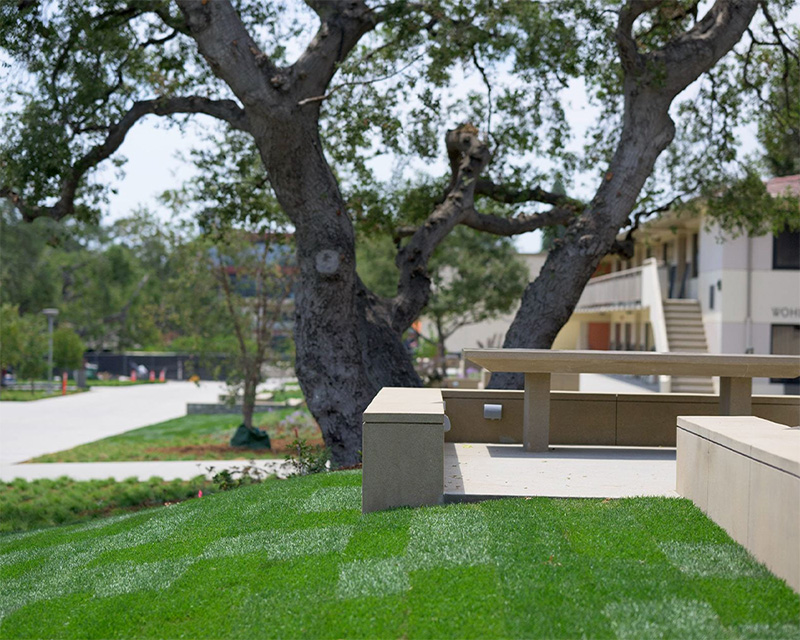
Get to Know our Campus Trees!
Locate and learn about every tree on the CMC campus!
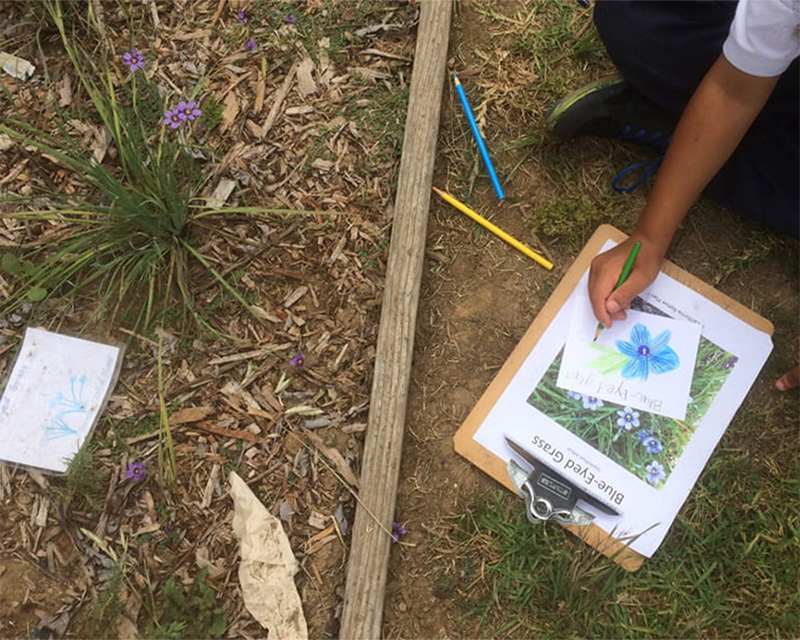
Check out our Community Garden!
Chat with Fran Rossi about her student and community garden!
5C Earth Month Events
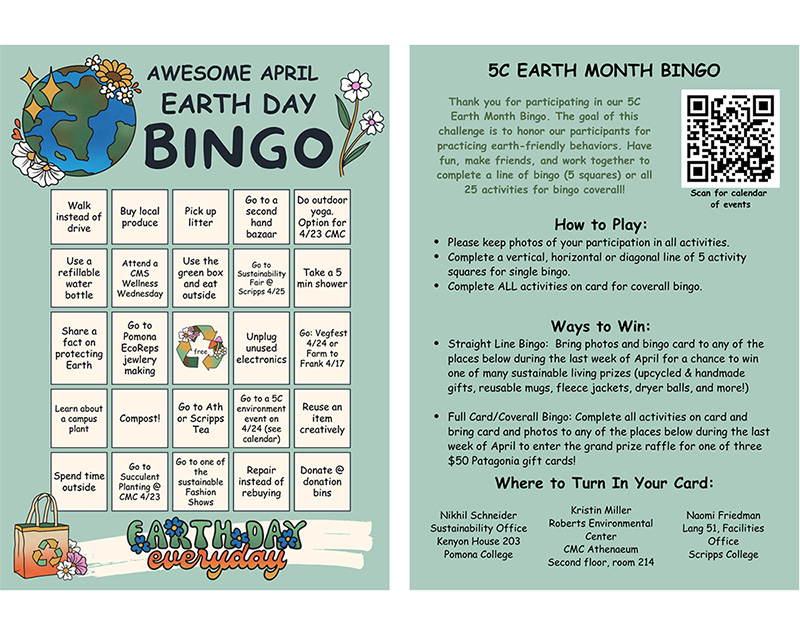
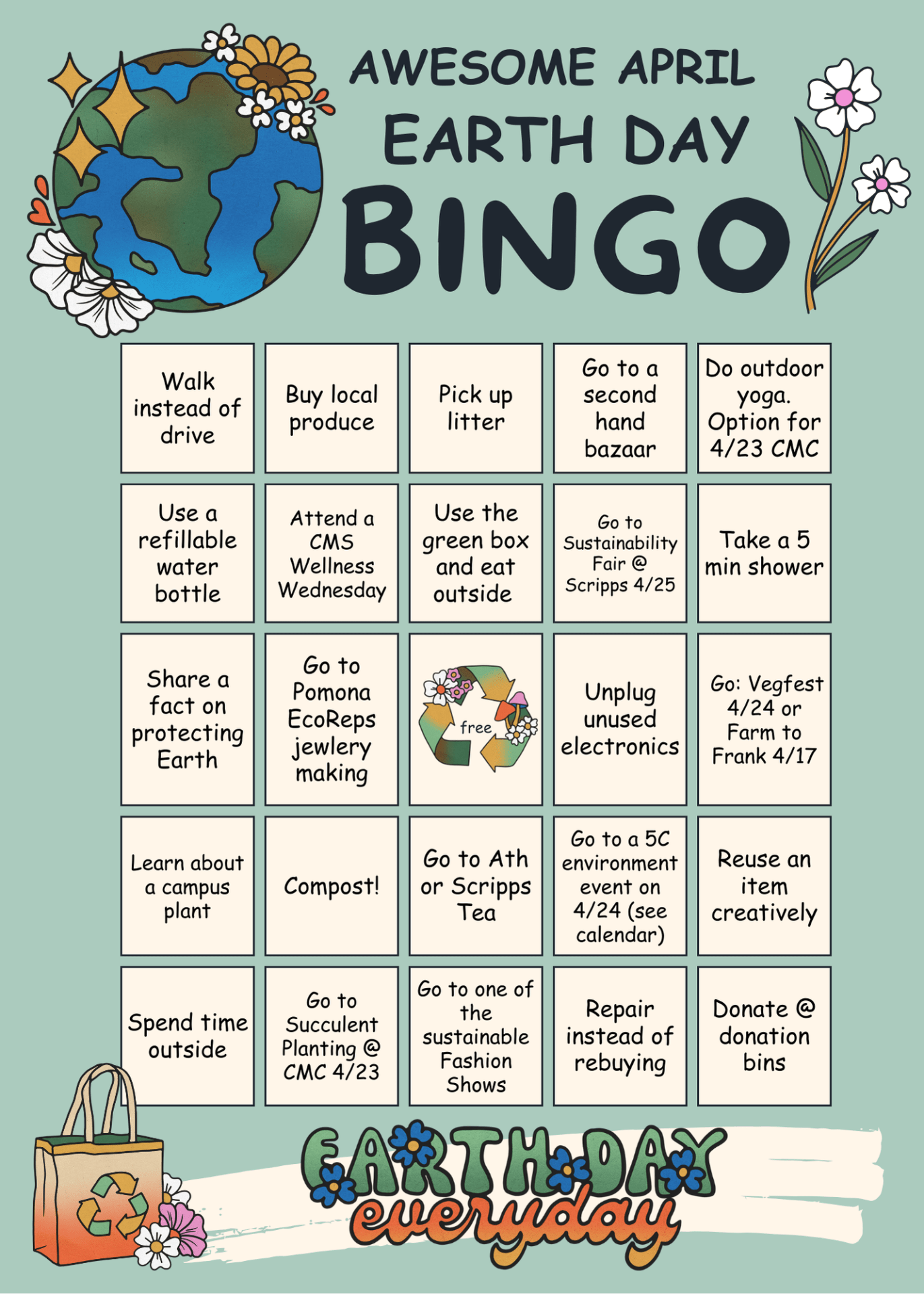
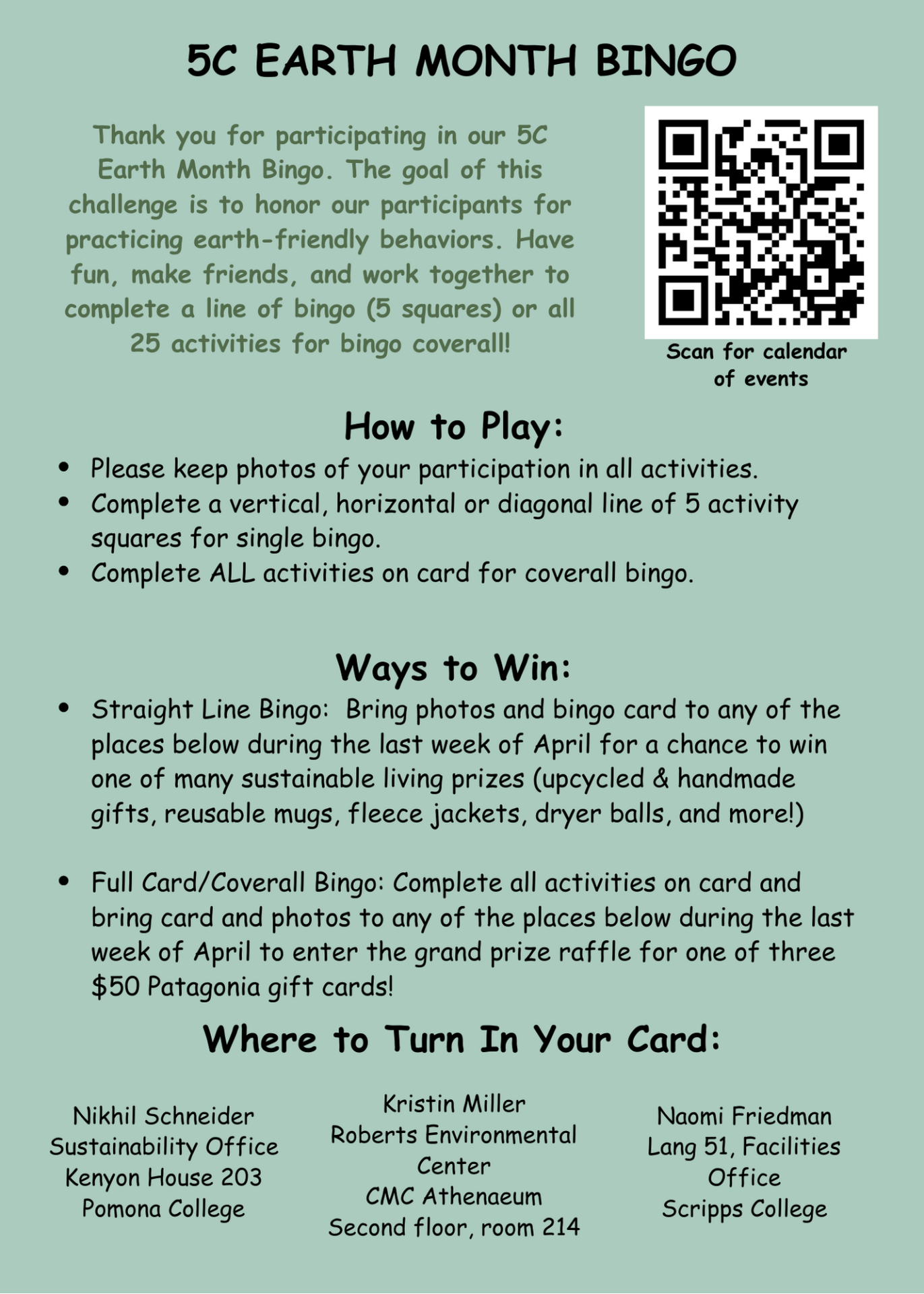
2025 5C Earth Month Events
Join us April 1–30, 2025 for fun activities and prizes
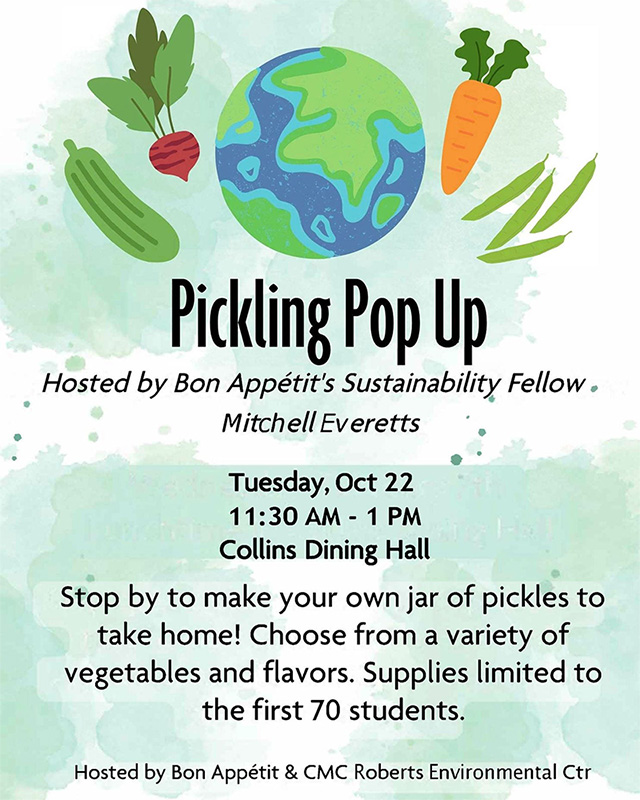
Pickling Event
REC EcoReps and Bon Appetit Fellow, Mitchell Everetts
October 21-25, 11:30 AM – 1 PM, Collins Dining Hall
Mary Sue Milliken, chef and restaurateur; owner, City Café, CITY Restaurant, Border Grill, Ciudad; creator and co-host, Too Hot Tamales, Tamales World Tour; cookbook author, City Cuisine (1989), Mesa Mexicana (1994), Cantina: The Best of Casual Mexican Cooking (1996), Cooking with Too Hot Tamales (1997) and Mexican Cooking for Dummies (1999/2002).
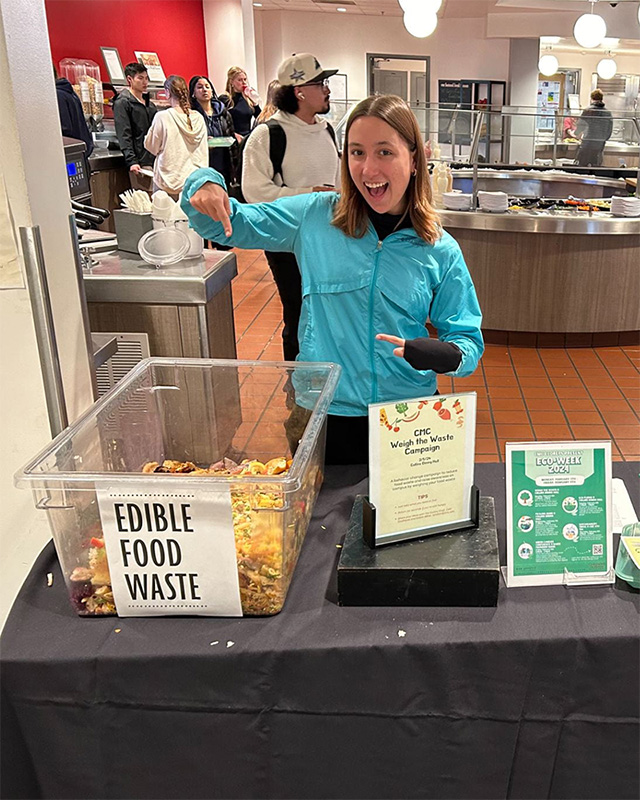
Weigh the Waste
REC EcoReps & Sustainable Food Interns
October 21-25, 11:30 AM – 1 PM, Collins Dining Hall
Every year in the United States we generate more than 14 million tons of food waste — much of it discarded directly from our plates. Help tip the scales to make your dining at Collins zero food waste! We will be collecting and weighing food waste, conducting surveys and informing diners about options to cut waste.
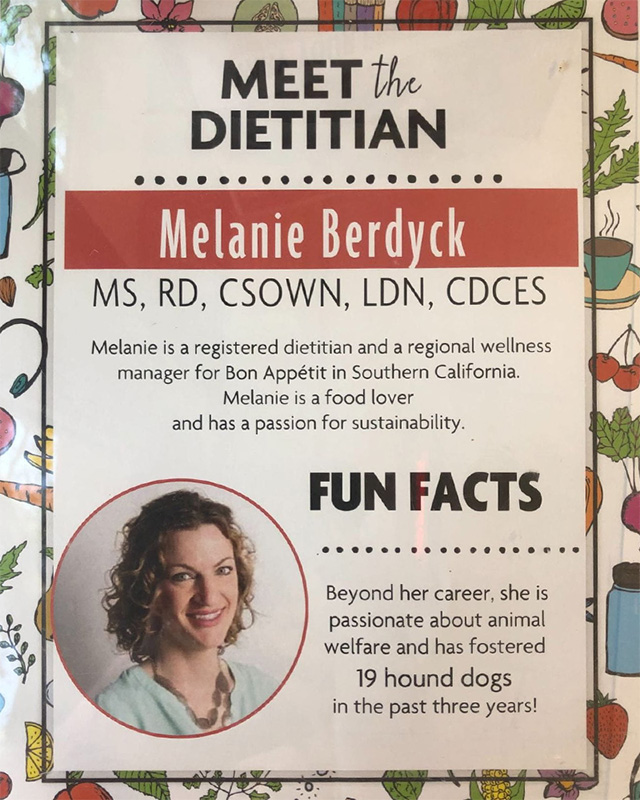
Melanie Berdyk
Regional Wellness Manager, Bon Appetit
October 29, Collins Dining Hall
Join Collins Dining Hall on Tuesday October 29th, for the Wellness Day Event, “Vary Your Protein Routine”!
Bon Appetit’s very own Regional Wellness Manager, Melanie Berdyck, will be at Collins Dining Hall for lunch at 11:00am, showcasing a Superfood Power Bowl made of 100% plant proteins! Let’s discuss the powerful benefits of a plant based diet, and sample some delicious superfood combinations.
Stop by our Options station to make your own superfood creation, and lettuce do our best to make it delicious!

Helena Bottemiller Evich ’09
The Politics of Food and Climate Change: A Reporter’s Notebook
September 26, Athenaeum Dinner Program
Helena Bottemiller Evich ’09 is the founder and editor-in-chief, Food Fix; former national food and agriculture reporter, POLITICO; former Washington correspondent, Food Safety News; George Polk Award Winner; two-time James Beard Award Winner.She will address the politics of food, agriculture and climate change in the U.S.

Mary Sue Milliken
Chef and Restaurateur
November 12, Athenaeum Dinner Program
How does sustainability affect our food systems, and how does that affect the restaurant business? Join famed Los Angeles chef Mary Sue Milliken for an evening of exploration!
Milliken is a James Beard and Julia Child Award-winning chef, cookbook author, media personality, and co-owner of Mundo Hospitality Group (Border Grill, BBQ Mexicana, Pacha Mamas, SOCALO, and Alice B.) with her business partner Susan Feniger. After becoming the first female chef at Chicago’s top French restaurant, Le Perroquet, in 1978, Milliken went on to work at the woman-owned, two-Michelin-star Restaurant D’Olympe in Paris, before rejoining Feniger in L.A. to launch City Café in 1981, applying French techniques to unfamiliar dishes from around the world. Milliken and Feniger brought their innovative approaches to The Food Network with the “Too Hot Tamales” and “Tamales World Tour” series, along with the Los Angeles’ popular food-centric radio show, KCRW’s “Good Food.”
In 2011, Milliken competed on season three of Bravo’s “Top Chef Masters” and won $40,000 for her chosen charity, Share Our Strength. She has also co-authored five cookbooks. Milliken is passionate about food policy and works with nonprofits around the world to bring her expertise to help shape sustainable food systems. Milliken also serves on the Board of Trustees for the James Beard Foundation, as a member of the U. S. State Department’s American Chef Corps, and is a co-founder of Regarding Her.
About
The Sustainability Fund Committee (SFC) awards grants to student campus sustainability projects in amounts up to $2,000 through a competitive Request for Proposal (RFP) process. The Fund will be sponsored by a $5,000 grant from the President’s Fund at the Roberts Environmental Center (REC).
The RFP process will open at the beginning of the fall and spring semesters and it will close after one month. Awardees will be announced at least one month after the RFP process has closed. Projects that receive a grant in the fall semester will be able to extend through the remainder of the fall semester and the entire spring semester. Projects that a receive grant in the spring semester will only be able to extend through the remainder of the spring semester. While projects are being implemented, awardees will be required to provide updates to SFC every other week.
Purpose
The purpose of the Fund is to provide grants for projects that improve the environmental sustainability of Claremont McKenna College (CMC). These grants allow students to pursue innovative and entrepreneurial ventures at CMC that increase sustainability and environmental awareness, and have the potential to yield positive returns on investment.
Project Eligibility
Those eligible for funding include all students enrolled at CMC. This does not include students studying abroad or doing other internship programs far away from the campus.
Criteria for Securing a Grant
In additional to meeting project eligibility, applicants must focus their projects on increasing the sustainability of CMC’s operations or infrastructure by doing one or more of the following:
- Reducing the use of electricity, carbon based emissions, and water;
- Mitigating pre- and post-consumer food waste;
- Facilitating positive effects on the financial stability of the College, particularly with an understanding of future implications of the project;
- Integrating environmental, social, and economic concerns;
- Promoting collaboration among a variety of stakeholders;
- Improving the health of the natural environment with understanding of local and global ramifications of the project; or
- Educating the campus community.
Projects meeting these requirements could include, but are not limited to, the following:
- Increasing the use of onsite renewable energy;
- Reducing the amount of materials used by the College;
- Accounting for life cycle costing of procured materials with a focus on environmental responsibility from cradle to grave;
- Coordinating sustainability efforts among different campus entities;
- Reducing the energy and or water footprint of the College;
- Improving the waste diversion rate of the College;
- Improving the endurance of campus infrastructure and assets;
- Responsibly managing resources both in the natural and built environment;
- Supporting biological diversity;
- Improving the quality of life of the College community through environmental improvements;
- Improving innovative sustainable grounds or agricultural practices;
- Building green structures; and
- Developing tools to assess sustainability on campus.
Out of scope:
- Funding will not be granted to projects focused solely on education and improving the sustainability of other colleges. Funding will not be granted to projects focused on off campus improvements.
Application process
- SFC allocates grants to three types of RFPs:
- Implementation grants fund programs and projects that are already successful or have quantifiable outcomes, such as improving existing or new physical structures with LED light bulbs;
- Innovation grants fund programs and projects that may be difficult to quantify, but demonstrate promise, such as new programs and initiatives that create new sustainability-based employment opportunities; and
- Projects that are a combination of implementation and innovation.
- Projects must assess the impact on the college community, with a plan for continued monitoring and successful operations into the future. Where applicable, a proposal should include letters of commitment from all major partners both on and off campus. A partner is considered major where the planning, implementation, or continued success of the project depend on the partner’s support.
- SFC is interested in supporting projects that demonstrate a robust and collaborative network. Partnerships among multiple programs, departments, and offices will add to the overall sustainability of the proposed projects and programs, adding value and commitment to the project.
Applications must:
- Identify the applicant’s name and project name
- Describe the entity’s (person, club, etc.) role in the project
- Identify the other students who will be involved in carrying out the project
- Identify the amount of staff time and other resources it intends to commit to the project
Example implementation project RFP:
- Title of project: e.g. “Expansion of CFL light bulb program”
- Name(s) and Class year(s) of applicant(s):
- Contact information (email and phone):
- Project Duration and Timetable: Duration is limited to a maximum of two semesters (not including semester grant was administered). List start and end dates of the project.
- Problem: Describe the problem the project will fix – e.g. “Most people use incandescent light bulbs in their dorm rooms. These bulbs use significantly more energy than CFL bulbs (support with data if relevant).”
- Proposed project: Describe your project in detail, and discuss how it will mitigate the problem described above. E.g. “This project would purchase an additional 100 bulbs for the current CFL program. Expanding the program will allow for more people to receive bulbs, thus reducing the College’s overall energy use and environmental impact.”
Implementation of the program: Who is responsible? Who needs to be involved? - Awareness and education: If relevant, describe any educational or awareness-raising efforts that will go along with this project. E.g. “Flyers, Digester messages and signage will alert people to the availability of more light bulbs and how they can check them out.”
- Budget: Detail the budgetary requirements of your proposed project, indicating both unit and total cost for items purchased (e.g. “100 light bulbs at $5.00 each, for a total of $500”). Include tax, shipping, and installation costs where relevant. If you’re going to make flyers or outreach materials along with your project, make sure to include prices for those elements as well.
- Future savings and returns: It is necessary to include the environmental, social, and financial savings and returns for the College. It can be helpful for you to describe these, even if you do not know specific numbers. E.g. “100 more CFL bulbs on campus will reduce our annual energy use by 2,000 kWh, which equates to a cost of approximately $300.” The Sustainability Coordinator can also help you determine numbers, where available.
Next steps if you receive a grant
- Meet with Kristin Miller, Associate Director of the Roberts Environmenal Center, to thoroughly discuss the purchase of the equipment stated in the budget.
- Submit purchase requests Kristin, who will review the requests and use his or her “purchase card” to buy the equipment.
- Closely adhere to the Purchase Card Policy of the College.
- Always submit this Check-in Form to SFC every other week, at least one day prior to the meeting with SFC.
Next steps if you do not receive a grant, but wish to resubmit your RFP
- Thoroughly consider the RFP vetting statement you receive via email.
- Discuss and implement changes with your team that address the critiques in the RFP vetting statement.
- Set up a meeting with the EAC Chair or Sustainability Coordinator to get feedback on your changes.
- Resubmit your RFP next semester.
Whom can I contact for more information?
SFC is always eager for your feedback and inquiries. Please do not hesitate to contact us with your comments and questions!
Kristin Miller, Associate Director of Roberts Environmental Center
[email protected]
The CMC Bike Shop is a student run initiative that helps CMC students, staff, and faculty become more mobile! All members of the CMC community are invited to rent bikes for free for a small rental period. Student staff are able to help patrons put together new bikes and fix bikes or longboards free of charge!
If you have a friend visiting for the weekend, your tires are flat, or you need to get those brakes checked before riding down to the Village, come check us out!
More Information
- We are located in the basement of Wohlford Hall, on the west side.
- The Bike shop typically opens sometime during the second week of class each semester. It is not open during College breaks.
- We rent bikes, locks, and helmets to CMC students, faculty, and staff for two days at a time at no charge.
- Each 5C institution has its own bike shop!
- Non-CMC students may have their bikes repaired and pay for parts.
- Non-CMC patrons may not rent out bikes.
- The Bike Shop Techs will fix your bike for free. The Shop only charges money for parts or if the fix goes beyond the Tech’s training.
- You must pay for parts before your bike is released to you. Cash, check, or student account charge are the only accepted methods of payment.
- We will assemble new bikes for you free of charge.
- The Bike Shop may hold a bike auction for bikes abandoned over the summer. An email will be sent out to the CMC Community with more details if it is to take place.
- To contact the Bike Shop, send an email to [email protected].
Free Services
- Bicycle Tire Inflation
- Patching of Punctured Tube
- 2-day Bike Rental
- Longboard/Skateboard Bearings Cleaning
- Chain/Part Lubrication
- Personal Bike Repair and Maintenance Labor, Part Fees May Apply (See Below)
Repair/Replacement Fees
| Service | Price |
|---|---|
| Tube | $5 |
| Brake/Shifter Wire | $5 |
| Brake/Shifter Housing | $5 |
| Brake Pads | $10 – $20 |
| Rim Liner | $5 |
| Tube | $5 |
Charges
| Service | Price |
|---|---|
| Tube | $5 |
| Brake/Shifter Wire | $5 |
| Brake/Shifter Housing | $5 |
| Brake Pads | $10 – $20 |
| Rim Liner | $5 |
| Tube | $5 |
Charges (Fees)
| Service | Price |
|---|---|
| Late Bike Rental | $5 per day |
| Late Lock Rental | $3 per day |
*Rental Locks and Bikes not returned after 7 days are considered lost.
| Service | Price |
|---|---|
| Lost Key | $10 |
| Lost Lock | $35 + Tax |
| Lost Rental Bike | $600 + Tax |
| Lost Helmet | $45 + Tax |
Bike Storage
Please fill out the bike storage form first and then email [email protected] for keycard access.
REC EcoReps serve the CMC community as student liaisons between the administration and student body. They aim to promote sustainable practices on campus by connecting students to information, resources, funding and the CMC administration. EcoReps believe that everyone has something unique to contribute to the conversation and that sustainability requires a community-based culture of awareness, care, and engagement.
The EcoReps promote energy and water saving, low-waste living, sustainable eating, and alternative transportation all of which will support CMC’s goal of achieving carbon neutrality, reducing CMC’s expenditures, and increasing the number of students engaged in environmental initiatives.
EcoRep Programming
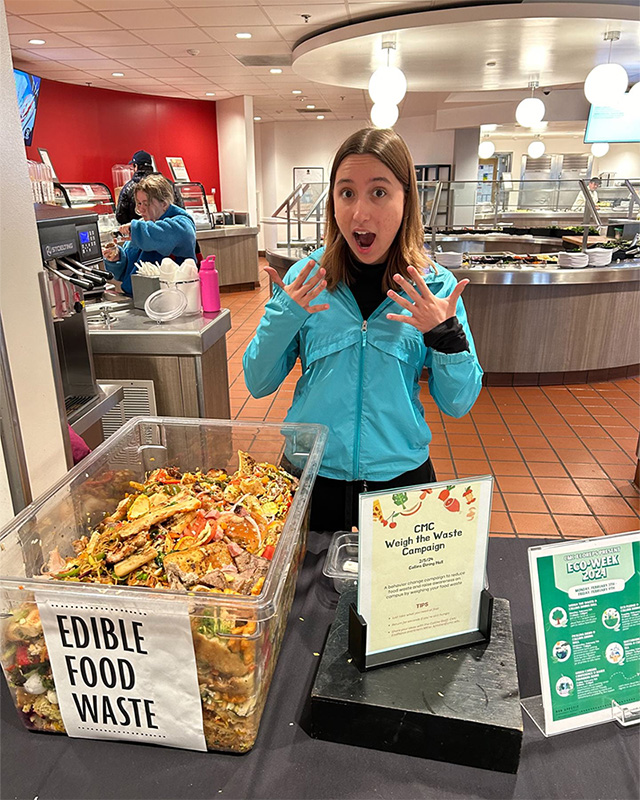
Weigh the Waste
A behavior change campaign to reduce food waste and raise awareness on campus by weighing food waste.
Mission
The Greenbox Program eliminates waste from disposable containers on our campus and across the 5Cs.
The containers, green plastic clamshells, are available to all students and faculty who wish to take their food on the go.
Using and Swapping
Take your food on the go. Return the container (please scrape food but no need to clean) to Collins and swap for a clean one.
Greenboxes may be swapped at Collins during breakfast, lunch and dinner hours.
5C students can exchange a Greenbox at Pomona dining halls. This will be untagged and outside of our piloted Reusables program. They can also purchase a Greenbox for $10 (untagged and outside of Reusables).
First Year & Transfer Students
Each new (first year or transfer) student is given a free greenbox at the beginning of the semester.
The boxes can be used and swapped with the cashiers throughout the semester at 5C dining halls. At the end of the school year, boxes must be returned for a credit on the student’s dining hall account at Collins. If the box is not returned at the end of the school year, then $6 will be charged for a new box in the new academic year.
Greenboxes may be swapped at Collins during breakfast, lunch and dinner hours.
Please contact Kristin Miller, [email protected] for questions. Or, swing by the REC, room 214, Athenaeum.
Returning Students
Get a new box at Collins. If you returned your box at the end of the school year, you will have a credit to check a new box out.
If you have lost your box, then you will pay $6 for a new box.
At the end of the school year, boxes must be returned for a credit on the student’s dining hall account at Collins. If the box is not returned at the end of the school year, then $6 will be charged for a new box in the new academic year.
Greenboxes may be swapped at Collins during breakfast, lunch and dinner hours.
Please contact Kristin Miller, [email protected] for questions. Or, swing by the REC, room 214, Athenaeum.