While CMC’s Salvatori Center for the Study of Individual Freedom in the Modern World is the oldest research institute at the College, its mission—to engage in the study of “American Constitutionalism and the American Founding”—remains vital as ever today.
And, as Americans approach and reflect upon the nation’s 250th anniversary this year, the work of the Salvatori Center seems especially relevant.
Established in 1969, the Center focuses on political philosophy and constitutional law, fostering student-faculty collaboration and interaction while encouraging a deeper understanding of democracy.
George Thomas, the Burnet C. Wohlford Professor of American Political Institutions and Director of the Salvatori Center, sees “a real continuity” between the Center’s original focus on American Constitutionalism and the current moment. “We are wrestling with the same issues in political philosophy as they relate to big questions,” he said.
Thomas and the Salvatori Center are certainly addressing the big questions, collaborating with The Open Academy (OA) on programming centered on the 250th anniversary of the Declaration of Independence, and the founding document’s universal significance. Throughout the academic year, the Salvatori Center has co-sponsored Declaration-themed talks by luminaries like Nadine Strossen, William Kristol (who serves on Salvatori’s board), and Danielle Allen, as well as numerous salons, “fishbowl debates,” and seminars.
Expanding research and reach
One of Thomas’ early goals when he first became the Salvatori Center’s director in 2016 was to “widen the research and scholarship we produce to a bigger scholarly arena.” His own scholarship resounds in the public sphere, with his recently authored The (Un)Written Constitution (Oxford University Press, 2021), as well as numerous scholarly articles and essays in publications such as The Atlantic and The Washington Monthly.
In addition to expanding the reach of the Salvatori Center’s research and scholarship, Thomas, who joined CMC’s faculty in 2007, has led several notable initiatives. These include hosting academic symposia (with accompanying manuscript workshops and co-publication with the prominent journal, American Political Thought); reviving CMC student news outlet, The Forum; supporting the student-initiated Salvatori-OA Reading Society; as well as curating cross-disciplinary seminars featuring faculty colleagues to showcase their scholarship.

Empowering students to take the lead on planning activities, such as the Salvatori-OA Reading Society, is baked into the current ethos at the Center. Or, as Thomas described it: “So many of the great things Salvatori does are ideas that come from the students or staff, and I work to help make them happen.”
The faculty discussions reflect a diverse range of viewpoints on timely topics, such as “The Role of the Academy,” the “Abundance Agenda,” and “The Missing Declaration: Jefferson and Antislavery.” Taking part are scholars from CMC and other institutions, representing academic disciplines such as Thomas’ homebase Government department, as well as Economics and Literature.
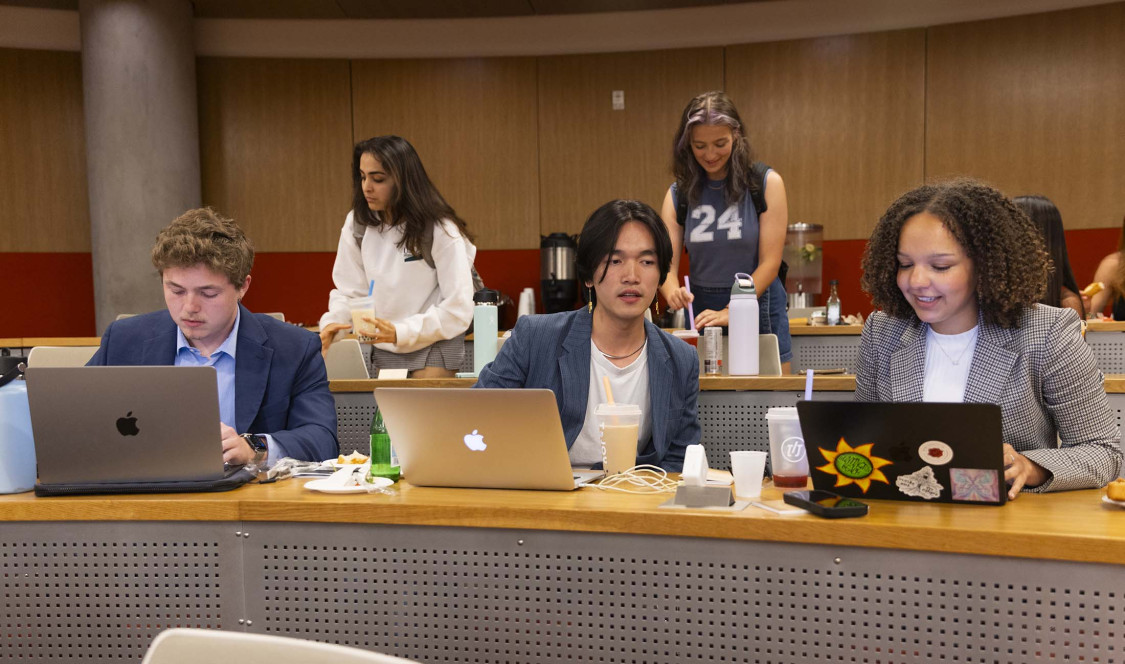
“Salvatori’s luncheons and salons allow students to access a similar sort of rigorous, intimate seminar environment outside of the classroom,” said Enya Kamadolli ’26, a Salvatori Research Assistant who has helped organize some of the Center’s events. “It is truly invaluable to be able to pitch a topic that I want to learn about—and that other students may also be interested in learning more about—pull in professors from across the 5Cs, and convene a group of students who have strong opinions and want a place where they can express them.”
Exploring history abroad
The success of the student-faculty seminars has influenced the current Saturday Salon series, and even more ambitious gatherings such as the “Anglo Roots of American Liberty” conference held in London during the summer of 2024. Together, the seven faculty and 11 students participating dug into seminal texts such as John Locke’s Letter Concerning Toleration and John Milton’s Areopagitica.
“The aim was to give students a deeper and richer understanding of the origins of modern liberal democracy, and especially aspects of the American constitutional order,” Thomas said. “Taking the students to historical places, like the British Library and Churchill War Rooms, helped make the ideas that animated our discussion real and concrete. I hope it gave them a real sense of the origins of liberal democracy and a better sense of its historical development.”
Michael Fortner, Pamela B. Gann Associate Professor of Government and George R. Roberts Fellow, was among the CMC faculty who made the trip. “The conversations we had were not only intellectually stimulating, but also deeply meaningful as we bridged these timeless thinkers to the challenges and questions of our own time,” he said.
Mirroring “the goals of The Open Academy,” the conference’s setting and length also provided students an additional benefit: seeing their “professors disagree with one another even though we are great friends who take each other seriously,” Thomas said.
With the Declaration’s Semiquincentennial on the horizon, The Open Academy and the Salvatori Center will return to the ideas that shaped the nation, once again co-organizing a London-based conference, “The English Influence on American Liberty” from May 24-30 of this year.
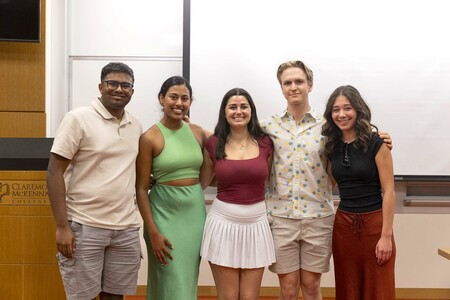
In addition, on March 27, the Salvatori Center will bring back last year’s Constitutional Convention, which Kamadolli described as a “pitch competition” for “student-written Constitutional amendments. We’re always looking for ways to diversify our programming, to tap into students beyond our usual audience,” said the PPE major and former Ath Fellow, who co-organized the inaugural convention. The 2026 competition, she promises, will be “even bigger.”
Careers and campus bonds
The Salvatori-sponsored, student-run Forum also provides a venue for CMC students to reach beyond their usual audience, showcasing a diverse range of views, from an analysis of recent campus elections, to broader issues, such as Supreme Court cases. (Forum staff even penetrated the national conversation last fall, when an interview with Bill Kristol about the New York City mayoral race went viral.)
Nate Weisberg ’24, the first editor-in-chief of the revived Forum, said he “got the ball rolling” in 2023 “by writing a series of pieces on campus issues, as well as national political topics (and sometimes both at the same time). I like to think that helped give others the confidence to write candidly,” he said.
Now an editor with The Washington Monthly, Weisberg, who majored in Government and Legal Studies, leveraged his Forum experience into a career. “I don’t think I would have gone into journalism if the Salvatori Center hadn’t given me the chance to write and edit. I never really wanted to be a traditional reporter, and Salvatori let me focus on what I actually cared about—writing, editing, and argument. I’m especially proud that The Forum is still publishing; I’ve enjoyed reading a lot of thoughtful and interesting work in it since graduating.”
While the Salvatori Center offers intellectually rigorous opportunities that expand student experiences beyond the classroom, both Weisberg and Kamadolli especially appreciate how their involvement with the Salvatori deepened bonds with their fellow CMCers.
“My favorite Salvatori memories are the late-night conversations that I have with my friends and co-RAs in the student office,” Kamadolli reflected. “We argue for hours about political, moral, and social topics—everything from feminism to religion to niche philosophers—and it’s truly one of the places at CMC I feel most at home. I’ve made many new friends and deepened existing friendships.”