

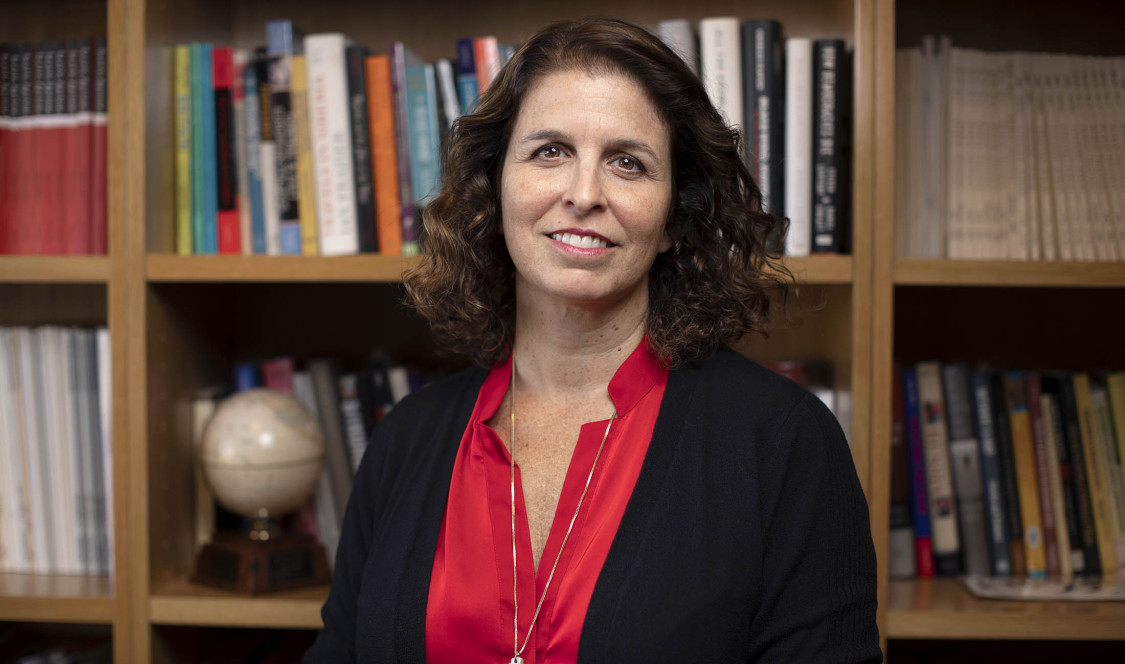
In the days following American military action in Venezuela—and the ouster of the country’s President Nicolás Maduro—Professor Hilary Appel paid close attention to how the ripple effects might have an immediate effect globally.
In her roles as Director of the Keck Center for International and Strategic Studies, Podlich Family Professor of Government, and George R. Roberts Fellow at CMC, Appel analyzes the politics of economic reform and, most notably, the foreign policy of Russia and Eastern Europe. She graciously offered insights into the Trump administration’s current foreign policy and how the events in Venezuela could affect the outcome of the Russia-Ukraine war, as well as possible scenarios for China and Taiwan.
In your view, what are the global implications of the U.S. military action in Venezuela to remove the country’s president, Nicolás Maduro?
Over the past year, U.S. President Donald Trump has been masterful at undertaking dramatic, stunning, and unprecedented actions at home and abroad that capture the attention not just of the American public but also of leaders around the world who must prepare for the possibility of something similar happening in or to their own country. While much of what the President does and says seems intended to shock and disrupt in the short run before he moves on to the next thing, foreign leaders cannot take his words lightly.
Trump’s use of the military in Venezuela has added to the credibility of his foreign policy threats generally, even if the administration does not always follow through on its extraordinary measures. Like the capture and extraction of President Maduro, global leaders have had no choice but to take seriously and literally Trump’s repeated threats—such as to withdraw all support for Ukraine’s defense (February 2025), to impose sky-high tariffs announced on “Liberation Day” (April 2025), or to use military force to stop Iran’s nuclear program (June 2025).
However, it’s interesting to note that Trump’s tariffs have fallen far short of their announced rates; the limited attacks on Iran’s nuclear sites may only have delayed Iran’s nuclear program by months; and the U.S. still provides Ukraine with crucial military intelligence and American weapons via the Europeans.
In this vein, the truly spectacular events in Venezuela, including quite significantly the capture and removal of President Maduro, may be somewhat inconsequential, resulting only in the elevation of Maduro’s Vice President, Delcy Rodriguez, and hence the endurance of the previous regime. Nonetheless, these dramatic foreign policy events executed by the Trump administration put the world on notice once again that the U.S. is willing to act unilaterally, unpredictably, and with disregard to the longer-term consequences and risks for allies and foes alike.
Based on your expertise, what does this mean for Russia and Ukraine? And to zoom out, how does this military action fit in with current U.S. foreign policy? Does this represent a shift, or a new world order?
Most likely, Trump’s actions in Venezuela were quite welcome by the Kremlin. This assessment might be surprising, given that Venezuela is a traditional ally of Russia, Venezuela’s leader was deposed, and the U.S. subsequently commandeered a Russian-flagged oil tanker moving Venezuelan oil. Indeed, the inability of the Kremlin to provide any protection to its partners and allies once again (like in the case of Bashar al Assad of Syria), and the inefficacy of the Russian-provided air defense systems made Moscow look extremely weak. So, why would this be welcome?
I would argue that Trump’s use of the military to decapitate the Venezuelan government with the intention of securing a regime friendlier to U.S. interests—while ideally gaining control over the country’s natural resources—together look a lot like what Russian President Vladimir Putin has tried to do in Ukraine. This U.S. precedent not only neutralizes the West’s critique of Russia’s Ukraine policy; it also bodes well for the instantiation of a global order in which powerful countries can do what they will and will do what they can.
In other words, in this world order, powerful states can pursue their economic and security interests and dominate smaller, less powerful countries, largely unconstrained by the norms of national sovereignty and international law. While the global system has seldom lived up to the liberal ideals behind the creation of post-World War II international institutions, there was the aspiration of respecting national sovereignty and valuing a rules-based order with the aim of promoting stability, facilitating economic growth, and avoiding nuclear annihilation. When the most powerful country in the world disregards those norms, it becomes easier, and certainly more tempting, for foreign leaders to use force against their neighbors as well.
Returning to the impact on Russia and Ukraine, the most direct and immediate consequences of the invasion of Venezuela are: First, it strengthens the resolve of President Putin to continue or escalate the war; and, second, it discourages Putin from signing a ceasefire agreement or peace deal that requires any compromise or concessions. The global order is moving in a direction that suits his ambitions and worldview. He may feel that time is increasingly on his side.
Could China see this as an opportunity for intervention in their own part of the world?
Hopefully not. The most dangerous scenario would be that Beijing interpreted the recent U.S. military action in Venezuela as creating an opening to make a parallel move in Taiwan: i.e., using force to remove Taiwan’s current leadership and imposing a new regime that is less autonomous and more compliant. However, the similarities between China invading Taiwan and the U.S. invading Venezuela are quite limited. First, China would not be interested in undertaking symbolic, attention-grabbing military action in Taiwan for its own sake, as may be the case for Trump in Venezuela. Despite his announcement, I doubt the President is really all that interested in “running” Venezuela. The U.S. commitment is likely very shallow. By contrast, Beijing’s interest in Taiwan runs deep, and for this reason, the Chinese Communist Party has displayed caution and patience in the timing for ultimately taking control of Taiwan.
Second, while an American response is unpredictable, Beijing cannot be certain that it could take over Taiwan without sparking a wider, costly war. Taiwan’s importance to global supply chains, especially in technology, is much more important than Venezuela’s position in global oil markets, making Chinese military intervention in Taiwan harder to contain. In short, while China’s timeline may have been shortened by recent events, I imagine its calculation of the risks involved with military action in Taiwan were not altered that much. Let us hope that cool heads prevail.
Coming soon: On Jan. 24, the Keck Center and The Open Academy will cohost a Saturday Salon. "Is there a Legal Basis for the U.S. Action in Venezuela?" In addition, Professor Appel appears in an upcoming episode of CMC Conversations, where she further explores power politics, as well as the ongoing Russia-Ukraine war and its impact.