

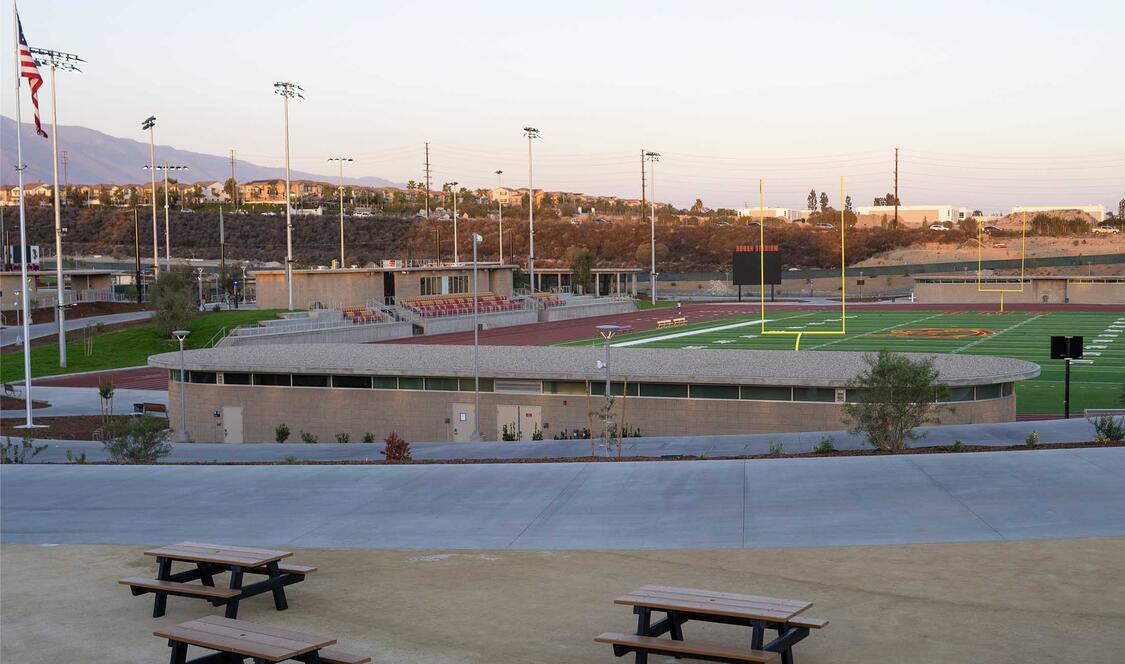
As the Sports Bowl at the Roberts Campus evolved from a former gravel quarry into a championship-caliber athletic facility and breathtaking recreation area, its literal rocky origins served as an unlikely inspiration for the sustainability-focused design.
Designed by Bjarke Ingels Group (BIG)—the same architecture firm that last year completed the award-winning and LEED-Gold-Certified Robert Day Sciences Center—the Sports Bowl spans 75 acres east of Claremont Boulevard, doubling the CMC campus footprint, while repurposing the site itself from rocky terrain into an oasis for sports and exercise enthusiasts alike.
“CMC places a high value on our responsibility to be excellent stewards of the environment,” said Sharon Basso, Executive Vice President and Chief Operating Officer at CMC. “We are very proud of the intentional design decisions we made all the way through the Sports Bowl construction that reflect this commitment.”
Even before it became a commercial quarry in the 1920s (and before that, citrus groves), the area was historically part of the San Antonio Wash, which captures snow and rain runoff from the south side of Mount Baldy, the San Gabriels’ highest peak. The Sports Bowl site was designed to incorporate the natural hydrology of the San Gabriel Foothills—which stretch and are visible north of the new facility—as well as the native plant species that thrive there.
“A big part of the DNA of the Sports Bowl concept is repurposing and taking advantage of the geometry and the land topography that was formed from the gravel quarry,” said Amir Mikhaeil, an associate senior architect and technical lead at BIG, who also worked as a key member on the RDSC team.
Retaining the quarry’s bowl shape, in addition to enhancing the Sports Bowl’s dramatic aesthetics versus “filling and leveling the site,” was a sustainability strategy that Mikhaeil said mitigated the need to import approximately 1.6 million cubic yards of fill, thus reducing the environmental impacts associated with sourcing, loading, and trucking the fill material. This also includes “emissions and dust that contribute to global warming and local air quality.”
From pollution mitigation, to energy conservation, water management, dark sky protection, and EV charging stations, Mikhaeil summarized some of the site’s main sustainability features:
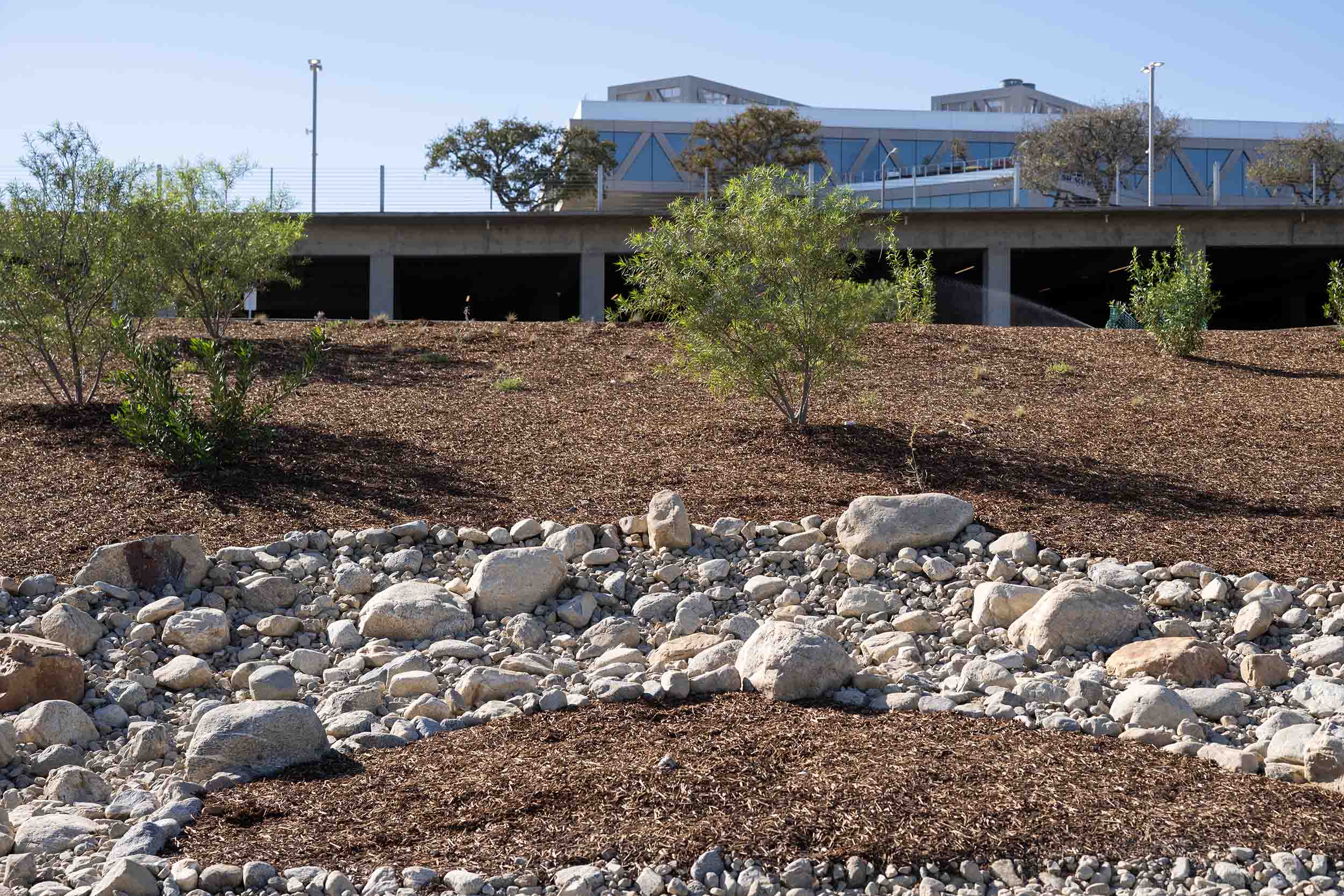
- Repurposing gravel: All gravel on field structure roofs, as well as rocks and boulders utilized in landscape rock swales (shallow rock-lined water channels) throughout the Sports Bowl, were sourced locally from the site. “We used a lot of the gravel from the site to create these rock swales and dry ponds that are meant to contribute to how we deal with stormwater and recharge the underground water system. And, with the roofscapes with the same gravel, they are also aesthetically part of the landscape,” Mikhaeil said.
- Reuse-recycle: 65% of construction and demolition debris generated by the project is salvaged, reused, or recycled to adhere to a local municipality requirement.
- Native plant paradise: Landscape plantings consist of locally indigenous native plant species. “Native planting zones within the Sports Bowl landscape design are organized to reflect the site’s natural topography and hydrology, with drought-tolerant species located on drier slopes and ridgelines and moisture-adapted species concentrated in lower, wetter areas," Mikhaeil said. "This approach mimics the natural ecological patterns of the San Gabriel Mountains and supports a more resilient, water-efficient landscape.”
- Water management: According to Mikhaeil, the irrigation system has been designed as a high-efficiency, automated water management solution that ensures “optimal plant health while significantly reducing water use.” He added that “the system incorporates advanced moisture sensors, flow meters, and precision-controlled valves to adaptively deliver water based on real-time soil conditions and evapotranspiration rates.”
- Capturing runoff: Inspired by the natural hydrology of the San Gabriel Foothills, stormwater is collected through dry wells, vegetated swales, and riparian landscape areas (where land and water meet). In addition, the site contains a 221,867-cubic-foot below-ground stormwater retention chamber. The system captures runoff from the campus and surrounding upstream areas, manages 100-year storm events, reduces flood risk, and helps restore a more natural water cycle by supporting groundwater recharge. In an average rain year, the Sports Bowl stormwater retention chamber will capture and recharge to groundwater 7.4 million cubic feet of water. (By comparison, a house uses about 11K cubic feet of water annually. So, this chamber will provide enough water that equals the use of 675 homes.)
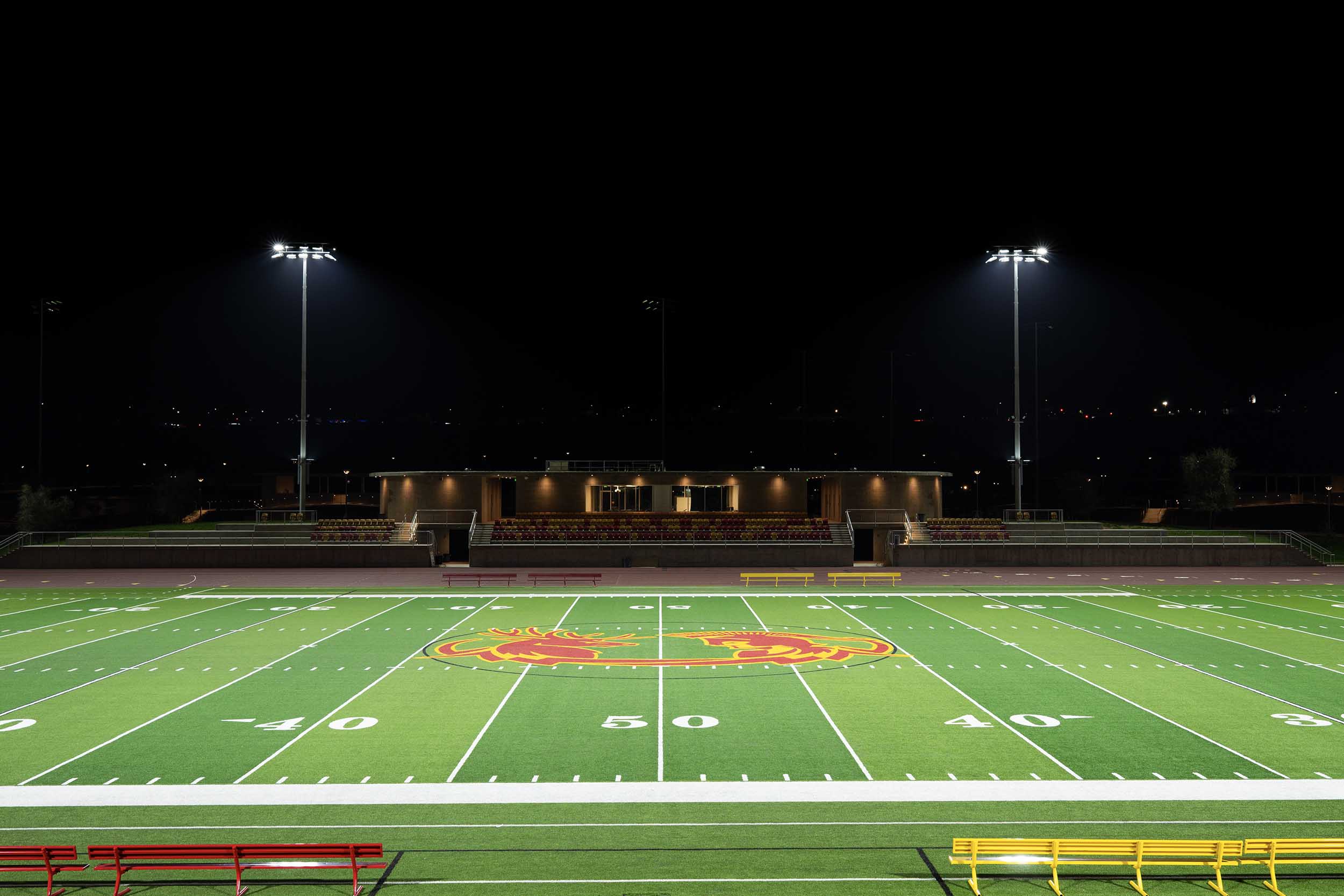
- Efficient lighting: All interior and exterior applications utilize high-efficacy LED fixtures, substantially lowering base energy demand and reducing long-term operation and maintenance requirements across the entire athletic footprint.
- Dark Sky compliant: To protect the local Southern California night sky and surrounding environment, 100% of exterior fixtures are Dark Sky compliant. Precision optics and full-cutoff shielding prevent light pollution, skyglow, and off-site light trespass while maintaining focal light on intended surfaces.
- Sun power: In the future, a Photovoltaic solar array is planned on shelters above the parking structure.
- EV charging: The project includes 22 EV charging spots and parking, with an eventual total of 106 spaces (a mix of installed chargers, and others that will be EV-capable).
Read our recap and view photos from the Sports Bowl at the Roberts Campus dedication ceremony during Inauguration Weekend.