
With the goal of cultivating “a lasting community of teacher-scholars who will continue to collaborate in advancing undergraduate science education,” the Kravis Department of Integrated Sciences (KDIS) at Claremont McKenna College will host its first Future of Undergraduate Science Education (FUSE) conference from April 16-18, 2026.
Professor Ran Libeskind-Hadas (Founding KDIS Chair) and Professor Emily Wiley (KDIS Director of Program Development) co-organized the conference, which “will explore advances in pedagogies, the integration of scientific and non-scientific disciplines, the expanding roles of computation and AI, public-facing research and projects, and collaborations with local communities, industry, and stakeholders.”
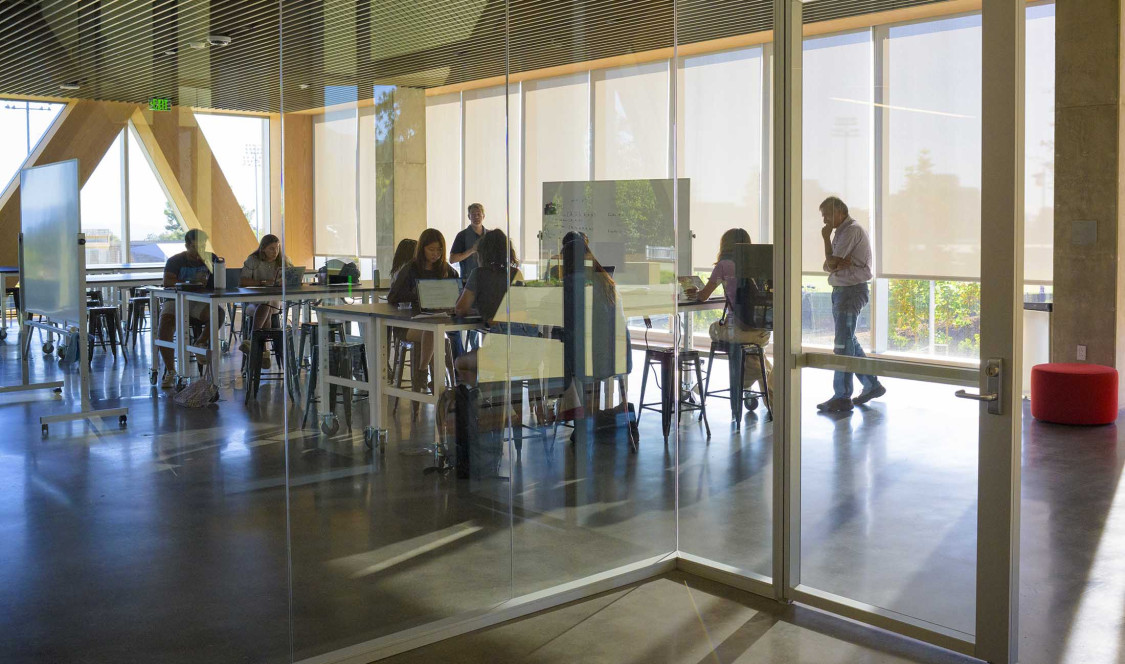
After nearly a full academic year of teaching, learning, and conducting research in the Robert Day Sciences Center, the new building will serve as home base to more than 60 science educators attending the conference from across the country, including members of the KDIS Advisory Council and KDIS faculty, who will actively engage in exchanging ideas.
In the days leading up to FUSE, we asked Libeskind-Hadas, Kravis Professor of Integrated Sciences: Computational Biology, to preview this unique conference—which will explore the themes of “Partnering with AI for Discovery” and “Research Experiences for All”—at a time of innovation and discovery at CMC.
Tell us more about the upcoming FUSE conference. What is your intention for FUSE?
The intention of this conference is to bring together undergraduate science educators to exchange ideas on innovations in science education. We believe that it’s important to build communities around these themes because it allows us to learn from each other’s experiences and teaching experiments. Science departments at primarily undergraduate institutions are generally small but full of creative individuals, forging communities that allow them to multiply their creative exploratory power.
Overall, both of the themes of this conference reflect values and aspirations of science educators at CMC and at many of our peer institutions. I believe that this is the major driver in attracting such a strong group of participants. We’re eager to share what we’re doing here, get feedback and suggestions from our colleagues at other schools, and generally facilitate interactions between educators on these important topics.
And how did you land on the themes: “Partnering with AI for Discovery” and “Research Experiences for All”?
It is clear that AI is having a huge impact on science and education and KDIS has a commitment to integrating computational approaches, including AI, throughout our curriculum. We know that colleagues at other schools are interested in this as well and see this as an opportunity to share ideas and experiences. There are very few undergraduate science programs that have been able to fully embrace computational approaches. And so, I think that’s also attracting attention, and we’re eager to share our approach. We’re also eager to bring in people who have different perspectives and try things to enrich our own offerings. So, it’s a two-way street, one hundred percent.
In “Codes of Life” [one of the thematic sections of SCI 10, the innovative KDIS course for all CMC students regardless of major] students actually build their own generative AI tool from scratch. It’s called “Chat-CMC.” They get to see how it works by actually building a small one. We train it on Dr. Seuss, and it generates Dr. Seuss to their heart’s content. The idea there is, we know that students are going to use it, so they should be able to reason about the foundations of how it actually works. That’s really important. And then also, in their research projects, they are invited to use AI in deliberate and responsible ways. And we talk about what does it mean to use it well, and what it does well, and what does it mean not to use it well? And why? So, we’re really trying to harness AI as a partner for discovery. Make it a power tool for students. Don’t ignore it. But there are a lot of things that about the use of AI that are really dangerous, and they need to understand why, and I think they start to get that in this context.
“Research for All” is another KDIS commitment. SCI 10 engages every CMC student in an authentic research experience. For many of our students, this is their first science course since high school, and for some it’s the last science course they will ever take, while for others it’s the first course of the Integrated Sciences major. So all those audiences together are working on actual science. I think that’s substantial, and the fact that we made a commitment to doing it for every single student is unusual, and we are eager to share that with colleagues at other schools and learn from their experiences as well.
Further, in the newly built Robert Day Sciences Center, our science teaching labs and our science research labs are transparent and adjacent to each other, and they even share instrumentation. This means that a student taking SCI 10 in her first year at CMC can look across the way and she can see her senior dorm mate doing her senior thesis and about to go off to graduate school or medical school. And that’s the arc, from the beginning, all the way through to a level of mastery. It is something that we take a great deal of pride in, a really important component of what it’s signaling.
CMC will welcome numerous faculty participants from prestigious institutions to FUSE. Why do you think this conference is sparking such a strong interest from your peers in science education?
I think we are pushing a lot of envelopes here at CMC with KDIS. We’ve also learned a lot from others—both here in Claremont and beyond. I don’t want to suggest that we have invented the wheel, and we certainly haven’t reinvented science. We certainly make no such claims, but I think we’ve really done some unusual things in the way we teach science to undergraduates. A lot of people coming to this conference have also done amazing things at their home institutions. We have the special benefit at CMC of being able to build this program from the ground up and having attracted a faculty and staff that share a commitment to the vision of our integrated program. Not everyone has the resources nor the support from their institution’s leadership to pursue this kind of vision. So, we have a huge advantage there. But I don’t think we have a monopoly on good ideas, so that’s why we're excited to bring these thoughtful and creative science educators and hear about their innovations.
The faculty from other schools who are attending FUSE are energetic and excited to talk about innovation in undergraduate science education. We believe that this meeting will benefit all of us!